Recently, a family came to our office with a concern that I hear more often than you might expect. They had been in the United States for just over a year, admitted as refugees. They knew they were eligible to apply for a green card. They had done some research online. And they were frightened.
The document they had used to travel to the United States — their refugee travel document — had expired. Different documents seemed to say different things. They had read about the requirement to “maintain status” to qualify for a green card, and they could not see how their status was being maintained when their main document had a date on it that had already passed.
They were not in trouble. Their status was fully intact. They were exactly where the law expected them to be. But their anxiety was completely understandable, because the information available online is almost entirely written for a different category of immigrant — and applying it to refugees produces the wrong answer.
This article explains why. If you are a refugee who has been in the United States for a year or more and are wondering whether you still have valid status, the short answer is: almost certainly yes. The longer answer requires understanding how two different documents — and two different sections of federal law — actually work.
Two Documents, Two Different Jobs
When a refugee is approved for admission to the United States, two separate documents come into play. Understanding the difference between them is the key to understanding why an expired travel document does not mean expired status. The same visa-versus-status logic underlies automatic revalidation for nonimmigrants traveling on an expired visa.
The Refugee Travel Document
Before a refugee travels to the United States, the refugee receives travel paperwork that allows the trip and the request for admission at a U.S. port of entry. It is, in function, a travel authorization, and it carries an expiration date because it is meant to be used for the journey.
Once the refugee arrives and is admitted by a Customs and Border Protection (CBP) officer, the travel document has done its job. It got the person to the door. What happens after that is governed by something else entirely.
The I-94 Arrival/Departure Record
When a refugee is admitted at the port of entry, DHS issues a Form I-94 Arrival/Departure Record showing the date of admission as a refugee. That record, not the travel document, is what USCIS asks for as proof of refugee admission when you apply for a green card (USCIS, Green Card for Refugees).
Refugee status itself has no expiration date. It continues until USCIS terminates it, and under 8 CFR § 207.9 USCIS may do that only if the person “was not a refugee within the meaning of section 101(a)(42) of the Act at the time of admission.”
Key distinction: The travel document is a ticket that gets you here. When the travel document expires, the ticket has been used. Your refugee status, recorded on your I-94, does not expire with it.
Why Online Research Produces the Wrong Answer for Refugees
If you search for “adjustment of status requirements” or “maintain status green card,” you will find accurate information — accurate for a different group of people. The results you see are almost entirely about adjustment of status under INA § 245(a), which is the pathway used by the vast majority of people seeking green cards: H-1B workers, F-1 students, K-1 fiancé(e)s, family members waiting for visa availability, and many others.
Under § 245(a), those requirements are real and strict. The applicant must have been lawfully admitted or paroled. They must have maintained continuous lawful status since entry. They must not have engaged in unauthorized employment. Violating any of these conditions can bar adjustment entirely or require a waiver.
Refugees reading this information naturally assume it applies to them. It does not. Refugees adjust status under a completely separate statute: INA § 209(a). Congress wrote § 209 specifically for refugees and asylees precisely because the ordinary nonimmigrant maintenance-of-status framework does not fit their circumstances. The two sections are parallel tracks, not the same track.
The GIGO Problem in Immigration Research
Computer scientists use the phrase “Garbage In, Garbage Out” to describe what happens when a system receives flawed input. A search engine is a retrieval tool, not a reasoning tool. If a refugee types “do I need to maintain status to get a green card,” the search engine returns accurate answers to that question — answers built for the § 245(a) world, because that is where most adjustment information online is written.
The search engine has no way of knowing that the premise embedded in the question is wrong for a refugee. It cannot recognize that the framework assumed by the question does not govern the questioner’s situation. The result is confidently accurate information that leads to the wrong conclusion. The problem is not the internet. The problem is the mismatch between the question and the legal reality.
INA § 209(a): The Refugee Adjustment Statute
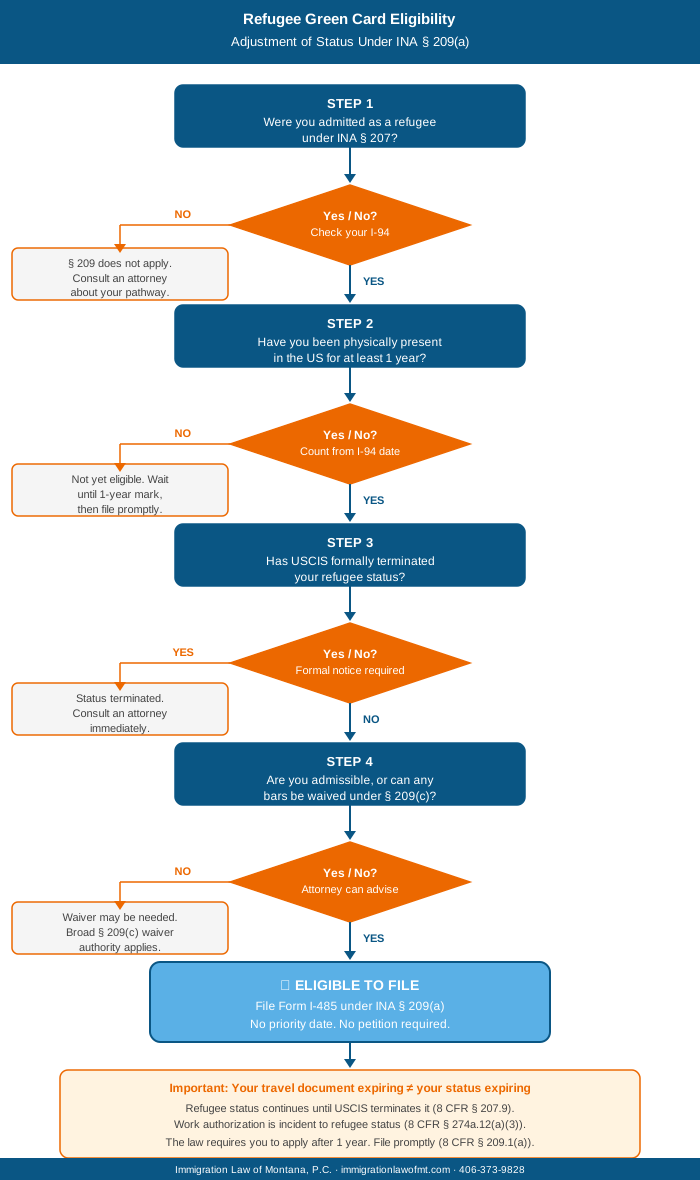
Section 209(a) of the Immigration and Nationality Act provides that the status of a refugee who has been physically present in the United States for at least one year shall be adjusted to that of a lawful permanent resident. That is the operative rule. Let’s unpack what it requires — and what it does not.
What § 209(a) Does Require
- Refugee status: You must have been admitted as a refugee under INA § 207. This is established by the record of admission itself.
- One year of physical presence: You must have been physically present in the United States for at least one year since your admission as a refugee.
- Continued refugee status: Your refugee status must not have been terminated. Termination requires an affirmative action by USCIS, and under 8 CFR § 207.9 the only ground is that the person was not a refugee at the time of admission. Being present and not filing for a green card does not terminate refugee status, although, as explained below, it can now lead to arrest.
- Admissibility (or a waiver): You must be admissible to the United States as an immigrant, or any grounds of inadmissibility must be waived. USCIS has broad waiver authority for refugees under § 209(c).
What § 209(a) Does Not Require
- Continuous maintenance of nonimmigrant status — this is a § 245(a) requirement that does not appear in § 209.
- A separately maintained employment authorization document — work authorization flows from refugee status itself (see below).
- A valid travel document at time of filing — the travel document is the mechanism of entry, not a condition of maintaining status.
The One-Year Requirement, and Why It Now Matters
The regulation has long said that a refugee “is required to apply to USCIS one year after entry” (8 CFR § 209.1(a)(1)), and USCIS’s own guidance says that “U.S. immigration law requires refugees to apply for lawful permanent resident status after they have been physically present in the United States for at least 1 year” (USCIS). For many years, though, nothing happened to a refugee who waited. A 2010 ICE policy treated a failure to adjust, by itself, as no basis for detention or removal, so in practice the one-year mark worked as a starting line rather than a deadline.
That changed. DHS rescinded the 2010 policy on December 18, 2025, and on February 18, 2026, USCIS and ICE issued a joint memorandum, “Detention of Refugees Who Have Failed to Adjust to Lawful Permanent Resident Status” (filed in federal court). It states that a refugee who does not return for inspection after one year “will be returned to DHS custody,” that DHS “will return the individual to custody (i.e., arrest and detain),” and that “DHS may maintain custody for the duration of the inspection and examination process.” DHS gives its reason as thorough re-vetting of refugees for national security, public safety, and fraud. The same memo says refugees “may be considered to have voluntarily returned to custody by submitting an application to adjust status and appearing at scheduled interviews or appointments.” The policy is being challenged in federal court (for example, U.H.A. v. Bondi, D. Minn., and Jean A. v. Noem, D. Mass.). Check its current status, but do not wait: if you have been here a year or more, file now.
Two related developments may affect your timeline. In November 2025, USCIS paused decisions on green card applications filed by refugees admitted between January 20, 2021, and February 20, 2025, pending a re-review of their cases, and it has announced re-interviews and additional background checks of refugee claims (Operation PARRIS); USCIS says it is lifting holds case by case and by group (USCIS vetting update). Separately, the USCIS holds on applicants from certain “high-risk” countries (PM-602-0192 and PM-602-0194) were vacated by a federal court in Rhode Island on June 5, 2026, and enjoined by a federal court in California on August 24, 2026 (USCIS court-order notice). This area is changing month to month. Filing still starts the process and shows that you have complied, but talk to a lawyer if you were admitted during that window.
Work Authorization: You Never Needed a Separate EAD
One of the most important and least understood aspects of refugee status is that work authorization comes with the status itself. You do not need to separately apply for an Employment Authorization Document (EAD) to work lawfully in the United States as a refugee.
The governing regulation is 8 CFR § 274a.12(a)(3), which places refugees among the “[a]liens authorized employment incident to status.” That phrase means the authorization comes from holding the status, not from a document you applied for. USCIS creates a work permit application for arriving refugees automatically and says plainly that “Refugees do not need an EAD to work in the United States.” For Form I-9, USCIS explains that your I-94 is acceptable evidence of identity and work authorization “for 90 days after your arrival to the United States”; after that, you present an unexpired EAD or another combination of documents, such as a state-issued driver’s license and an unrestricted Social Security card (USCIS).
This has a direct consequence for any concern about unauthorized employment. Because your work authorization flows from your refugee status, and your refugee status remains valid until formally terminated, you cannot have engaged in unauthorized employment simply by working while your travel document was expired. The authorization was never conditional on the travel document.
The Asylee Parallel: A Useful Frame of Reference
The situation of a refugee who has been in the United States for several years without yet adjusting status is closely analogous to a situation many practitioners encounter with asylees.
An asylee — someone granted asylum affirmatively by USCIS or defensively by an Immigration Judge — typically receives an I-94 with no expiration date, reflecting their asylum status. Many asylees go years, sometimes a decade or more, without filing for a green card. They work lawfully under 8 CFR § 274a.12(a)(5) (the asylee equivalent of the refugee incident-to-status work authorization provision). They may not have thought about adjustment at all until something prompted it — a family member they wish to sponsor, a desire to naturalize, or a need for an actual U.S. travel document.
When that asylee finally comes to an attorney, they have not violated their status. Their asylum has not expired. Their work authorization was never interrupted. The only question is whether any disqualifying events have occurred in the intervening years. Much of the same analysis applies to a refugee, with one important difference: refugees are required to apply after one year, and DHS now enforces that requirement (see above).
The refugee and the asylee share the same structural situation: a grant of humanitarian protection that continues until formally terminated, incident-to-status work authorization, and a right to adjust status that does not expire simply because the person has not yet exercised it. The travel document a refugee uses to arrive is no more a measure of their ongoing status than the initial grant notice an asylee receives. Both are point-in-time documents that do not govern the duration of protection.
What Actually Terminates Refugee Status
Because the continuation of refugee status is the foundation of everything discussed in this article, it is worth being clear about what does — and does not — terminate it.
Under INA § 207(c)(4) and 8 CFR § 207.9, USCIS terminates refugee status if the person “was not a refugee within the meaning of section 101(a)(42) of the Act at the time of admission.” USCIS must first notify the person in writing and allow 30 days to respond. It does not happen automatically.
The following do not terminate refugee status:
- Expiration of the refugee travel document
- Failure to file for adjustment of status after one year (although, as explained above, it can now lead to arrest and detention)
- Working without a separately issued EAD
- Extended time inside the United States without interacting with immigration authorities
- Changed circumstances in your home country
If your status has not been formally terminated and you remain admissible, you remain eligible to file for your green card.
Filing for Your Green Card Under § 209(a): Practical Overview
When you are ready to file, the process is more straightforward than it may appear. Refugee adjustment does not require an immigrant visa petition. There is no waiting for a priority date. You file directly.
The Core Filing: Form I-485
The application for adjustment of status is made on Form I-485, Application to Register Permanent Residence or Adjust Status. On Part 2 of the form, you will select the eligibility category that corresponds to refugee adjustment under § 209.
Supporting Documents
The specific document requirements are set out in the Form I-485 instructions, but typical supporting documents for refugee adjustment include:
- Copy of your I-94 Arrival/Departure Record showing refugee admission
- Copy of your refugee travel document (even if expired — it establishes the admission)
- Passport-style photographs
- The vaccination record portion of Form I-693 (a full medical exam is required only for applicants with a “Class A” medical condition)
- Evidence of one year of physical presence (typically established by the I-94 date of admission)
- Any documents relevant to inadmissibility grounds and waivers if applicable
Biometrics and Interview
USCIS will schedule biometrics (fingerprints and photographs). Under 8 CFR § 209.1(d), USCIS decides case by case whether an interview is needed. USCIS has announced re-interviews of refugee claims, so be prepared for one.
The Filing Fee Question
Refugees pay no fee. USCIS’s fee schedule lists the Form I-485 fee for a refugee as $0, and USCIS states that “Refugees do not need to pay the Form I-485 filing fee or the biometric services fee” (checked September 29, 2026). No fee waiver request is needed.
A Word About Delays and What to Prioritize
Delay does not forfeit your right to adjustment, but it is no longer safe (see “The One-Year Requirement” above). Filing also brings practical benefits:
- International travel: International travel before you become a permanent resident is complicated and needs advance planning. LPR status makes travel simpler.
- The path to citizenship: When your green card is approved, USCIS records your permanent residence as beginning on the date you arrived in the United States (8 CFR § 209.1(e)), so your time as a refugee counts toward the five years for naturalization. The clock does you no good, though, until the green card is actually approved.
- Derivative benefits for family: Adjustment opens additional options for family members. The sooner you adjust, the sooner those options become available.
- Potential changes in admissibility: The longer the period between arrival and filing, the more opportunity there is for events that could complicate admissibility — arrests, travel issues, changes in civil status. Filing sooner eliminates this exposure.
The bottom line: file as soon as you reach one year. The law requires it, DHS now enforces it, and LPR status serves your long-term interests and the interests of your family.
The Most Common Mistake: Assuming the Wrong Legal Framework
The concern that brought the family to our office — the worry that an expired travel document meant expired status — is exactly the kind of confusion that well-meaning online research can create when the searcher does not yet know which legal framework governs their situation.
The maintenance-of-status requirements that dominate green card information online are real requirements — for the people they apply to. They do not apply to refugees adjusting under § 209. The work authorization rules that frighten refugees who did not file for a separate EAD are a real concern — for people whose work authorization depends on a filing. Refugees are authorized incident to status. The travel document expiration dates that look alarming are real expiration dates — for the travel document. Not for the status.
Understanding which legal framework governs your situation is the first step, and it is the step where having counsel makes the most difference. If you are a refugee in Montana, Wyoming, North Dakota, Colorado, Utah, or Idaho and you have questions about your status, your eligibility to apply for a green card, or where you are in this process, contact our office.
Contact Immigration Law of Montana at immigrationlawofmt.com or call 406-373-9828.
Immigration Law of Montana, P.C. • Christopher J. Flann, Attorney • Licensed in Montana
This article is for informational purposes and does not constitute legal advice. Immigration law changes frequently. Consult a licensed immigration attorney about your specific situation