
Canadian Custom Combine Crews and the H-2A Program: How the System Actually Works
Every summer, Canadian-owned custom combining operations cross the border into Montana, the Dakotas, Kansas, and down through Oklahoma and Texas, then follow the wheat harvest north again as the season progresses. Their combines, grain carts, housing trailers, and crews move together on an itinerary planned months in advance. The owner is usually working the harvest alongside his employees — not sitting at a desk in Saskatchewan.
The H-2A visa program is what makes this legally possible on the US side. But the specific legal architecture that allows a Canadian custom combiner to bring his own crew, and to work the harvest personally as part of that crew, on a petition filed by a US entity he himself owns, is spread across several regulatory sources, mostly on the Department of Labor (DOL) side rather than at US Citizenship and Immigration Services (USCIS). Much of it was consolidated only in 2022, and some of the most interesting features of the regime are less about affirmative authorization than about what the rules don’t require.
This article walks through the framework as it appears to operate based on the published regulations, the underlying DOL guidance letters, and how the program is adjudicated in practice. Where the regulations are silent on a question that the practice appears to answer, I flag the gap honestly rather than papering over it.
Why Custom Combining Needed Its Own Rules
The ordinary H-2A program assumes a fixed-site employer: a farm in a defined area of intended employment, hiring workers to perform agricultural work on that farm during a defined season. File the labor certification, cross-check the wage rate for that state, provide housing at a fixed location, run the season, send everyone home.
Custom combining does not fit that template. A combining crew works dozens of farms across a half-dozen states on a continuously moving schedule. The housing is mobile — combine-crew trailers that travel with the equipment. The work period in any one state may be days or weeks, not months. The compressed seasonal nature of the work is itself a qualifying factor under H-2A, but the geography is the harder problem. The owner-operator is often a foreign national, and for Canadian operations the owner and the equipment cross a Federal border to reach the work. Filing a separate H-2A application for each state, each with its own housing inspection and area-of-intended-employment analysis, would be unworkable on the compressed timing of the harvest.
DOL addressed this in stages. For years the custom combine accommodations lived in a DOL guidance letter — Training and Employment Guidance Letter (TEGL) No. 16-06, Change 1, signed in June 2011 — which directed Office of Foreign Labor Certification (OFLC) staff on how to process these applications. In 2022, DOL codified most of the TEGL’s substance into the Code of Federal Regulations, at 20 CFR 655.300 through 655.304. The 2022 rule took effect November 14, 2022 and replaced the TEGLs for these occupations; applications with a first date of need after February 12, 2023 are processed under the new sections (20 CFR 655.102). Those five sections are now the primary DOL rules for the three occupations that share an itinerant multi-state structure: animal shearing, commercial beekeeping, and custom combining.
What the Special Procedures Actually Do
Section 655.300 establishes the scope. It applies to job opportunities where workers must perform agricultural work “on a scheduled itinerary covering multiple areas of intended employment.” Outside those accommodations, the custom combine employer must comply with the general H-2A rules at 20 CFR 655.100 through 655.185.
Section 655.301 defines custom combining in detail. It covers operating self-propelled combine equipment, performing manual or mechanical adjustments to the cutters and conveyors, safety checks, maintenance and repair of the equipment, and — importantly — transporting harvested crops and moving equipment between fields when that work is performed by members of the same crew. The regulation excludes planting, cultivation, and separate post-harvest services like grain cleaning when performed by a different entity. The definition draws a tight boundary around what counts as H-2A-eligible custom combine work.
Section 655.303 is the most practically valuable provision for the operator. It permits a single Application for Temporary Employment Certification and a single job order to cover multiple areas of intended employment in one or more contiguous states. One filing, one OFLC adjudication, one itinerary.
Section 655.302 governs what goes into the job order — how much experience the employer can require (up to six months for custom combining), and that applicants may be required to join the crew at the time and place the employer is located and to complete the scheduled itinerary. It also requires that at least one worker per crew have an employer-provided means of emergency communication, which reflects the practical reality that a combining crew may be fifty miles from the nearest populated place.
The Mobile Housing Provision and the Canadian Inspection
Section 655.304 is the most distinctive piece. It permits employers engaged in animal shearing or custom combining to use mobile housing — a camper, trailer, or similar unit — in place of fixed worker housing, subject to detailed standards on drinking water, waste disposal, structural soundness, heating, electricity, bathing, food storage, and fire safety.
Paragraph (a)(2) of that section reads:
A Canadian employer performing custom combining operations in the United States whose mobile housing unit is located in Canada when not in use must have the housing unit inspected and approved by an authorized representative of the Federal or provincial government of Canada, in accordance with inspection procedures and applicable standards for such housing under Canadian law or regulation.
That is a remarkable piece of drafting. In one short sentence the Code of Federal Regulations acknowledges Canadian Federal or provincial governmental inspection authority as a substitute for the US inspection procedures that would otherwise apply. It is not a common feature of US labor regulation to accept a foreign government’s inspection as definitive. The provision exists because the alternative — requiring a Canadian operator to arrange US inspection of equipment that spends nine months a year in Saskatchewan or Alberta — would be administratively absurd. The regulation simply accepts the practical fact that these are cross-border operations and adjusts accordingly.
The Structural Classification: Multi-State Custom Combiners Are H-2A Labor Contractors
One piece of the regime came from the TEGL rather than the regulations. TEGL 16-06, Change 1, stated explicitly that a multi-state custom combine employer is, by definition, an H-2A Labor Contractor (H-2ALC) under the regulations. Its language was direct: “An employer who desires to employ one or more nonimmigrant workers on an itinerary to provide custom combine services to fixed-site farmers/ranchers is, by definition, an H-2ALC.” The 2022 rule did not carry that sentence into the regulations, but the current definitions reach the same result. Under 20 CFR 655.103, a fixed-site employer owns or operates the farm, ranch, or similar fixed site where it hires workers for its own agricultural operation; an H-2A labor contractor is an employer that is not a fixed-site employer, an agricultural association, or an employee of either, and that recruits, hires, employs, furnishes, houses, or transports H-2A workers. A combining crew harvesting other people’s farms fits the second definition. The current H-2A application form, ETA-9142A, asks the question directly in Section A: whether the employer is operating as an H-2ALC as defined by 20 CFR 655.103.
Because a custom combining operation is an H-2A labor contractor by definition, everything in the H-2ALC filing requirements applies to it too, including the surety bond and the requirement to name every fixed site before filing.
This classification is the structural key to the whole system. An H-2ALC is defined under the H-2A regulations as an entity that supplies H-2A workers to fixed-site agricultural employers — the farmers and ranchers whose fields the crew combines. The H-2ALC is the employer of record for H-2A purposes, not the farmer receiving the combine services. That is what allows the multi-state itinerary to work. The custom combiner, not each of the dozens of farms on the itinerary, is the employer. The custom combiner files one labor certification, one petition, and one set of wage and housing attestations covering the entire itinerary.
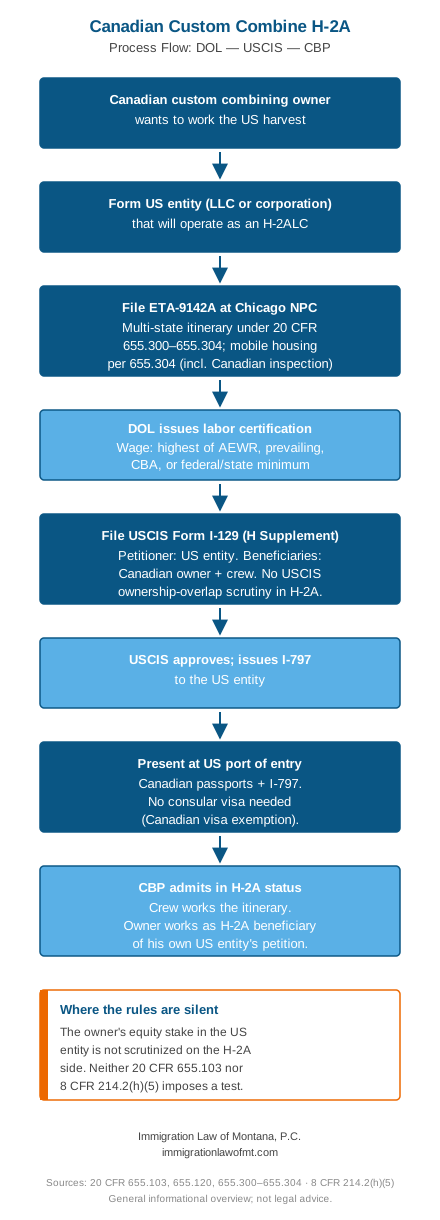
For Canadian custom combining operations, the H-2ALC is typically a US corporation or LLC that the Canadian owner has formed to conduct US operations. That US entity is the petitioner on the H-2A side. The Canadian owner and his Canadian crew members are the H-2A beneficiaries whom the US entity petitions for. The H-2ALC surety bond requirement itself sits in the current regulations at 20 CFR 655.132(c); the history of U.S. agricultural guest-worker programs runs back much further, to the Bracero Program (1942–1964), the first large-scale US guest worker program.
The Ownership Question — Where the Rules Are Silent
This is the point where experienced practitioners start to ask a sharp question. If the Canadian owner owns the US entity, and the US entity petitions for him as an H-2A worker, is he not effectively sponsoring himself? H-1B practitioners will recognize the shape of this problem. In the H-1B context, USCIS spent more than a decade fencing off single-shareholder self-sponsorship through the 2010 Neufeld memorandum, Defensor v. Meissner, and a body of Administrative Appeals Office (AAO) decisions that scrutinized the bona fide employer-employee relationship when the owner and the beneficiary overlapped. To loosen that, USCIS had to issue the H-1B Modernization Final Rule (effective January 17, 2025), which for the first time expressly permits a beneficiary with a controlling interest in the petitioner to be the subject of an H-1B petition, subject to conditions.
None of that apparatus exists in H-2A.
The DOL definition of “employer” at 20 CFR 655.103 is broadly drawn. It includes any individual, partnership, association, corporation, cooperative, firm, joint stock company, trust, or other organization with legal rights and duties that either has an employment relationship with an H-2A worker, files an Application for Temporary Employment Certification other than as an agent, or is a person on whose behalf such an application is filed. There is no ownership test, no right-of-control inquiry equivalent to the H-1B framework, and no prohibition on a single-owner entity serving as the employer.
The USCIS H-2A regulation at 8 CFR 214.2(h)(5) is equally silent on these points. A plain-text search of the entire (h)(5) subsection for the terms “right of control,” “employer-employee,” “ownership,” “beneficial owner,” and “bona fide employer” returns no matches. The regulation simply provides that an H-2A petition may be filed by the employer listed on the DOL-approved labor certification, the employer’s agent, or the joint-employer association. USCIS H-2A adjudication is fundamentally a check on the underlying DOL certification, not an independent ownership inquiry.
While it was in force, the TEGL reinforced rather than restricted this posture. It contemplated Canadian owner/operators throughout — it even instructed OFLC staff on how to bill them, noting that Canadian custom combine owners may pay by check, money order, or International Money Order. The Canadian owner was treated as the employer of record without any flag about the overlap with his personal status as a beneficiary.
Is there some unpublished understanding between USCIS, DOL, and industry trade associations — US Custom Harvesters Inc. or the Association of Canadian Custom Harvesters — that explicitly blesses this arrangement? It is possible, and practitioners should not assume there is not. Agency practice sometimes rests on decades of operational accommodation that never reaches the Federal Register. What can be said based on the publicly available sources is that the arrangement operates because the regulatory definitions are permissive enough to accommodate it and because no agency has seen fit to add a restriction.
From a client-counseling perspective, the practical implication is straightforward. A Canadian custom combining operation that already has a US-registered entity, that files a clean H-2A labor certification through OFLC, and whose US entity petitions for the owner and crew members as H-2A workers, should expect the petition to be adjudicated under standard H-2A rules. The owner’s equity stake in the petitioner does not appear to draw USCIS scrutiny in the way it would in an H-1B case.
Wages: The AEWR Floor and the Custom Combine Prevailing Wage
The H-2A wage framework requires that workers be paid no less than the highest of: the Adverse Effect Wage Rate (AEWR) for the applicable occupation and state; a prevailing wage, but only where DOL has issued one for the crop or agricultural activity from an approved state survey; an agreed-upon collective bargaining wage (rare in this context); the federal minimum wage; the state minimum wage; or any other wage the employer intends to pay (20 CFR 655.120(a)).
Custom combiners are subject to this wage floor. They are not exempt from the AEWR, and the October 2, 2025 Interim Final Rule that moved AEWR calculation to the Occupational Employment and Wage Statistics (OEWS) survey methodology applies to them without carve-out. Under the new methodology, custom combine operators typically fall under SOC 45-2091 (Agricultural Equipment Operators), one of the five occupations in DOL’s combined field and livestock worker group. That group has two skill-based AEWRs published by state: Skill Level I (entry level) and Skill Level II (experienced).
Update, October 2026: On August 26, 2026, a federal court held the October 2025 rule unlawful in United Farm Workers v. U.S. Department of Labor, No. 1:25-cv-01614 (E.D. Cal.). The court did not vacate the rule at first; it ordered DOL to promptly produce a new methodology and publish new AEWRs. On October 2, 2026, the court ordered DOL to issue a new interim final rule by December 30, 2026 and vacated the October 2025 rule effective that date. Until then, the current AEWRs remain in effect. As the court required, DOL gave public notice on September 2, 2026 that employers who use the current AEWRs from that date until the new rates are issued may later have to make wage adjustment payments to workers who were paid less than the new rates. DOL says no such obligation exists today and that it will oppose one. Check DOL’s notice and the current rates before setting a season’s wage. We explain the ruling, the back-pay window and the records to keep in What H-2A Wage Do I Pay?
A prevailing wage can also set the floor. Under the TEGL, state workforce agencies surveyed custom combine wages each spring and OFLC published the results in a Federal Register notice. The 2022 rule replaced that process: today a prevailing wage applies only if a state workforce agency submits a survey for the crop or agricultural activity that meets the standards in 20 CFR 655.120(c) and the OFLC Administrator issues a wage from it. An issued prevailing wage is posted on the OFLC website and stays valid for one year or until it is replaced.
When no prevailing wage has been issued for the activity and area, the AEWR (or a higher minimum wage) is the floor. Operators planning a season should check the OFLC-posted rates for both the AEWR and any prevailing wage before finalizing wage offers on the itinerary.
The question of how wages flow to the Canadian owner-operator himself is worth a separate note. Operationally, some owners structure their involvement so that they draw no W-2 wages from the US entity, taking distributions as a shareholder instead. Whether the H-2A wage floor applies to a worker who is also a controlling owner of the petitioning entity is a question that the published regulations and DOL Wage and Hour Division opinion letters do not directly address. A cautious approach is to pay the owner at least the applicable AEWR for the days he works the harvest, and to document that payment in the usual way. That avoids any later argument that the H-2A wage attestation was evaded.
What USCIS Looks At
The USCIS side of the process is straightforward compared with the DOL side. The US entity files Form I-129 with H Supplement (or, online only, Form I-129H2A through a USCIS online account) with the DOL labor certification. An online petition for workers not yet named may be filed once DOL has accepted the labor certification application, but USCIS cannot approve it until DOL certifies (8 CFR 214.2(h)(5)(i)(A)). USCIS reviews the petition for completeness, confirms the labor certification is valid, and approves. There is no USCIS-side custom-combining carve-out and no owner-beneficiary scrutiny layer. Paper H-2A petitions go to a USCIS lockbox chosen by the petitioner’s primary office state; for Montana, North Dakota, and Wyoming that is the Elgin, Illinois lockbox (USCIS I-129 filing addresses, as of October 2026).
Because Canadian nationals are visa-exempt for H-2A purposes, the beneficiaries do not need to appear at a US consulate abroad for a visa stamp. Once the I-129 is approved, Canadian crew members present their passports and the petition approval notice (Form I-797) to US Customs and Border Protection at a port of entry. CBP inspects the documentation and admits them in H-2A status for the period of the approved petition. For a Canadian custom combiner crossing from Alberta or Saskatchewan into Montana or North Dakota, this means the CBP interaction at the port of entry is the last step in the immigration chain, not a consular one.
Practical Issues That Tend to Come Up
A few recurring issues in Canadian custom combine H-2A filings are worth flagging.
The itinerary needs to be realistic. Section 655.303 requires the employer to identify each place of employment with as much geographic specificity as possible, including farm or ranch names, physical locations, and estimated period of employment at each location. Vague itineraries draw a Notice of Deficiency (20 CFR 655.141) from the Chicago National Processing Center. Experienced operators work with their farmer-clients before filing to lock in the planned sequence.
The Canadian housing inspection for mobile units needs to be current. The 655.304(a)(2) provision is useful, but it is conditional on a valid inspection by a Canadian Federal or provincial authority. Some provinces have well-developed inspection programs for agricultural worker housing; others are less formal. An operator should document the inspection before the housing enters the United States, and should be prepared to produce that documentation if OFLC asks for it.
H-2ALC surety bond requirements apply. Because the custom combiner is, by definition, an H-2ALC, it must comply with the H-2A surety bond requirements for labor contractors under the general regulations, not merely the special-procedures rules. The bond amount scales with the number of workers certified. This is one of the compliance details where the general H-2A rules and the special procedures combine.
Pay close attention to whether equipment transport counts as H-2A work. Section 655.301 includes transportation of harvested crops and of combine equipment between fields only when those activities are performed by workers employed by the same employer as the combining crew. If a separate trucking company moves the equipment between states, that work is not part of the custom combine H-2A job. This can matter for how operators structure their US entities, especially if they also operate a transport affiliate.
Think ahead about workers who may want to stay beyond one season. A crew member who builds a skill set and a relationship with the operation may eventually want options to stay past the H-2A season, and those options are narrower than they look at first glance. It is worth having that conversation with a returning worker before the season ends rather than after.
How to Think About Advising in This Space
For a Canadian custom combining operation seeking to work in the United States lawfully, the H-2A pathway is the right answer. The system is operationally workable — Canadian custom combining operations have used it every season for decades — but it requires a practitioner who understands both the special procedures at 20 CFR 655.300 through 655.304 and the H-2ALC framework that supports them, and who can assemble the US-entity, labor-certification, and petition components in the right sequence. For readers approaching this for the first time, our broader guidance on immigration options for farmers and ranchers gives helpful context.
The owner-beneficiary overlap question is where I would be most careful in client counseling. The arrangement works today based on the regulatory permissiveness described above, but clients should be advised that this is a practice that rests on the absence of restriction rather than on affirmative authorization. If USCIS or DOL were ever to focus enforcement attention on H-2A ownership overlap in the way USCIS once focused on H-1B self-sponsorship, the ground under Canadian custom combining would shift. In the meantime, careful file documentation — genuine business purpose for the US entity, bona fide employment duties for the owner during the harvest, clean wage records — reduces the risk that a future review looks anything other than routine.
If you run or work with a Canadian custom combining operation and have questions about structuring the US entity, filing the labor certification, or navigating the CBP port-of-entry process, those are the stages of an H-2A case we handle for employers. We would be happy to hear what you are working on.


