When “No” Is the Wrong Answer: Immigration Forms, Honest Answers, and the Consequences of Getting It Wrong

In February 2026, a federal court in Florida stripped a naturalized U.S. citizen of his citizenship. Joff Stenn Wroy Philossaint, a Haitian-born Fort Lauderdale resident, had his naturalization revoked after a federal jury convicted him of obtaining citizenship unlawfully (Justice Department release): he had lied during his citizenship interview — while actively committing fraud against the very COVID-19 relief programs he had sworn under oath he had never misused.
The case is not an outlier. It is a pattern.
Earlier this year, the Justice Department filed to denaturalize the former mayor of North Miami on similar grounds. In September 2025, an immigration judge ordered a Columbia University graduate deported after finding he made material misrepresentations on his I-485 adjustment of status application. In the North Miami case, which so far is only allegations, the Justice Department said the fraud was uncovered by a fingerprint comparison under a joint DOJ–USCIS initiative (Justice Department release).
What unites these cases is not their politics, their notoriety, or even the specific statutes involved. What unites them is a single moment: a government form, a sworn question, and a person who answered “no” when the true answer was something else.
Two Cases, One Lesson
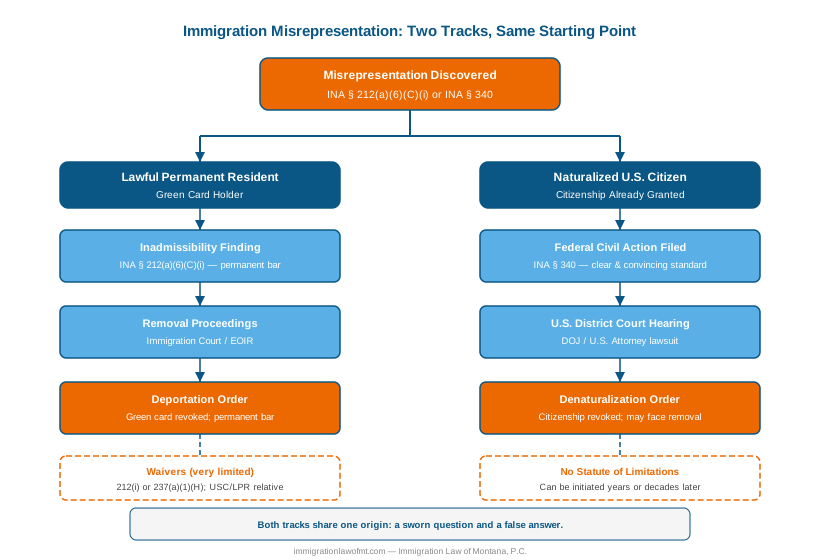
The Philossaint denaturalization and the Khalil deportation arose under different provisions of the Immigration and Nationality Act and proceeded in different courts. Denaturalization — the formal revocation of naturalized citizenship — is governed by INA § 340 and comes about in one of two ways. The government can file a civil action in federal district court, where it must prove its case by clear, unequivocal, and convincing evidence, one of the highest standards in civil law. Or, as in Philossaint’s case, citizenship is revoked after a criminal conviction for knowingly procuring naturalization unlawfully (18 U.S.C. § 1425); the statute then says the court “shall” revoke it (INA § 340(e)). LPR revocation through removal proceedings operates through the immigration courts. These are not the same legal mechanism.
But the human reality of what went wrong in both cases is identical.
Philossaint, at his December 2020 naturalization interview, was asked questions about good moral character: had he ever committed a crime for which he was not arrested? Had he ever made misrepresentations to receive a public benefit? He answered no. Between April 2020 and May 2021, he and his co-conspirators had submitted 40 fraudulent loan applications and obtained approximately $3.8 million in COVID-19 relief funds.
Khalil, at his I-485 adjustment interview, answered questions about organizational memberships and employment history. Immigration Judge Jamee Comans found that he “willfully misrepresented material fact(s),” and that he did so “for the sole purpose of circumventing the immigration process” — not as oversights by an uninformed applicant.
In both cases, the question on the form was the moment of decision. In both cases, the answer given did not match reality. And in both cases, the government eventually came back to collect.
What These Questions Are Actually Asking
Here is something I tell every client before an immigration interview, and have for nearly thirty years: read the question. Not your idea of the question. Not what you think it probably means. The actual question.
This distinction matters more than most people realize.
Part 9 of Form I-485 (edition 09/18/26) asks about arrests, citations, charges, detentions, convictions, and organizational memberships. Form N-400 asks about good moral character, criminal history, and whether the applicant has ever made false representations to obtain a public benefit. These questions use legal terms of art that do not always match colloquial understanding. Marijuana that was legal under state law is a common example of conduct people leave off the form; see why Montana-legal marijuana still matters to immigration.
The word “detained,” for example. Most people interpret this as being put in handcuffs, taken to a police station, and held in a cell. That is not how federal law defines it.
A traffic stop is a detention under Terry v. Ohio and its progeny. When a police officer activates his lights and pulls in behind you, you are not free to leave. That is, by legal definition, a detention. Simply pulling away and leaving can bring a charge of fleeing from or eluding a peace officer, which in Montana is a misdemeanor or, when aggravated, a felony (MCA 61-8-316 and 61-8-707), and it can bring obstruction charges as well. The fact that you were stopped in Yellowstone National Park for speeding and received only a verbal warning — not even a citation — does not change what the interaction was. It was a detention.
I walk through exactly this analysis with clients before their I-485 interviews. A common version: an applicant has answered “no” to the question about detentions. When we work through what actually happened — a traffic stop that ended in a verbal warning — the applicant changes the answer. A correction like that usually makes no substantive difference to the application, and a verbal warning may not be recorded anywhere.
But the form now accurately reflects reality. And that matters.
The Failure Can Go in Either Direction
What I described above is one kind of mistake: a good-faith misunderstanding of what a question covers. The applicant genuinely did not know that a traffic stop qualified as a detention. The applicant was not trying to hide anything, and answered based on an intuitive sense of the word rather than its legal definition.
Philossaint and Khalil represent the other kind: cases where, based on all available evidence, the person understood what was being asked and chose to answer falsely. Philossaint was actively running a fraud scheme when he told the interviewing officer he had never misrepresented anything to receive a public benefit. Khalil, whom the court found to be “intelligent” and “ivy-league educated,” answered incompletely to questions about organizational affiliations whose disclosure he understood might complicate his application.
Formally, the law does distinguish them: inadmissibility requires a willful misrepresentation, which the USCIS Policy Manual reads as “knowingly,” as distinguished from accidentally, inadvertently, or in good faith. In practice, though, both can produce a finding of material misrepresentation, because a sworn answer that turns out to be false can itself be treated as a sign of willfulness. But the practical difference for purposes of correction is enormous. A client who misunderstood the question can correct their answer, explain the gap, and proceed. A client who answered falsely while knowing the true answer faces a permanent inadmissibility bar with very limited waiver options.
This is why the pre-interview review exists.
The Legal Consequences Are Severe
For lawful permanent residents, a finding of material misrepresentation under INA § 212(a)(6)(C)(i) renders the person inadmissible. Because inadmissibility is a basis for removal, an LPR who obtained their green card through willful misrepresentation can be ordered deported — regardless of how long ago the misrepresentation occurred, how established their life in the United States is, or how minor the underlying fact they concealed might seem. Misrepresentation is only one ground of inadmissibility — criminal convictions raise a separate set of immigration problems of their own.
For naturalized citizens, INA § 340 authorizes the government to seek denaturalization if citizenship was “illegally procured or … procured by concealment of a material fact or by willful misrepresentation.” A civil case is filed in federal district court, and the burden of proof is high. Philossaint’s citizenship was revoked the other way, after a criminal conviction. Either way, as his case shows, the government is willing to bring these cases.
In both contexts, there is no statute of limitations.
For a green card holder, that sentence is the whole problem, and the only waiver that answers it exists in immigration court alone; see when the government says your green card was never valid.
And the government has described at least part of its investigative infrastructure as systematic, not reactive. In the North Miami complaint, DOJ said the fingerprint comparison that uncovered the alleged fraud is “part of an ongoing national initiative called the Historic Fingerprint Enrollment project, a joint effort by the Justice Department and USCIS.”
The machine is on.
Before Your Interview: Active Moral Inventory
Before any immigration interview — adjustment of status, naturalization, consular processing, or any other encounter with an immigration officer — take these steps:
- Read every question as a legal question, not a conversational one. If a question uses terms like “detained,” “arrested,” “charged,” “cited,” or “convicted,” do not answer based on your gut sense of those words. Ask your attorney what they mean under the law.
- Inventory your reality honestly before the interview. Every traffic stop. Every interaction with law enforcement, even one that ended in a warning. Every organization you have belonged to or supported. Every job you held during a period of uncertain work authorization. Every government benefit you have received.
- Understand that honest disclosure almost always helps you. Most things that applicants are tempted to conceal are either already known to the government, discoverable from public records, or addressable through waivers and explanations. The consequences of a willful misrepresentation finding are not addressable the same way.
- Do not answer “no” to anything without being certain it is correct. When in doubt, say “I’d like to think about that question” or “I’d like to consult with my attorney.” Officers hear this regularly. A hasty “no” that turns out to be false can end your case permanently.
If the interview ahead of you is the naturalization interview, the inventory matters more than at any earlier stage, because the N-400 re-opens your entire file back to the original admission, with no time limit on that part of the review. USCIS now receives a fuller FBI record than it used to, which makes this inventory more important, not less; see USCIS continuous vetting and your FBI record.
A Final Observation
I am an immigrant. I obtained LPR status and later citizenship, and neither came easily. I do not take them lightly.
When I look at cases like Philossaint’s, I do not see the government acting harshly. I see it taking seriously something that deserves to be taken seriously. LPR status and U.S. citizenship are among the most valuable legal privileges a person can hold. Enforcing the standards that have always existed on paper — consistently, for everyone — honors the people who obtained them honestly.
The lesson for anyone navigating the immigration process is simple: these questions are not bureaucratic formalities. They are the mechanism by which the government decides whether you deserve the privilege you are asking for. Answer them as if they matter.
They do.
If you have questions about how to answer immigration forms correctly, are preparing for an adjustment or naturalization interview, or are concerned about prior omissions in a pending application, contact Immigration Law of Montana. We handle immigration matters throughout Montana, North Dakota, Wyoming, and the broader Rocky Mountain West.
Legal References: INA § 212(a)(6)(C)(i), 8 U.S.C. § 1182(a)(6)(C)(i) (material misrepresentation inadmissibility) | INA § 340, 8 U.S.C. § 1451 (denaturalization) | USCIS Policy Manual, Vol. 8, Part J, Chapters 2–3 | Terry v. Ohio, 392 U.S. 1 (1968) | 9 FAM 302.9-4(B) (State Dept. FAM on misrepresentation) | DOJ USAO-SDFL, Press Release (March 2026, Philossaint)


