Your teenager is ready to get a driver’s license. You take him to the DMV with his Canadian birth certificate—the same document you’ve used for everything since you brought him home from Alberta as an infant. The clerk looks at it, then looks at you. He needs proof of citizenship or immigration status to get a license in Montana. You’ve never thought about this before. He was born abroad, but he’s your son—you’re an American—and you assumed he was American too.
The question you’re suddenly asking, standing in a DMV office, is one that I answer regularly: did your child inherit U.S. citizenship at birth? For most children born abroad to at least one American parent, the answer is yes. The question that follows immediately is why no one documented it.
What INA 301 and 309 Do: Citizenship by Transmission
INA Section 301 and INA Section 309 are the statutes that govern citizenship at birth for children born outside the United States. These provisions create citizenship that exists from the moment of birth—not acquired through a process, not conferred by an officer’s approval, but transmitted from parent to child at the instant of delivery.
This is not naturalization. Naturalization converts a non-citizen into a citizen through a legal process: the N-400 application, the English test, the civics examination, the oath ceremony. None of that applies to a child who inherited citizenship at birth through a parent. The citizenship existed before any form was filed. The task is documentation, not acquisition.
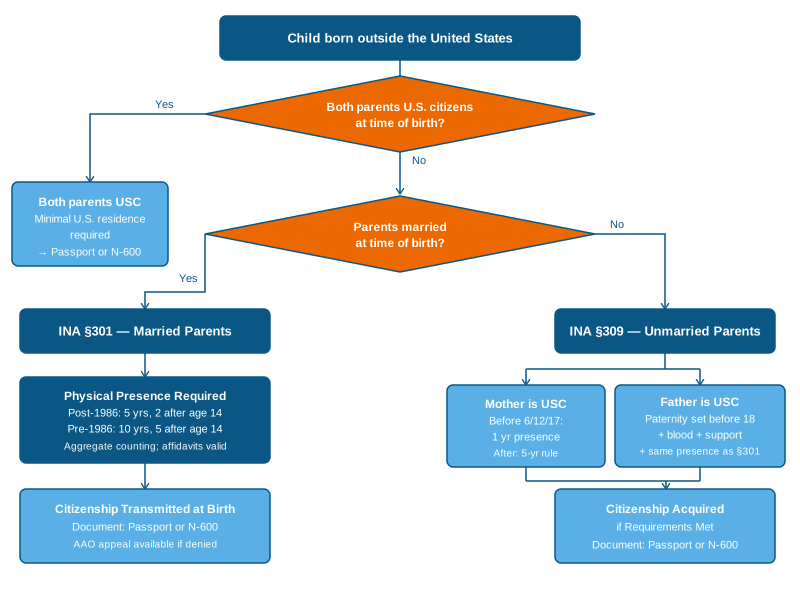
INA 301 covers children born in wedlock—to married parents. INA 309 adds requirements for children born outside of marriage, with different rules depending on whether the transmitting parent is the mother or the father. Together they cover every scenario in which U.S. citizenship is transmitted at birth to a child born on foreign soil. Your derivative citizenship analysis starts here.
The Simplest Case: Both Parents Are U.S. Citizens
If both parents are U.S. citizens, the citizenship question is the easiest version of this analysis. A child born abroad to two U.S. citizen parents is a citizen from birth, provided at least one parent had a residence in the United States at some point before the child was born. This is a minimal threshold—not a physical presence requirement in the demanding sense discussed below. It means one parent lived in the United States at some point. For most American families, it raises no issues.
I handled a case like this some years ago. Two American parents had a child while living overseas, brought the child home when their time abroad ended, and never recorded the birth with a U.S. consulate. The child grew up here and lived an entirely American life. Decades later, applying as an adult for a government benefit, the client was asked for proof of citizenship and had none.
We filed for a U.S. passport to document the citizenship that had existed since birth. The process worked. The evidentiary threshold for a two-U.S.-citizen-parent case is considerably lower than for cases involving one citizen and one foreign national. When both parents are American, the government’s concern is straightforward: can you prove who the parents are and that they were citizens? Proving years of physical presence is not the issue. The challenge in a case that old is simply locating records that are old and scattered. An attorney can help when those records are incomplete.
If you are an adult who has never documented citizenship you may have acquired at birth through two American parents, a passport application with supporting evidence is typically the right first step.
When the Other Parent Has a Green Card
A common misunderstanding: a green card does not shorten the requirement. A lawful permanent resident is still an “alien” in the statute’s terms, so a child born abroad to a U.S. citizen and a green-card holder falls under the five-year rule in the next section (INA 301(g)). The shorter rule—one continuous year of physical presence by the U.S. citizen parent—applies only when the other parent is a U.S. national who is not a citizen (INA 301(d)). If your spouse held a green card when your child was born abroad, use the five-year rule. For context on the full framework of citizenship through a parent, see our overview of all derivative citizenship pathways.
One U.S. Citizen Parent, One Foreign National: The Five-Year Rule
The most common scenario I see in my practice involves one U.S. citizen parent and one foreign national—most often a Canadian spouse. The physical presence requirement here is more demanding.
Under current law—which applies to children born on or after November 14, 1986—the U.S. citizen parent must have been physically present in the United States for at least five years, at least two of which were after the parent turned fourteen. This presence must have occurred before the child was born. Five years totals 1,825 days, counted in aggregate; no single unbroken stretch is required. A parent who spent years moving back and forth across the Montana-Alberta border can satisfy the requirement if the total time in the United States adds up. The counting is what requires documentation.
The Older Ten-Year Rule
For children born on or after December 24, 1952, and before November 14, 1986, the requirement was ten years of physical presence—five of which had to be after age fourteen. Births before December 24, 1952 fall under older statutes with their own rules. This older standard still comes up in my practice, though less often than it did when I started. The cases I see involving the ten-year rule tend to involve older adults: people discovering citizenship questions when they apply for Social Security retirement benefits or other government programs, rather than when a teenager needs a driver’s license. If you were born before 1986 and are only now examining your citizenship status, the older rule governs your analysis. The documentation challenge is correspondingly greater because the physical presence you are proving may span decades in the past.
The Pattern I See Most Often
The most common way these cases arrive in my office follows a predictable pattern. A U.S. citizen lives near the Montana-Alberta border, married to a Canadian spouse. Someone—often the Canadian spouse—suggests that having the baby in Canada might be more economical, or simply more convenient. The child is born in Canada. The family brings the infant home to Montana. No documentation is obtained at the time. No one thinks about it.
The trouble starts years later. The child applies for a driver’s license, needs a passport for a school trip, tries to enroll in college, or applies for a federal job. Suddenly the question of citizenship documentation becomes urgent. The child has lived an entirely American life but cannot prove it on paper.
These cases are almost always resolvable. The work is gathering the evidence to prove the U.S. citizen parent’s physical presence before the birth.
When one parent is a First Nations Canadian, check the Jay Treaty route for American Indians born in Canada as well; a child with at least 50 percent blood may already be a U.S. permanent resident even if not a citizen.
Building Your Evidence: The Spreadsheet Method
Proving physical presence across years or decades requires a systematic approach. Here is how I handle it.
I start by building a spreadsheet that maps the U.S. citizen parent’s years of physical presence in the United States. Each row covers a period—a year of school, a period of employment, years at a specific address. The goal is to account for as much time as possible with documentary support, then identify the gaps.
Social Security earnings statements are the most persuasive evidence available. The Social Security Administration maintains earnings records going back decades. When a person worked in the United States, those wages were reported. A Social Security earnings statement showing reportable wages for a given year is treated as essentially conclusive proof of U.S. presence during that period. I request them in every physical presence case, without exception. They take some effort to obtain, but the government treats them as authoritative.
Official university transcripts document years of enrollment. Tax returns establish presence. Employment records, housing records, and school records all serve the same function: anchoring the person to the United States during a specific period. The more years you can cover with hard documentary evidence, the stronger the application.
The harder cases are those where formal documentation does not cover the full required period. This happens most often when some physical presence time was spent informally—at a family property or a relative’s home, for example, where the stay was real but records are sparse. In those situations, affidavits from family members and others who can confirm the person’s presence during that period fill the evidentiary gap.
Affidavits and the AAO Standard
Early in my career, I handled a case in which citizenship turned partly on family vacation time spent in the United States. I had strong documentary evidence for most of the required physical presence. For those vacation periods, I assembled sworn affidavits from family members and others who had been there with them.
The local USCIS field office treated the affidavits as unreliable and denied the application. My argument had been that sworn affidavits deserve to be weighed, and that if the government doubted one, it was free to question the person who signed it under oath—not to set the whole category aside. I appealed to the Administrative Appeals Office, and the AAO sustained the appeal: it held that the field office erred in simply disregarding the affidavits, and that on a preponderance of the evidence the burden of proof had been met.
That case is a useful reminder. A denial from a local USCIS field office is not the end of the road. It is the beginning of the appellate process.
Children Born Out of Wedlock: INA 309
When the parents were not married at the time of birth, INA Section 309 applies. The requirements differ depending on which parent is the U.S. citizen.
U.S. Citizen Mothers
For a U.S. citizen mother, the rule depends on when the child was born. For a child born before June 12, 2017, the mother needed one continuous year of physical presence in the United States before the birth. For a child born on or after June 12, 2017, USCIS applies the same five-year rule that governs a married parent: five years of physical presence, at least two of them after age fourteen. The change follows the Supreme Court’s decision in Sessions v. Morales-Santana (2017), which held the old difference between unwed mothers and unwed fathers unconstitutional (USCIS Policy Manual, Vol. 12, Part H, Ch. 3).
U.S. Citizen Fathers
For U.S. citizen fathers, the requirements are stricter. To transmit citizenship to a child born out of wedlock, a U.S. citizen father must establish: a blood relationship with the child (by clear and convincing evidence), that he held U.S. citizenship at the time of the child’s birth, that he agreed in writing to provide financial support until the child turned eighteen (unless he died before then), and—critically—that before the child’s eighteenth birthday the child was legitimated, he acknowledged paternity in writing under oath, or a court established his paternity. He must also meet the same physical presence requirement as a married U.S. citizen parent: for births on or after November 14, 1986, five years, at least two of them after age fourteen.
Whichever of those routes applies, it must happen before the child turns eighteen. This is the requirement that breaks cases.
Some of these cases are hard. When the father died young, lived under another name, or left little paper behind, each of these elements has to be proved from whatever records survive—and the blood relationship by clear and convincing evidence. Cases like this are where honest case evaluation matters: not every claim to citizenship through a U.S. citizen father can be established on the available evidence, and the client deserves that assessment before a filing is made. If the child is still abroad and the family is about to file an I-130, read why a child born abroad may not need an I-130 at all first.
A Practical Note on the Passport Office
The Passport Office is structured for straightforward applications—a U.S.-born parent applying for a child’s first passport, or a new naturalized citizen seeking travel documents. Transmission cases do not always fit that template. Even on a clean Section 301 claim—married parents, one U.S. citizen parent, physical presence documented—we regularly receive requests for evidence that do not fit the case, such as a request for the child’s green card, a document that matters for automatic citizenship under INA 320 but not for citizenship acquired at birth. Out-of-wedlock cases, legitimation questions, and a father whose name is missing from the birth certificate draw even more of these requests. In difficult out-of-wedlock situations, filing Form N-600 with USCIS is often the better choice, for reasons discussed below.
Documenting the Citizenship: CRBA, Passport, and Form N-600
Three documentation options exist for citizenship acquired at birth abroad.
Consular Report of Birth Abroad
The Consular Report of Birth Abroad (CRBA) is the right tool when citizenship is recognized at or shortly after birth. A U.S. citizen parent applies through the U.S. embassy or consulate (at most posts now online through MyTravelGov), typically while still in the foreign country or shortly after returning. The CRBA is a permanent record of U.S. citizenship. For families who address the documentation question at the time of birth, it is the cleanest option and eliminates the need to revisit the question later.
Most families I work with did not file a CRBA. The child was born, brought home, and the paperwork never happened. For these families, documentation runs through the passport application or Form N-600.
U.S. Passport
A passport issued on the basis of citizenship acquired at birth abroad proves citizenship and serves simultaneously as a travel document. It is faster and less expensive than Form N-600. For most transmission cases with adequate documentary evidence of physical presence, the passport application is the right first step. Apply, get the documentation resolved, and the child has both proof of citizenship and the ability to travel internationally.
How do I apply for my child’s first passport from inside the United States?
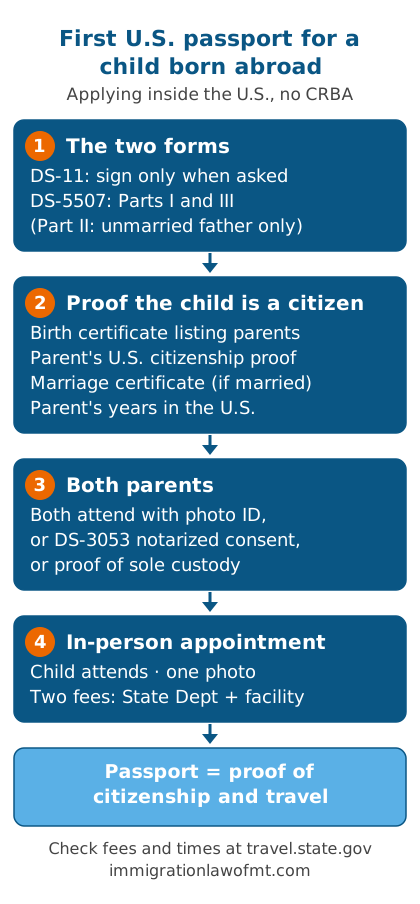
Apply in person, with the child, at a passport acceptance facility (many post offices, county clerks and libraries) on Form DS-11, and add Form DS-5507, the State Department’s Affidavit of Physical Presence or Residence, Parentage, and Support. A child born abroad who never received a Consular Report of Birth Abroad has no U.S. birth certificate or CRBA to show, so the passport specialist decides the citizenship claim from the documents in the envelope. The regulation requires the applicant to document every element of the claim (22 CFR 51.43). For a child who became a citizen at birth through a parent, the State Department’s citizenship evidence page (updated October 5, 2026) asks for four things: the foreign birth certificate listing the parents, the parent’s proof of U.S. citizenship, the parents’ marriage certificate if they were married, and a statement of when and where the parents lived in the United States and abroad before the birth. Form DS-5507 is the State Department’s own form for that statement. Leave it out and the file has no sworn, dated timeline of the U.S. citizen parent’s physical presence (or residence) in the United States before the birth, which is the fact the claim usually turns on.
The U.S. citizen parent completes Part I of the DS-5507: marital status, the child, and dated periods in the United States and abroad (month and year are acceptable when exact dates are unknown). Make those dates match the evidence; the spreadsheet of years in the United States described earlier on this page is the easiest way to fill in Part I. Parts II and III are sworn statements, and the form says they must be signed in front of a notary public, a passport specialist or an acceptance agent when the oath is taken, so do not sign them at home. Part II is only for a U.S. citizen father of a child born outside marriage, who swears there that he is the biological father and promises financial support; married parents leave it blank. Part II does not cover everything INA 309(a) requires: an unmarried father must also prove the blood relationship by clear and convincing evidence (the State Department may ask for DNA) and meet the other conditions described in the section on U.S. citizen fathers above. In difficult out-of-wedlock cases, Form N-600 is often the better route.
For a child under 16, both parents normally sign the application in front of the acceptance agent (22 CFR 51.28). A parent with sole custody, or whose co-parent has died, can apply alone with the court order or other proof. If one parent cannot come, for example a mother who still lives in Canada, that parent signs Form DS-3053, Statement of Consent, before a notary, and the State Department’s page on children’s passports (updated October 28, 2026) says it must be submitted within 90 days of signing. A parent outside the United States may need to have it notarized at a U.S. embassy or consulate.
What goes in the packet (checked November 8, 2026):
- Form DS-11, filled in but not signed until the acceptance agent asks.
- Form DS-5507, Parts I and III (Part II only for an unmarried father).
- The child’s foreign birth certificate listing both parents, with a photocopy. Some places, including Canadian provinces, also issue a short version without the parents’ names; order the long-form version. A document not in English needs a professional English translation with the translator’s notarized letter.
- The U.S. citizen parent’s proof of citizenship (U.S. birth certificate, passport, naturalization certificate or CRBA), with a photocopy.
- The parents’ marriage certificate, if they were married when the child was born.
- Evidence of the U.S. citizen parent’s physical presence before the birth: school transcripts, a Social Security earnings statement, W-2s, leases.
- One passport photo of the child.
- Both parents’ photo IDs, with photocopies of the front and back.
- Form DS-3053 and a copy of that parent’s ID if one parent cannot attend, or proof of sole custody.
- Fees: a $100 check to the “U.S. Department of State” for a child’s passport book, plus a $35 acceptance fee paid to the facility (State Department fee page, updated March 19, 2026).
Routine processing was 4 to 6 weeks as of October 2026 (State Department processing times). A born-abroad claim is decided on its documents, though, and as the practical note on the Passport Office explains, we regularly see requests for evidence on these cases even when the claim is clean, so apply well ahead of any planned trip.
Form N-600
Form N-600, the Application for Certificate of Citizenship, produces a Certificate of Citizenship from USCIS—a permanent document that does not expire. The filing fee is $1,385 on paper or $1,335 if filed online (USCIS fee schedule, Form G-1055, as of October 20, 2026). Processing times vary by office; check the current time on the USCIS processing-times tool. For most straightforward transmission cases, the passport is faster, cheaper, and equally effective as proof of citizenship.
However, Form N-600 filed with USCIS has a strategic advantage in difficult cases: an adverse decision can be appealed to the Administrative Appeals Office. A passport denied for lack of proof of citizenship has no administrative hearing under the State Department’s passport rules (22 CFR 51.70); the remaining route is a federal lawsuit. The forum selection—Passport Office versus USCIS—is a deliberate choice, not a default.
Choosing Your Forum: Passport Office vs. USCIS
For most clean transmission cases—two U.S. citizen parents, or one U.S. citizen parent with good documentary evidence of the required physical presence—the passport application is faster, cheaper, and produces functional proof of citizenship quickly. File the passport application.
For difficult cases—out-of-wedlock, limited documentation, legitimation questions, or a situation where a denial is a realistic possibility—the Form N-600 with USCIS may be the better forum. The AAO appeal option matters in those cases.
I made this strategic choice deliberately early in my career. A client came to me after receiving a denial on a work-visa petition. The stated reason: USCIS believed this person might already be a U.S. citizen. That is not a denial notice I see every day. After examining the situation, I agreed the citizenship claim was plausible. Rather than filing a passport application with the State Department, I filed Form N-600 with USCIS. My reasoning: if USCIS itself was saying this person was likely a citizen, starting the documentation process at USCIS gave me a better posture than going to State. The case was not easy—the evidence centered on family time at a U.S. property, with documentation gaps—but the forum choice was sound. When the local field office denied the claim and I appealed to the AAO, the AAO agreed that the field office had erred.
The lesson: the choice of where to file is part of the strategic analysis, not an afterthought.
When the Case Goes Wrong: Appeals and Federal Court
A denial at the USCIS field office level is not a final answer. The Administrative Appeals Office applies a de novo review and a preponderance-of-the-evidence standard. As in the case described above, the AAO can correct a denial based on legal error, such as disregarding a legitimate category of evidence.
I am not, however, a reflexive AAO advocate. The AAO is the right forum when the field office made an identifiable legal or factual error that the AAO is positioned to correct. It is not the right forum for every difficult case. In cases where the evidentiary record is genuinely thin, the AAO faces the same constraints as the field office.
Federal court is the next step. Under 8 U.S.C. 1503(a), a person in the United States who is denied a right or privilege of citizenship—a passport, for example—on the ground of not being a U.S. national may sue in federal district court for a judgment declaring U.S. nationality. The suit must be filed within five years of the final administrative denial, and the route is not available when the citizenship question arises in removal proceedings. For cases involving complex legitimation questions, agency errors of law, or situations where both the field office and the AAO have denied a meritorious claim, federal court is an available remedy. I do not bring cases to federal court that I do not believe I can win. But for the right case—where an agency has made a legal error and the evidentiary record supports the claim—it is a viable and sometimes necessary path. Part of doing this kind of work is knowing where each case belongs.
The Right Question to Start With
The driver’s license moment, the Social Security application, the federal job inquiry—these are not the best times to first examine whether a child born abroad acquired citizenship at birth. They are often just the first time the family thinks to ask.
The better time to ask is earlier. If you are a U.S. citizen with a child born outside the United States, the first step is to analyze whether you met the physical presence requirements at the time of birth. If you did, the documentation you obtain now reflects citizenship that has existed since the day your child was born. For most families, that analysis leads to a passport application, a spreadsheet of physical presence evidence, and a resolved question.
For families with more complicated facts—out-of-wedlock circumstances, a father whose documentation is incomplete, limited evidence of physical presence, or a situation where the parent’s U.S. ties are genuinely unclear—the analysis is harder and the forum choice matters. Those are the cases where an attorney’s involvement from the beginning is worth the investment.
This article covers the transmission of citizenship at birth under INA 301 and 309. If your situation involves a child who is already a lawful permanent resident living in the United States with a U.S. citizen parent, the governing analysis is different: you may be looking at automatic citizenship acquisition under INA Section 320 rather than transmission at birth. That process—and the critical difference between it and the rules discussed here—is explained in detail in a companion article.
If you have questions about whether your child born abroad inherited U.S. citizenship, or if you are an adult who has never documented citizenship you may have acquired at birth, contact Immigration Law of Montana to schedule a consultation.
Related on this topic: Form N-600K (borrowing a grandparent’s U.S. time).