
Your visa or your DS-2019 carries a notation that says you are “subject to 212(e).” A sponsor told you that when your program ends you will have to go home for two years before you can come back to work or stay. Before you reorganize your life around that, understand one thing: a great many J-1 visitors who are told they are subject to the two-year rule either never were — or, after a major change in December 2024, no longer are.
The two-year home-residency requirement is one of the most misunderstood provisions in immigration law, and the misunderstanding runs in both directions. People who are subject often do not realize it until the worst possible moment. People who are not subject sometimes spend years believing a stamp that was never accurate. This page explains exactly when the rule applies, why your paperwork may be wrong, what the 2024 changes did, and how to get a definitive answer. If your paperwork is stale, you can file an Advisory Opinion yourself — we walk through the steps in a separate guide.
What the two-year rule actually does
The requirement comes from Section 212(e) of the Immigration and Nationality Act. It is not a ban and it is not a deportation. It is a precondition. Until you either spend two years physically present in your home country or obtain a waiver, you cannot do three specific things: receive an H or L work visa (the H-1B is the one that catches most people), receive a K fiancé(e) visa, or become a lawful permanent resident — the green card — whether through an immigrant visa abroad or by adjusting status inside the United States (22 CFR 40.202).
Notice what is not on that list. The rule does not stop you from getting most other nonimmigrant visas — a B visitor visa, an F student visa, an O visa — and it does not stop you from traveling. One more limit applies inside the United States: while you remain subject, you generally cannot change from J-1 to another nonimmigrant status here, other than to A or G status (INA 248(a)(3)), so a change to F-1 or O-1, for example, means leaving and applying for the visa abroad. It blocks the specific doors that lead to working long-term or staying permanently. That is precisely why it matters so much to anyone thinking past their program: it is the gatekeeper to every plan that involves remaining. An O visa is still open to you, but if you are subject and have no waiver you generally cannot change from J-1 to O-1 inside the United States, so an approved petition is used at a U.S. consulate; see when a J-1 can move to an O-1.
You are subject only if one of three things is true
This is the heart of it. The two-year rule attaches in only three ways. If none of them applies to you, you are not subject — no matter what a consular stamp or a DS-2019 says.
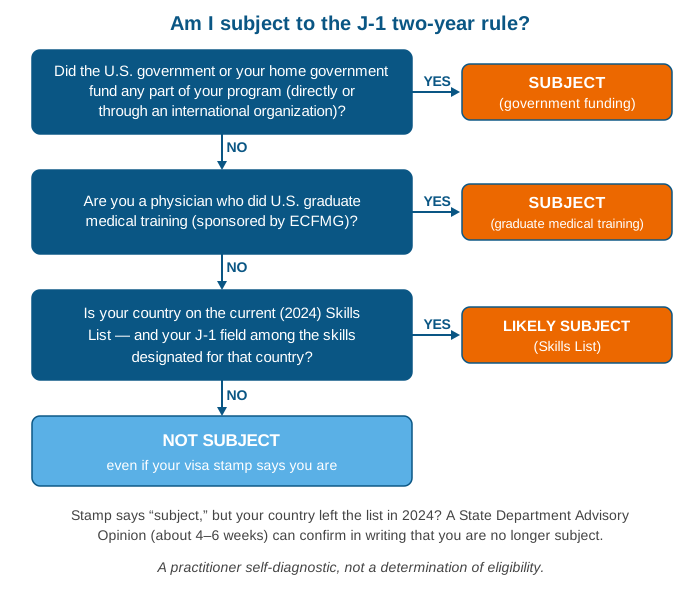
1. Government funding
If your program was financed, in whole or in part, by the U.S. government, or the government of your country of nationality or last residence — directly or indirectly, including through an international organization that received money from either government — you are subject. The key word is government. Money from a private U.S. host employer — the ordinary way an intern, trainee, or au pair is paid — does not trigger this prong. A privately funded exchange visitor clears the funding test entirely; a Fulbright grantee or a government-sponsored scholar does not.
2. The Exchange Visitor Skills List — country AND field
This is the prong that catches most privately funded participants, and it is more precise than people assume. The Exchange Visitor Skills List is a list of countries the State Department has designated as needing certain skills back home. You are caught by it only if both are true: your country of nationality or last legal permanent residence is on the list, and the field of your J-1 activity is among the skills designated for that country.
That two-part test is why your specific field matters. Two exchange visitors from the same listed country can come out differently depending on whether their occupational field appears on that country’s skill list. It is worth checking the actual designation for your country rather than assuming that “my country is on the list” settles the question.
The list shrank dramatically in 2024. Effective December 9, 2024, the State Department revised the Skills List for the first time in fifteen years, cutting it from more than 80 countries to 44. Major economies came off entirely — among them China, India, South Korea, Saudi Arabia, and the United Arab Emirates. Western Europe was not on the 2009 list either. Countries that remain include the Philippines and much of sub-Saharan Africa, Central America, and the Caribbean. Importantly, the 2024 change updated only which countries are listed; for a country still on the list, the underlying skills are unchanged from the 2009 version.
3. Graduate medical training
Foreign physicians who come to the United States for graduate medical education or training — residencies and fellowships sponsored by ECFMG — are always subject to the rule — graduate medical training is one of the three statutory triggers. For physicians it is less a question of whether the rule applies than of how to satisfy or waive it, which is a subject of its own. We cover it in how Conrad 30 waivers work for J-1 physicians.
Why the “subject” notation on your paperwork may be wrong
Here is a point I find myself explaining constantly. The notation on a visa or a DS-2019 that says “bearer is subject to 212(e)” is a preliminary indication made at the time of issuance. It is not a final, binding determination, and it is wrong often enough that it should never be treated as the last word — especially now.
A consular officer makes that call quickly, sometimes conservatively, and sometimes simply by reading the old Skills List. People have carried a “subject” annotation for years that did not reflect their actual situation. After December 2024, the number of stale annotations jumped overnight, because every visitor whose country came off the list still has paperwork that says the opposite of what the current law provides.
The 2024 change looks backward — it is retroactive
This is the good news for many people, and it is frequently missed. The revised Skills List applies retroactively. If the only reason you were ever subject to the two-year rule was the Skills List, and your country has since been removed, you are no longer subject — even if you are in the middle of your program, even if you finished it years ago, and even though your visa still says you are. The funding and graduate-medical-training triggers are not affected by the list, so a government-funded visitor or an ECFMG physician remains subject regardless; but for the large group caught only by their country’s former listing, the door has quietly reopened.
How to get a definitive answer: the Advisory Opinion
If your paperwork says one thing and the current law appears to say another, you do not have to live with the ambiguity, and you should not guess. The State Department’s Waiver Review Division will issue an Advisory Opinion — a formal review of your program documents that states whether you are, in fact, subject to 212(e). It typically takes about four to six weeks.
For someone whose visa carries a “subject” annotation that the 2024 changes have made obsolete, the Advisory Opinion is the clean fix: a written determination you can put in front of a consular officer or USCIS to show that the requirement does not apply to you. It is the difference between arguing about a stamp and holding a document that settles the argument.
Why you cannot simply tell USCIS to read the new rule
Here is the practical trap, and it is one I warn clients about directly. The authority to decide whether 212(e) applies to you belongs to the State Department — not USCIS. So if your country has come off the Skills List and you go file an H-1B, you will not succeed by arguing to the USCIS officer, “read the 2024 rule; I am not subject.” That is not how the determination is made, and an adjudicator is not going to re-decide your subjectivity from the regulation on your say-so. What carries weight is a State Department Advisory Opinion stating that you are not subject. You present the determination; you do not argue the rule. Holding the document is the whole game.
What clearing the rule unlocks
Once an Advisory Opinion confirms you are not subject, the doors 212(e) had closed swing open. Take an example: a teacher who was subject under the old list, from a country removed in 2024 — South Africa, say — becomes eligible to be sponsored for an H-1B by a school district, a path the two-year rule had foreclosed. The contrast is the lesson. A teacher from the Philippines saw essentially no change in 2024 and remains subject; the African and other countries that came off the list are where this most often rewrites a person’s plan. Because the analysis is country-specific, a stale stamp should never be the reason someone assumes a job offer is beyond reach — that is a question worth answering before turning the offer down. What the district then has to prove is set out in our guide for school districts sponsoring an H-1B teacher.
For the full set of routes once the rule is cleared, see the options for staying after your J-1 year.
If you are subject: the five waivers, in brief
Being subject is not the end of the road. The law provides five ways to waive the two-year requirement, and which one fits depends entirely on your facts.
No Objection Statement. Your home government states that it does not object to your remaining in the United States. It is usually the most straightforward route — but it is not available to physicians who came for graduate medical training. And if your program was funded by the U.S. government, the State Department’s J-1 waiver FAQs say waiver requests are generally denied, because the program and foreign-policy considerations behind that funding outweigh the reasons given.
The same funding can matter for a married student choosing J-1 for the J-2 work permit, who may take on the two-year rule along with it.
Interested Government Agency. A U.S. federal agency requests the waiver because your departure would harm a program it cares about. This route is also open to physicians when a federal agency sponsors them; the separate state route, Conrad 30, is described below.
Exceptional hardship. You show that your departure for two years would cause exceptional hardship to a U.S.-citizen or permanent-resident spouse or child. This is a demanding standard and a slow process — often slower than the time a teacher or physician has left on a program, which is exactly why these cases need to start early.
Persecution. You show you would be persecuted at home on account of race, religion, or political opinion if required to return.
Conrad 30. For foreign physicians: a state health department sponsors the waiver in exchange for three years of full-time service in a shortage area. Each state has thirty slots a year, and the mechanics vary enough by state to deserve their own treatment. Each of these is covered in depth in our guide to the five J-1 waivers.
Why this is the first question, not the last
In practice, people come to this rule backward. The teacher arrives at year four-and-a-half of a five-year program, suddenly aware that the requirement stands between her and staying, with too little time left to prepare a hardship waiver. The trainee plans an H-1B without realizing a stamp forecloses it. The answer in nearly every case would have been easier had it been asked at the beginning. The same is true of the calendar: the date your J-1 ends sets the deadline for any change of status.
Whether the two-year rule applies to you is not a detail to sort out later. It is the threshold question that determines whether an H-1B, a marriage-based green card, or any other path to staying is even available. If you are on a J-1 — or thinking about one — in Montana or elsewhere in the Rocky Mountain West, a short consultation can confirm your status, prepare and file the Advisory Opinion for you if your paperwork is stale — a process we walk through in a companion article — and map the options while you still have all of them. For the wider picture of how the J-1 works, see our overview of the J-1 exchange visitor visa.


