
Most people assume that when their lawful permanent resident parent becomes a U.S. citizen, their immigration case can only improve. Usually that assumption is correct. But if you are from Mexico or the Philippines and your unmarried adult child case is pending under the F-2B preference category, your parent’s naturalization may trigger an automatic change that actually lengthens your wait — unless you know to ask for something called the F-2B election.
This is one of the most counterintuitive corners of immigration law. The election right exists precisely because “upgrade” is not always an upgrade. Here is how it works.
What Happens Automatically When Your LPR Parent Naturalizes
When a lawful permanent resident sponsors an unmarried child who is 21 or older, the case is filed under the F-2B preference category. The priority date — the date USCIS received the Form I-130 petition — holds the applicant’s place in line.
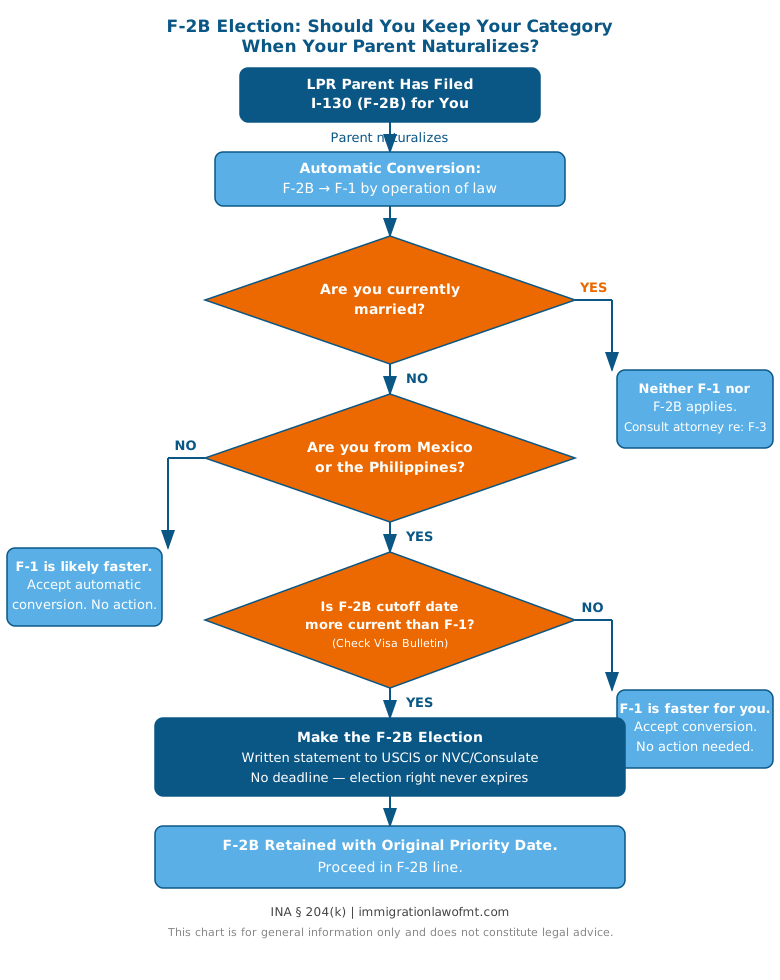
When that sponsoring parent later naturalizes and becomes a U.S. citizen, the law automatically converts the pending or approved I-130 from F-2B to F-1 — the category for unmarried sons and daughters of U.S. citizens. This happens by operation of law, without any filing or request. In most cases, F-1 moves faster than F-2B, so the conversion is genuinely good news.
But not always.
Why F-1 Is Not Always Better Than F-2B
The State Department publishes a monthly Visa Bulletin showing the priority date cutoffs for each preference category and each country. Demand for immigrant visas is not equal across countries. High-demand countries — particularly Mexico and the Philippines — have backlogs that can stretch for decades in some categories.
For applicants from these two countries, the F-1 backlog is often dramatically longer than the F-2B backlog. A family from Mexico might find that their F-2B priority date is current — or close to it — while the F-1 cutoff for Mexico is ten or fifteen years behind. Accepting the automatic conversion to F-1 would push them back to the end of a far longer line.
Congress anticipated this problem when it created the election right.
The F-2B Election: Keeping Your Original Category and Priority Date
Under INA § 204(k), the petitioner or the beneficiary may elect to retain F-2B classification rather than accept the automatic conversion to F-1. When the election is made, the original F-2B priority date is preserved. The applicant continues forward in the F-2B line exactly where they were.
There Is No Deadline for the Election
This is the detail that surprises most people. The election can be made at any time — there is no statutory or regulatory deadline. You do not have to decide at the moment of your parent’s naturalization. The election can be made:
- At or shortly after naturalization
- When the priority date becomes current in the Visa Bulletin
- When filing Form DS-260 (consular processing) or Form I-485 (adjustment of status)
- Even at the consular interview or adjustment of status interview, if it has not been addressed earlier
USCIS policy confirms that the election is not time-barred. If you missed the moment of naturalization, the right has not expired.
How the Election Is Made
There is no separate USCIS form for this election. It is made by written statement, submitted to USCIS (for adjustment of status cases) or to the National Visa Center and the consulate (for consular processing cases). The election should be clearly stated in the cover letter accompanying the immigrant visa application package or the adjustment of status filing. Once noted, the record is annotated to reflect F-2B classification and the original priority date is applied.
One Caveat: Marriage Changes Everything
Both F-1 and F-2B require the beneficiary to be unmarried. If the beneficiary marries after the petitioning parent naturalizes, they fall out of both categories entirely. The petition does not automatically move to F-3 (married sons and daughters of U.S. citizens). A new I-130 would need to be filed, and the F-3 line starts fresh from the new filing date. For heavily backlogged countries, this can represent a loss of many years.
If you are in a relationship and marriage is a possibility, discuss timing with an attorney before the wedding.
The Practical Bottom Line
For most applicants from most countries, F-1 is faster and the election is unnecessary. But for unmarried adult children from Mexico or the Philippines, the F-2B election is one of the most valuable and underused tools in family immigration law. It exists because Congress recognized that “upgrade” is not a universal truth.
If your parent has recently naturalized — or is planning to — and you have an I-130 pending as an unmarried adult child, it is worth looking at the current Visa Bulletin side by side with your home country’s F-1 and F-2B cutoffs before you accept any conversion. The election window never closes, but making the right choice at the right time can matter significantly.
Our firm handles family immigration matters throughout Montana and the Rocky Mountain West, including F-2B election strategy and consular processing cases. If you have questions about how your parent’s naturalization affects your case, we are available for a consultation