Strategic E-2 visa guidance for Canadians seeking business opportunities and freedom of movement in the United States
Understanding the E-2 Treaty Investor Visa
The E-2 Treaty Investor visa allows nationals of treaty countries like Canada to invest in and direct businesses in the United States. With 29 years of immigration law practice and extensive experience helping Canadian entrepreneurs, we understand that the E-2 visa is far more than just a “business visa”—it’s a strategic tool for business expansion, family immigration, and cross-border freedom.
This comprehensive guide covers both the fundamental requirements for E-2 visas and the sophisticated strategies that make them work for real Canadian businesses and families.
Part 1: E-2 Visa Fundamentals
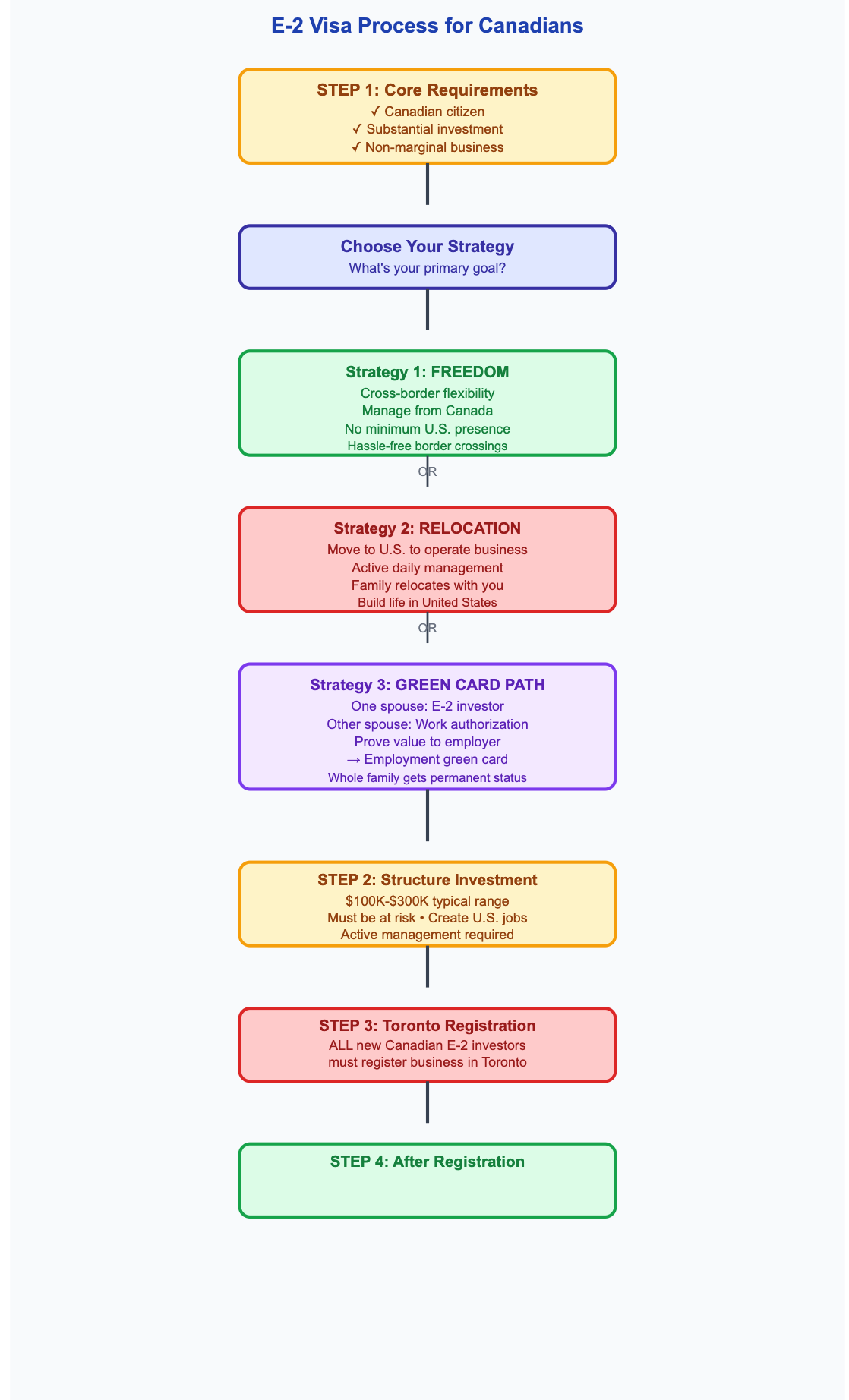
The Four Core E-2 Requirements
To qualify for an E-2 visa, you must meet four essential requirements:
1. Treaty Country National
You must be a national of a country with which the United States maintains a treaty of commerce and navigation. Canada has had this treaty relationship since 1990, making Canadian citizens eligible for E-2 visas.
2. Substantial Investment
You must have made a substantial investment in a bona fide U.S. business. “Substantial” is deliberately undefined in the regulations, giving consular officers discretion. In practice:
- Investment amounts vary widely based on business type and total cost
- Under $100,000: Possible for service businesses with solid business plans
- $100,000-$300,000: Most common range for small businesses and franchises
- $300,000+: Larger operations, technology businesses, significant expansions
The key is proportionality—your investment must be substantial relative to the total cost of the business.
3. Non-Marginal Business
The business must generate significantly more income than just supporting you and your family. It must have the capacity to make a significant economic contribution, typically demonstrated by:
- Creating jobs for U.S. workers
- Generating substantial business revenue
- Contributing meaningfully to the U.S. economy
4. Develop and Direct
You must be coming to the United States to develop and direct the enterprise. This is where many people misunderstand the E-2 visa—you don’t need to run the day-to-day operations. Your role is strategic:
- Develop: Grow and improve the business
- Direct: Make key business decisions and oversee operations
- NOT: Necessarily make sales, fulfill orders, or handle daily tasks
What Qualifies as an E-2 Investment
Successful Investment Types:
- Starting new U.S. business operations
- Purchasing existing businesses you’ll actively improve
- Expanding Canadian operations into the U.S.
- Franchise operations with active management
What Doesn’t Qualify:
- Pure real estate investments without active business operations
- Passive investments managed entirely by others
- Silent partnership arrangements
- Businesses where you have no meaningful management role
The Application Process for Canadians
Step 1: Make the Investment
The investment must be committed and at risk before applying. This means funds are irrevocably committed to the business, not merely deposited in a bank account.
Step 2: Toronto Consulate Registration
All new Canadian E-2 investors must register their business through the U.S. Consulate in Toronto. This establishes the company as a qualifying E-2 enterprise and creates the “registration” that allows future employees and renewals.
Step 3: Prepare Business Documentation
- Comprehensive business plan (typically 5 years)
- Financial projections and analysis
- Investment documentation
- Job creation evidence
- Market analysis
Step 4: Visa Interview
After Toronto reviews and approves the registration, you’ll be scheduled for an interview. The consular officer will evaluate whether your business meets E-2 requirements.
E-2 Status Duration and Renewal
Initial Period: E-2 visas for Canadians are typically issued for 2-5 years
Renewals: E-2 visas can be renewed indefinitely as long as:
- The business remains viable and operational
- You continue meeting E-2 requirements
- The business remains non-marginal
No Minimum U.S. Presence Required: Unlike permanent residents, E-2 holders have no specific requirement to spend a minimum amount of time in the United States.
Part 2: Strategic E-2 Applications for Canadian Success
Now that you understand the basics, let’s explore how smart Canadians actually use E-2 visas to achieve specific goals beyond simple business operations.
Strategy 1: Freedom of Movement Without Relocation
The Reality: You don’t need to live in the United States to maintain E-2 status. This creates unprecedented flexibility for cross-border business operations.
How It Works:
- Establish or invest in a U.S. business
- Hire U.S. citizens to handle day-to-day operations
- Focus your role on “developing and directing”
- Cross the border freely for business oversight
- Manage primarily from Canada if preferred
Real-World Application: One of our Calgary clients obtained an E-2 visa and continues managing his business primarily from Canada. He told us the visa made crossing the border dramatically easier—the hassle-free entry alone made it worthwhile for his cross-border operations.
Why This Works: Once you have an E-2 visa, you move out of the “suspect class” for CBP inspection. Instead of facing questions about unauthorized work, immigrant intent, or business activities, you’re a known quantity with legitimate documented business purposes.
Perfect For:
- Custom combine operators working seasonally across borders
- Contractors expanding into U.S. markets
- Trucking companies with cross-border operations
- Oil and energy investors with border-adjacent projects
- Any Canadian business owner tired of CBP questioning
Business Examples We’ve Handled:
- Coin-operated laundries: Daily oversight while living in Canada
- Small trucking operations: 2-3 vehicles with U.S. employees driving
- Border-adjacent service businesses: Regular visits without relocation
Strategy 2: The Spouse Employment Authorization Green Card Pathway
The Sophisticated Strategy: While one spouse invests in the business and gets the E-2 visa, the other spouse obtains work authorization to work for any U.S. employer—creating a strategic pathway to employment-based permanent residency.
How This Strategy Works:
- Investment Spouse: Gets E-2 visa as principal treaty investor
- Working Spouse: Receives work authorization (Form I-765) as E-2 derivative dependent
- Proof of Value: Working spouse demonstrates productivity to U.S. employer
- Employment Sponsorship: Employer sponsors family for employment-based green cards
Why Employers Agree: U.S. employers won’t spend $20,000+ on green card sponsorship for an unknown worker. But once an employee proves they’re productive beyond their salary, employers will often agree to a quid pro quo: “I’ll sponsor your green card, but you must work for me for 3 years after approval.”
This arrangement makes business sense for employers—they’ve already seen the worker’s value and are now investing in retention rather than gambling on an unknown foreign national.
Perfect For: Canadian couples where:
- One spouse has significant investment capital
- Other spouse has marketable skills (engineering, IT, healthcare, specialized trades, technology)
- The family wants a pathway to permanent U.S. residency
- Both spouses can contribute to the immigration strategy
The Long-Term Benefit: Employment-based green cards provide permanent residency for the entire family, not just the sponsored employee. This converts the E-2 investment into a bridge to permanent status.
Strategy 3: Low-Maintenance Investment for Lifestyle Goals
The Reality: Not every E-2 business needs to be a growth venture. Some of our most successful clients invest in simple, predictable operations.
Examples That Work:
- Coin-operated laundries: Perfect for retirees wanting year-round U.S. residence without demanding daily management
- Small trucking operations: Owner-operators expanding from Canada with $150,000-$200,000 investments
- Service businesses: Operations you can oversee without daily presence
Investment Reality Check:
Despite internet claims of strict minimums, we’ve secured approvals for under $100,000 when the business concept demonstrates:
- Genuine development potential
- Job creation for U.S. workers
- Active rather than passive management
- Sound business fundamentals
However, context matters. For trucking operations, given current equipment costs (quality used tractor-trailers run around $60,000), $150,000-$200,000 is more realistic—you need equipment plus operating reserves.
What Consular Officers Really Reject: A client with a $20 million AirBnb portfolio managed entirely by property management companies was rejected despite the massive investment. Why? No genuine ability to “develop and direct”—just passive rental income with hired managers doing all the work.
The Key Distinction: Active management capability matters more than investment amount. A $90,000 service business you actively direct will succeed where a multi-million dollar passive investment fails.
Strategy 4: Seasonal and Cross-Border Operations
Canadian Agricultural and Contractor Operations:
Many Canadian businesses naturally operate across borders or seasonally. E-2 visas accommodate these realities:
Agricultural Examples:
- Custom combining operations: Equipment moves across borders seasonally
- Seasonal contractors: Work both sides of the border as opportunities arise
- Agricultural equipment sales: Serving cross-border markets
Construction and Trade Examples:
- Home builders and contractors: Expanding to serve U.S. markets
- Specialized trades: Cross-border service provision
- Equipment operators: Seasonal U.S. projects
These businesses often benefit from E-2 structure because they need U.S. work authorization but not necessarily U.S. residency.
Family Benefits: Why E-2 Visas Are Immigration Gold
Spouse Work Authorization
E-2 spouses can work for any U.S. employer without restrictions—one of the most valuable benefits of the E-2 category.
How It Works:
- Spouse files Form I-765 with USCIS
- Receives Employment Authorization Document (EAD)
- Can work for any employer in any field
- No restrictions on type of employment
Strategic Value: This benefit alone often justifies the E-2 investment, especially when combined with the green card pathway strategy discussed above.
Children’s Education Rights
E-2 dependent children can:
- Attend U.S. public schools
- Enroll in private schools
- Attend colleges and universities
- Often qualify for in-state tuition after establishing residency
Children cannot work without separate authorization, but education rights provide significant family value.
Renewal Flexibility
Unlike many visa categories with strict time limits, E-2 visas can be renewed indefinitely as long as:
- The business remains viable
- You continue meeting treaty investor requirements
- The business stays non-marginal
There’s no maximum number of renewals—E-2 status can effectively last as long as your business operates successfully.
The Consulate Process for Canadians
Toronto Registration: Required for New Investors
All new Canadian E-2 investors must complete initial registration through the U.S. Consulate in Toronto. This process:
- Establishes your business as a qualifying E-2 enterprise
- Creates the “registration” in the consular system
- Provides the foundation for future renewals and employee visas
Calgary and Other Consulates: Available After Registration
Once your business is registered in Toronto, renewals and employee applications can be processed at any Canadian consulate, including:
- Calgary (550 miles from our Montana office)
- Vancouver
- Montreal
- Ottawa
- Toronto
Strategic Advantage for Western Canadians: Alberta and British Columbia residents can handle most E-2 matters at nearby consulates rather than traveling to Toronto.
Change of Status Option
Some clients pursue E-2 change of status while already in the United States, then later process renewals through Canadian consulates. This approach requires careful strategic planning to avoid complications and ensure smooth transitions between U.S. and consular processing.
Common E-2 Mistakes to Avoid
Structuring Errors
Investment Documentation: Insufficient or unclear evidence of where investment funds came from and how they were committed.
Passive Structure: Attempting to qualify with businesses entirely managed by others without genuine development and direction role.
Incomplete Business Plans: Generic or inadequate business plans that don’t demonstrate non-marginal potential or market understanding.
Timing Mistakes
Premature Applications: Applying before investment is complete and at risk.
Status Gaps: Poor coordination between U.S. operations and consular processing leading to status problems.
Inadequate Preparation: Rushing to establish business without proper structure and documentation.
Family Planning Oversights
Unused Work Authorization: Not maximizing spouse employment authorization opportunities.
Missed Education Benefits: Failing to take advantage of children’s education rights in U.S. schools.
No Long-Term Strategy: Treating E-2 as endpoint rather than potential bridge to permanent residency.
E-2 vs. Other Business Immigration Options
E-2 Advantages Over L-1 Intracompany Transferee Visas
- No requirement to operate business in Canada first
- No 1-year employment history requirement
- More flexible business structures
- Spouse gets unrestricted work authorization
E-2 Advantages Over EB-5 Investment Immigration
- Much lower investment requirements ($100K+ vs. $800K-$1.05M)
- Faster processing times
- More hands-on business involvement allowed
- Less regulatory complexity
E-2 Advantages Over H-1B Professional Employment
- No annual caps or lottery system
- Spouse gets work authorization
- Renewable indefinitely
- More control over your own business operations
When Other Options May Be Better
TN Visas: If you’re employed by a U.S. company in a NAFTA professional category, TN status may be simpler Employment-Based Green Cards: If you have extraordinary ability or advanced degree, direct permanent residency may be available EB-5: If you have capital and want guaranteed permanent residency path
Your E-2 Strategy Consultation
Every successful E-2 case starts with understanding your specific goals and circumstances. During our strategy consultation, we explore:
Business Goals Analysis
- Business expansion or lifestyle change?
- Active daily management or strategic oversight?
- S. relocation or cross-border flexibility?
- Short-term business goals or long-term immigration strategy?
Investment Planning
- What business opportunity makes sense for your investment capacity?
- How should we structure the investment for optimal immigration benefits?
- What documentation will maximize approval chances?
- How do we demonstrate non-marginal economic contribution?
Process Strategy
- Should we pursue initial change of status or consular processing?
- What’s the optimal timing for your situation?
- How do we coordinate business establishment with visa processing?
Family Immigration Planning
- How can your spouse maximize work authorization benefits?
- What education opportunities exist for your children?
- What’s your long-term pathway to permanent residency?
- Should we plan for eventual employment-based green cards?
Why Choose Immigration Law of Montana for Your E-2 Case
Cross-Border Expertise
Located 550 miles from Calgary, we understand the unique needs of Canadian businesses operating across borders. We’re familiar with Canadian documentation, banking systems, and business structures.
Real-World Experience
Our 29 years of practice includes extensive E-2 experience across industries:
- Trucking and transportation
- Agricultural operations
- Service businesses
- Technology ventures
- Energy investments
- Franchise operations
Strategic Immigration Planning
We don’t just get you the visa—we plan your entire immigration strategy from E-2 through potential permanent residency, including:
- Spouse employment authorization maximization
- Long-term green card pathways
- Family benefit optimization
- Business structure for immigration success
Practical, Results-Oriented Approach
Our focus is on what actually works in practice, not just what regulations theoretically allow. We understand:
- What CBP really questions at the border
- What consular officers actually approve
- How to structure investments for success
- When creative strategies make sense vs. traditional approaches
Ready to Explore Your E-2 Options?
The E-2 visa offers Canadian entrepreneurs unprecedented flexibility for business investment, family immigration, and cross-border operations. Whether you’re seeking hassle-free border crossings, business expansion opportunities, spouse work authorization, or a strategic pathway to permanent residency, we can help structure an E-2 investment that achieves your specific goals.
Contact us today for your E-2 strategy consultation. We’ll analyze your business objectives, investment capacity, and immigration goals to create a comprehensive plan that works in the real world.
Call 406-373-9828 or schedule your consultation online.
Immigration Law of Montana has guided dozens of Canadian families through successful E-2 investments, from small trucking operations to major business expansions. With 29 years of exclusive immigration law practice, we bring practical experience and strategic thinking to every E-2 case.