Your I-94 shows an admission date from two years ago. You filed an extension with USCIS — but you filed it six weeks after the expiration date. The extension was approved. You have a valid status stamp in your passport. What you may not realize is that for those six weeks between your I-94 expiration and the date USCIS received your late filing, you were accruing
unlawful presence — a technical immigration violation that has nothing to do with criminal law and everything to do with your future ability to enter the United States. If you leave the country and have accrued enough of it, you may face a three-year or ten-year bar to reentry before you cross the border home.
Unlawful presence is one of the most consequential and least understood concepts in U.S. immigration law. It is not an accusation. It is not a finding of wrongdoing. It is simply a clock — and once it starts running, it does not stop until you leave. This page explains how it works, when it starts, who is most at risk, and what options exist if you have already accrued it.
What Unlawful Presence Actually Means
The term comes from INA § 212(a)(9)(B), the section of the Immigration and Nationality Act that establishes the grounds of inadmissibility for unlawful presence. The statute defines two categories of people who accrue unlawful presence:
Those who were never admitted or paroled. If you entered the United States without inspection — crossed the border without going through a port of entry — you began accruing unlawful presence from the moment you entered.
Those who were admitted lawfully but whose authorized period of stay expired. This is the more common situation. You entered legally on a visa, you were admitted by Customs and Border Protection, and at some point your authorized period of stay ended — either because your I-94 expiration date passed, or because you fell out of compliance with the conditions of your status.
What unlawful presence is not: it is not the same thing as being out of status. Those two concepts overlap, but they are not identical. You can be out of status — meaning you have violated a condition of your visa — without necessarily accruing unlawful presence. The distinction matters, and we return to it below.
The Two-Number Rule: 180 Days and One Year
Congress established two thresholds that trigger mandatory bars to reentry. Both bars are activated at the moment of departure from the United States — not while you are still here.
The three-year bar: If you accrue more than 180 days but less than one year of unlawful presence — and then depart voluntarily — you are barred from returning to the United States for three years from the date of departure.
The ten-year bar: If you accrue one year or more of unlawful presence — and then depart voluntarily — you are barred from returning for ten years from the date of departure.
There is also a permanent bar for people who depart after more than one year of unlawful presence and then attempt to reenter illegally, but that scenario is beyond the scope of this discussion.
The critical phrase in both provisions is “voluntarily departs.” If you are removed or deported, separate bars apply. The unlawful presence bars are specifically for people who leave on their own — often without knowing that their departure activates a consequence they cannot undo at the airport.
This is the architecture of the problem. You might leave the United States in good faith — to visit family, attend a funeral, renew a visa — and discover at the border that you cannot come back for three or ten years. The bar activates at departure. You cannot see it while you are standing in the United States.
How Unlawful Presence Starts Accruing — And Why It Is Not Always Obvious
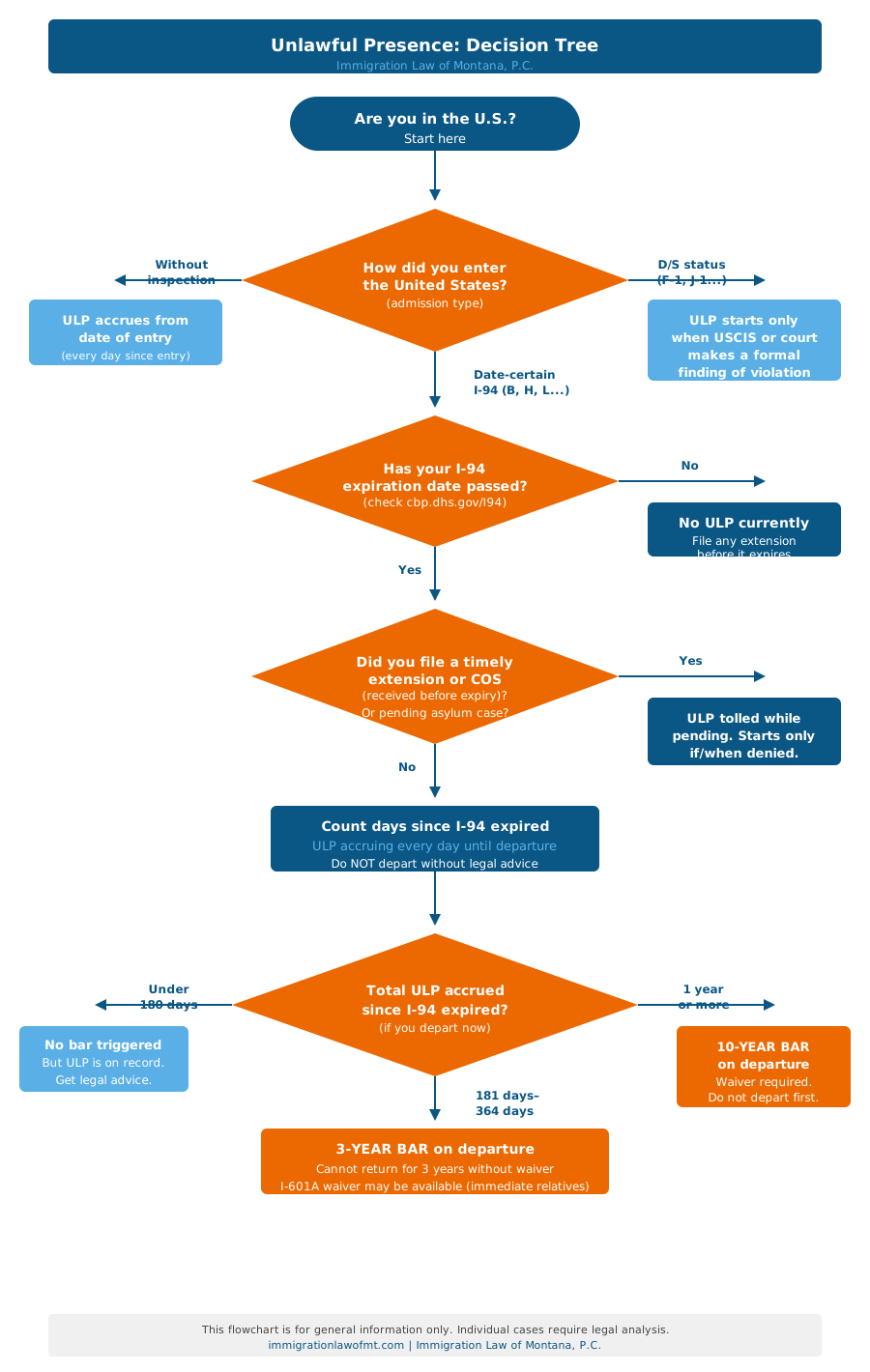
The most dangerous misconception about unlawful presence is that it starts when someone “overstays.” That framing is too simple. The actual mechanics depend on what kind of admission you received.
Date-Certain Admission: The I-94 as a Countdown Clock
Most nonimmigrant visa holders — B-1/B-2 visitors, H-2A agricultural workers, H-1B professionals, L-1 intracompany transferees, and others — are admitted for a specific date. That date appears on the I-94 arrival/departure record, which since 2013 has been maintained electronically at CBP’s I-94 portal. The day after that date, unlawful presence begins to accrue. It accrues every single day — weekends, holidays, and even days when USCIS is closed — until the person departs.
If you have a date-certain I-94 and you do nothing about it before it expires, the math is simple. The clock starts the day after your authorized stay ends. If you are 181 days or more past that date when you leave, the three-year bar activates. If you are at one year, the ten-year bar activates.
Duration of Status: A Different Set of Rules
A different class of nonimmigrant visa holders — primarily F-1 academic students, J-1 exchange visitors, and their dependents — are admitted for “duration of status,” commonly written as “D/S” on the I-94. This designation means they are authorized to remain as long as they maintain the conditions of their status: attending school full-time, pursuing the program objectives, and so on.
For D/S holders, unlawful presence does not begin to accrue automatically when they violate a condition of their status. Under longstanding USCIS policy — confirmed by federal courts that blocked a 2018 agency attempt to change this rule — unlawful presence for D/S holders begins only when:
(a) An immigration judge issues a decision finding the person deportable or removable, or
(b) USCIS formally denies an application or petition and determines, in that denial, that the person had no lawful status.
This distinction has significant practical consequences. An F-1 student who drops below full-time enrollment without authorization is out of status — and may face consequences related to that — but has not necessarily accrued unlawful presence that would trigger the reentry bars. The bars are triggered at the moment of a formal finding, not the moment the violation occurred.
The Critical Role of Timely Filing
For date-certain visa holders, there is a protective rule that many people do not know exists — and a trap that catches people who know about the rule but do not apply it correctly.
If you file a timely extension of stay or change of status — meaning your application reaches USCIS before your I-94 expiration date — unlawful presence does not accrue while that application is pending. If the application is approved, no unlawful presence accrued during the pendency. If the application is denied, unlawful presence begins accruing from the date of the denial, not retroactively from the I-94 expiration date.
The trap: This tolling protection applies only if the filing was timely. If your I-94 expired on a Monday and your extension application reached USCIS on Tuesday, there is no tolling. Unlawful presence was already accruing from Monday. The approval of a late-filed extension cures your out-of-status problem going forward — it does not retroactively erase the unlawful presence that accrued between expiration and filing.
This is where we have seen real damage done to real clients. A paralegal is swamped. An employer misses the filing window. A petitioner assumes that mailing the application a week before expiration is the same as USCIS receiving it before expiration. It is not. Timely means received — not postmarked, not sent. If there is any doubt about whether a filing was timely, that question needs to be investigated before the client travels internationally.
H-2A and Employment-Based Applicants: A Narrower Path
For H-2A agricultural workers and others in employment-based nonimmigrant status, the date-certain I-94 rules apply in full. H-2A workers are admitted for the duration of a specific job order — typically a season — and their authorized period of stay ends when that job order period concludes, usually with a ten-day grace period for departure built into the regulations.
If an H-2A worker overstays and then seeks to adjust status to permanent residence — or return to the United States on a future visa — unlawful presence accrued during that overstay will be a direct obstacle.
The 245(k) Exception for Employment-Based Adjustment
The Immigration and Nationality Act contains one specific provision — INA § 245(k) — that provides limited relief for employment-based adjustment of status applicants who have accrued unlawful presence. Under 245(k), a person may adjust status despite having been out of authorized status or accruing unlawful presence, provided the total period of such violations since their last admission does not exceed
This is the only statutory waiver mechanism available to employment-based applicants who have accrued unlawful presence and are seeking to adjust without departing. It is not a discretionary waiver for hardship. It is a statutory ceiling: either you are under 180 days or you are not.
Notably, 245(k) does not apply to family-based adjustment of status. An immediate relative of a U.S. citizen who has accrued unlawful presence and is adjusting status within the United States is not protected by 245(k) — though they may benefit from separate provisions applicable to immediate relatives. This is a distinction that matters and is frequently misunderstood.
Asylum Applicants and the Pending Case Exception
Filing an asylum application with USCIS or having a case pending before an immigration judge provides a significant — though not unlimited — protection from unlawful presence accrual.
Under 8 CFR § 208.4, unlawful presence does not accrue during any period when a properly filed asylum application is pending with USCIS. However, this protection has a condition: the application must have been filed within one year of the applicant’s last arrival in the United States, unless an exception to the one-year filing bar applies.
The one-year filing bar is its own complex topic, but the basic structure is this: an asylum applicant who missed the one-year deadline may still be eligible if they can demonstrate changed circumstances that materially affect their eligibility, or extraordinary circumstances related to the delay. If neither exception applies and the application is filed late, the asylum court may still grant withholding of removal or protection under the Convention Against Torture — but the unlawful presence accrual issue is not resolved in the same way.
For people who are lawfully in H-2A or other nonimmigrant status and then develop a fear of return, the timing question is particularly important. The one-year clock runs from the date of last arrival, not from the date status expires. An H-2A worker who has been here for three years and whose status is expiring may still be within the asylum filing window if they arrived less than a year ago — but this requires careful analysis of the facts.
Canadian Citizens: Different Rules at the Border
Canadian citizens occupy a distinct and often poorly understood position in U.S. immigration law, including with respect to unlawful presence.
As a practical matter, most Canadians who enter the United States as visitors — whether for tourism, business, or family visits — do so without receiving a paper I-94. Until relatively recently, CBP routinely waved Canadian visitors through land ports of entry with a brief inspection and no stamped document. This created a documentation problem: when did the visit begin, and how long is it authorized?
The longstanding CBP practice is that Canadian visitors entering without a specific nonimmigrant visa are admitted for up to six months from the date of entry. But if there is no record of that entry date, establishing when unlawful presence began — and whether it reaches the 180-day or one-year threshold — requires reconstructing the entry date from other evidence: cell phone records, bank transactions, employment records, and similar documentation.
Canadians who enter on specific nonimmigrant classifications — TN status for NAFTA/USMCA professionals, H-1B, L-1, or other categories — do receive date-certain I-94s, and the standard unlawful presence rules apply to them just as they apply to any other nonimmigrant.
For Canadian nationals who have accrued unlawful presence and are subject to the three-year or ten-year bar, the waiver process is the same as for any other nationality. There is no nationality-based exemption from the bars themselves. However, Canadians who are inadmissible to the United States for unlawful presence or other grounds may also find themselves
inadmissible to Canada if they have a removal order or certain other immigration violations on their record — a complication we frequently navigate for clients who have cross-border family and work situations.
The Bars in Practice: What Happens When You Leave
The bars do not announce themselves. There is no letter from USCIS informing you that you have accrued 200 days of unlawful presence and should not travel. The entire system is self-executing: you leave, the bar attaches, and you discover the problem when you attempt to return or when you apply for a visa at a consulate.
At the consular interview, the officer will ask about previous periods of unlawful presence. Disclosing the truth is legally required and strategically necessary — consular officers have access to USCIS records and CBP arrival/departure data. Attempting to conceal a period of unlawful presence at a consular interview creates an additional ground of inadmissibility for misrepresentation, which is a much harder problem to solve.
The practical consequence of the ten-year bar is that a person who has accrued more than a year of unlawful presence and then departs cannot return to the United States for ten years unless they obtain a waiver. That means ten years separated from a U.S. citizen spouse, ten years away from a U.S. citizen child, ten years outside the job market they have built. The stakes are not abstract.
The I-601A Provisional Unlawful Presence Waiver
For immediate relatives of U.S. citizens — spouses, children, and parents — there is a waiver mechanism that allows the unlawful presence bar to be addressed before the person departs the United States. This is the Form I-601A provisional unlawful presence waiver, and it is one of the most consequential immigration tools for families in this situation.
The I-601A waiver requires demonstrating extreme hardship to a qualifying U.S. citizen or lawful permanent resident spouse or parent. The standard is not whether leaving will be inconvenient — it is whether the hardship to the U.S. family member rises to the level Congress intended when it created this limited safety valve. Our office has significant experience with these cases; they require careful factual development and are not appropriate as a DIY project.
Approval of the I-601A does not eliminate the need to depart and attend a consular interview abroad. It means that the consular officer reviewing the immigrant visa application will have a pre-approved waiver in hand. The timeline is significantly shorter than applying for a waiver after departure, and the applicant has far more certainty before they leave U.S. soil.
Common Mistakes That Create Unlawful Presence
After nearly three decades of practice, a few patterns recur with enough frequency to be worth naming directly.
Filing an extension late and assuming approval cures everything. An approved extension cures the out-of-status problem going forward. It does not retroactively eliminate unlawful presence accrued between the I-94 expiration and the receipt date of the late filing. If there is any gap between expiration and timely receipt, that gap is unlawful presence.
Relying on a paper I-94 that was never reconciled with CBP. Travelers sometimes receive a paper I-94 at an older land port of entry. That document may not appear in CBP’s electronic system, or it may reflect an inaccurate date. Before any international travel, verify your I-94 record at the CBP portal and confirm that what you believe your status to be matches what the government’s records actually show.
Assuming D/S status means indefinite authorization. Duration of status does not mean “forever.” It means “for as long as you comply with the terms of your status.” An F-1 student who has graduated and whose OPT has ended is no longer in a period of authorized stay — even if no one has formally notified them of this.
Changing employers without filing an amended petition. H-1B workers in particular face this issue. A material change in employment terms — a different work location, a different job title, a new employer — requires an amended or new H-1B petition. Operating under outdated petition terms can create a status violation that eventually triggers an unlawful presence finding.
Not understanding what “authorized stay” means for Canadian visitors. A Canadian who enters the United States for what they intend to be a six-month visit and then extends it informally — driving back to Canada and returning the next day to “reset” the clock — is not necessarily re-starting an authorized period of stay. CBP has the authority to deny admission or admit for a shorter period if they determine the visitor is not maintaining a bona fide foreign residence.
If You Think You May Have Unlawful Presence
If you are reading this page because you are uncertain about your own situation, the most important thing is this: do not make any international travel decisions until you have a clear picture of where you stand. see:When Refugee and Asylum Law Intersect
The calculation is not always simple. Tolling periods, timely filings, pending asylum applications, and D/S status determinations all interact in ways that are not obvious from a calendar review. A period that looks like ten months of unlawful presence may actually be protected. A period that looks clean may have a gap hiding in the CBP records.
We have helped clients navigate unlawful presence issues across a range of contexts — from H-2A agricultural workers to employment-based adjustment applicants to Canadian families with cross-border ties. If you have a question about your specific situation, contact our office to discuss it before you book a flight.
Contact Immigration Law of Montana, P.C. — Billings, Montana — serving the Rocky Mountain West and Western Canada.