• Skip to main content
  • Skip to footer

Immigration Law of Montana

Christopher J. Flann, Attorney

406-373-9828
  • Make an Appointment
  • Client Log In
  • Home

Immigration Law of Montana

  • About
    • Christopher Flann, Attorney
    • Collette Layton, Legal Assistant
    • Rockwell “Rock” Hinkle, Legal Assistant
    • ILM Scholarships
    • Reviews and Testimonials
    • Gabriela Veroes Legal Assistant
    • Maryangel Aguilera Legal Assistant
    • Fidel Villegas, Legal Assistant
    • Gabriel Chávez, Legal Assistant
    • Erwin Noguera, Legal Assistant
  • US Citizenship
    • Citizenship through Adoption
    • Citizenship through Naturalization
    • Citizenship through Military
    • Derivative US Citizenship
  • Green Cards
    • Adjustment of Status
    • Asylee Green Card
    • Conditional Green Card Renewal
    • Employment Based Green Card
    • Consular Processing
    • Family Based Green Card
    • Green Card for Religious Worker
    • Green Card through Marriage
    • Green Card through Refugee or Asylee Status
    • Parole in Place Green Card
    • Green Card Renewal
    • Humanitarian Green Card
    • Refugee Green Card
    • Sheepherder Green Card
    • Marrying an Illegal Immigrant
    • For American Indians Born in Canada
    • Special Immigrant Visa
    • When Your LPR Spouse Dies
    • When Your USC Spouse Dies
    • Derivative Beneficiaries When Petitioners Die
  • Immigration Guides
    • Immigration for Employers
    • Immigration for Investors
    • Immigration for Farmers and Ranchers
    • Immigration for Religious Organizations
  • US Visas
    • The B-2 Visitor Visa: A Practical Guide
    • B-1 Visa Montana North Dakota Wyoming
    • E-1 Visa Treaty Trader Montana North Dakota Wyoming
    • E-2 Visa Treaty Investor Montana Wyoming North Dakota
    • H-1B Visa Montana North Dakota Wyoming
    • E-3 Visa Montana North Dakota Wyoming
    • H-2A Visa Montana North Dakota Wyoming
    • H-2B Visa Montana North Dakota Wyoming
    • H-3 Visa Montana North Dakota Wyoming
    • K-1 Fiancé Visa Montana North Dakota Wyoming
    • K-3 Spouse Visa Montana North Dakota Wyoming
    • O-1 Visa for Artists, Scientists, Educators, Businesspeople and Athletes
    • P-3 Visa Montana North Dakota Wyoming
    • R-1 Visa Montana North Dakota Wyoming
    • TN Visa Montana North Dakota Wyoming
    • U Visa Montana North Dakota Wyoming
    • Change of Status: Montana, North Dakota, Wyoming
    • Visa Extension Extension of Stay
    • Process for US Visa Application Through Admission and Stay
    • Entry into United States
    • I-94 Admission Record
    • Volunteer Visa USA
    • Humanitarian Parole
    • Leaving the United States
  • Immigration Services
    • RFE Response Help in Montana: When Immigration Requests Can Be Fixed (And When They Can’t)
    • Apostille Services
    • Document Translation Services
    • Illegal Immigrant Arrested in Montana
    • Why A Strategy Consultation
  • Removal Defense
  • Service Area
    • Immigration Lawyer North Dakota
    • Immigration Lawyer Wyoming
  • Contact
  • Blog
  • English
    • Español
You are here: Home / Category Blog Page

Category Blog Page

The CDL Crackdown and Your E-2 Trucking Business: What the New Rules Actually Mean

March 2, 2026 by Admin-ILM

If you are a Canadian national who has received E-2 investor visa status to operate a trucking company in the United States, you have almost certainly seen the headlines. Fatal crashes. Senate hearings. An executive order on English proficiency. A proposed federal law named after a five-year-old girl who was catastrophically injured when an undocumented trucker lost control of his rig in California. The Trump administration’s campaign against unsafe foreign commercial drivers has been aggressive, and it is accelerating.

The natural question, if you hold an E-2 or are in the process of applying for one, is whether any of this touches you. The short answer is no — but understanding why requires a closer look at what the administration is actually targeting. The regulations are not directed at lawfully admitted investors operating businesses. They are directed at a specific and well-documented abuse: undocumented individuals and asylum applicants using Employment Authorization Documents to obtain commercial driver’s licenses without the immigration screening that any visa holder goes through as a matter of course.

This article explains each of the administration’s regulatory actions, identifies exactly what problem each one addresses, and explains why E-2 trucking entrepreneurs are structurally outside the target zone of every measure currently in effect or proposed.

What the Administration Has Actually Done

The regulatory response has unfolded in layers since early 2025. Each layer addresses a different piece of the same underlying problem.

Executive Order on English Proficiency — April 28, 2025

President Trump’s April 2025 Executive Order reactivated strict enforcement of English language proficiency requirements that were already on the books at the Federal Motor Carrier Safety Administration (FMCSA). The longstanding rule at 49 CFR § 391.11 requires commercial drivers to be able to converse with law enforcement, read English road signs, respond to official inquiries, and complete driver logs without assistance. A 2016 FMCSA memo had effectively neutered enforcement by advising inspectors not to place drivers out of service for language violations alone. That memo is now reversed.

Since June 2025, inspectors conducting roadside checks have been placing non-English-proficient drivers out of service immediately. Secretary Duffy subsequently directed that CDL written tests be administered in English only — closing a loophole that California and a handful of other states had used to allow testing in Spanish and other languages.

Emergency Action on Non-Domiciled CDLs

A non-domiciled commercial driver’s license is a CDL issued by a U.S. state to a person whose legal home — their domicile — remains in a foreign country. These licenses were designed primarily for cross-border truckers from Canada and Mexico who operate into the United States without establishing U.S. residence. The FMCSA launched a nationwide audit of non-domiciled CDL issuance and found systemic problems, most severely in California, where more than 25% of non-domiciled CDLs reviewed were improperly issued. In some cases, California had issued licenses that remained valid years after the holder’s lawful U.S. presence had expired.

Secretary Duffy issued an emergency rule restricting non-domiciled CDL eligibility to holders of employment-based visas and requiring states to query the Systematic Alien Verification for Entitlements (SAVE) system to confirm every applicant’s immigration status before issuing a license.

That emergency rule was stayed by the U.S. Court of Appeals for the D.C. Circuit in November 2025 pending further review. However, the Department of Transportation has since issued a final rule with the same requirements, which supersedes the stayed interim rule and takes effect 30 days after Federal Register publication.

Proposed Dalilah Law

Named after Dalilah Coleman, a young girl severely injured in a 2024 California crash caused by an undocumented trucker, the proposed Dalilah Law would prohibit any state from issuing a CDL to an undocumented immigrant. This bill has not been introduced in Congress and is not yet law. It would require legislation to take effect.

State Enforcement Actions

California, Washington, and New Mexico have received formal notices threatening suspension of federal Motor Carrier Safety Assistance Program funding if they do not demonstrate compliance with English language proficiency requirements. California faces additional scrutiny for its non-domiciled CDL practices. Illinois received a letter citing over a dozen cases of CDLs issued to drivers from Ukraine, Russia, and Venezuela whose lawful presence had expired or was never verified. These enforcement actions reflect the administration’s willingness to use federal funding leverage against non-compliant states.

The Core Problem the Administration Is Solving

To understand why none of this affects E-2 investors, you need to understand what problem these measures are designed to fix. The administration’s stated concern, supported by FMCSA audit findings, involves three overlapping failures:

  • The EAD loophole — An Employment Authorization Document proves work authorization but does not prove that the holder entered the United States legally, passed any consular screening, or has a verifiable driving record in their home country. Asylum applicants — many of whom arrived without inspection or with no prior visa — could present an EAD to a state DMV, take a CDL test (sometimes in their native language), and receive a commercial license to operate an 80,000-pound vehicle, without any immigration background check.
  • Non-domiciled CDL abuse — Some states, particularly California, issued non-domiciled CDLs to individuals whose lawful presence had already expired, effectively creating a class of commercial drivers with no current legal status and no ability to be verified against U.S. or foreign driving records.
  • No foreign driving record access — Unlike U.S. citizen applicants, states have no ability to query foreign driving records. An individual from India or Venezuela with a history of serious traffic violations could obtain a U.S. CDL with a clean slate simply because there is no data pipeline between U.S. DMVs and foreign motor vehicle authorities.
Every measure in the administration’s CDL crackdown is aimed at this specific pathway: unauthorized or insufficiently screened individuals using EADs or expired status documents to obtain commercial licenses without the background scrutiny that any visa applicant receives as a matter of course. An E-2 investor passed through that scrutiny before ever setting foot in the United States.

Why E-2 Trucking Investors Are in a Different Category

Domicile: The Most Important Distinction

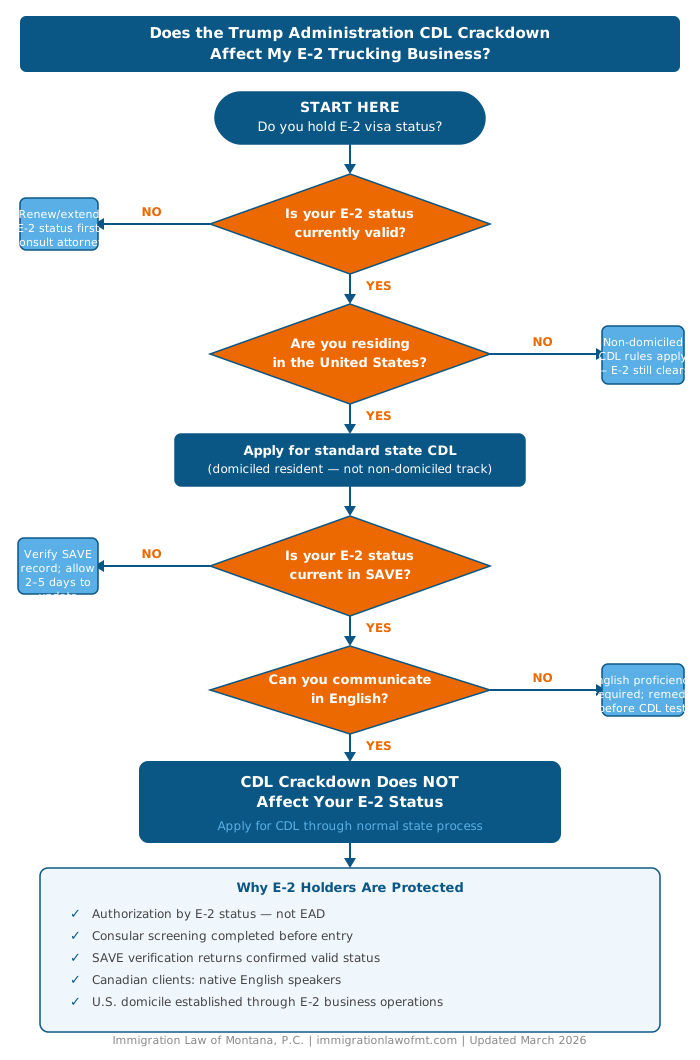
The non-domiciled CDL framework is the source of most of the administration’s enforcement activity. A non-domiciled CDL is issued to someone whose legal home remains abroad. Once you have established residence in the United States — which your E-2 business investment requires — you are domiciled here and apply for a standard state CDL through the same process as any U.S. resident. You never enter the non-domiciled framework at all.

E-2 status requires the investor to be present in the United States to develop and direct the enterprise. In practice, this means establishing a U.S. address, leasing or purchasing business premises, and building the operational infrastructure that USCIS will scrutinize in any extension or status review. An E-2 trucking investor who is genuinely operating their business is by definition domiciled in the United States.

Authorization by Status, Not by EAD

The EAD loophole exists because an Employment Authorization Document can be issued to people across a very wide range of immigration statuses — including asylum applicants who may have entered without inspection and have no verifiable prior history. An E-2 visa holder’s work authorization is not derived from an EAD. It is inherent in the E-2 status itself. Your authorization to work in the United States — specifically, to direct your E-2 enterprise — comes from the visa stamp in your passport and the I-94 record confirming your admission.

When a state DMV runs a SAVE query on your CDL application (as the new rules require), the query does not return an ambiguous result tied to a pending asylum claim. It returns confirmation of a valid, employment-based nonimmigrant status issued through consular processing. That is exactly the result the new rules are designed to produce.

Consular Screening

Every E-2 applicant — whether applying at the U.S. Consulate in Calgary, Vancouver, or Saskatoon — goes through a structured review before the visa is issued. The consular officer examines the investment, the business plan, the investor’s background, and confirms that the treaty investor qualifies under the Canada–U.S. treaty relationship. Biometrics are collected. Background checks are run. The officer exercises discretionary judgment about whether to issue the visa.

This is the screening that the CDL enforcement measures are trying to replicate on the back end for people who bypassed it on the front end. E-2 investors did not bypass it. They went through it.

English Proficiency

Your Canadian clients are native English speakers. The English language proficiency requirements — whether at the roadside inspection, the CDL written test, or the logbook completion standard — are non-issues.
One Situation Worth Monitoring: The Setup Phase

There is one scenario where a Canadian E-2 investor might briefly intersect with the non-domiciled CDL framework, and it is worth flagging even though it is fully resolvable.

During the initial setup phase of the trucking business — particularly if the investor is commuting between Alberta and Montana or spending significant time establishing operations while not yet having fully relocated — a state CDL office might classify them as non-domiciled if they cannot yet demonstrate established U.S. residence. Under the new rules, non-domiciled CDL applicants must hold an employment-based visa (E-2 qualifies) and clear a SAVE verification (which will confirm valid status).

In practice, this means the E-2 investor clears both requirements with no difficulty. The E-2 visa is explicitly an employment-based nonimmigrant visa. The SAVE query returns a clean, confirmed status. The investor gets the CDL.

Where you need to be careful as the attorney is ensuring that the investor’s E-2 status is current and correctly reflected in SAVE before they apply for the CDL. SAVE works off USCIS and CBP databases. An investor who recently extended their status or received a new I-94 should verify that the SAVE record is updated before the CDL application goes in. A mismatch between the investor’s documents and the SAVE record — even a temporary one — can cause delays at the DMV that are frustrating but not permanent.

What This Means Practically for Your Business

If you are an E-2 investor already operating a U.S. trucking company, no regulatory change currently in effect or proposed requires any action on your part with respect to your CDL eligibility. The rules that are tightening are not the rules that govern your situation.

What the crackdown does affect is the market you operate in. With thousands of improperly licensed truckers being sidelined — FMCSA estimates the enforcement actions could affect more than 194,000 CDL holders — demand for qualified drivers is increasing and driver compensation is rising in high-enforcement states. An E-2 trucking company with properly documented, English-proficient drivers and clean FMCSA compliance records is positioned to pick up freight contracts from carriers whose fleets are being audited.

The enforcement environment also means that FMCSA roadside inspections are more frequent and more likely to include a SAVE verification component for drivers who are foreign-born. Making sure your drivers’ work authorization documents are current, correctly reflected in SAVE, and readily available during inspections is basic compliance hygiene that was always good practice and is now more important.

A Note on the Proposed Dalilah Law

The proposed Dalilah Law has received significant press coverage because President Trump mentioned it by name in his February 2026 State of the Union address. It would ban states from issuing CDLs to undocumented immigrants — people who have no lawful immigration status whatsoever. This has no application to E-2 visa holders, who hold nonimmigrant status issued by the State Department through a formal consular process.

As of this writing, the Dalilah Law has not been introduced as legislation in Congress. It is a policy proposal, not an enacted rule.

The Bottom Line

The Trump administration’s CDL enforcement campaign is real, it is aggressive, and it has already resulted in the sidelining of thousands of drivers and the threatened defunding of non-compliant states. The problem it is solving — unauthorized individuals obtaining commercial licenses through a screening-free pathway — is a legitimate safety concern backed by a documented pattern of fatal crashes.

None of it, however, was designed to reach the E-2 investor who went through a U.S. consulate, invested substantial capital in a U.S. trucking enterprise, established U.S. domicile, and is operating a legitimate business under lawful nonimmigrant status. The regulatory architecture distinguishes exactly this person from exactly the person the crackdown targets.

If you are a Canadian national considering an E-2 application for a U.S. trucking business, or an E-2 investor who wants to understand how the current enforcement environment affects your compliance obligations, my office handles E-2 applications and business immigration matters throughout the Rocky Mountain West, including regular work with Canadian clients from Alberta, British Columbia, and Saskatchewan. We are familiar with the specific issues that arise at the Montana–Canada border and in the cross-border trucking industry.

Contact Immigration Law of Montana, P.C. at immigrationlawofmt.com to schedule a consultation.
Filed Under: Blog

Beyond the Season: H-2A Workers Who Want to Stay Longer

March 1, 2026 by Admin-ILM

If you’re reading this, chances are the standard H-2A pattern—work 9.5 months, return home, repeat—doesn’t fit your situation. Maybe you’re an employer who has invested in training a reliable worker and doesn’t want to lose them. Maybe you’re an H-2A worker from South Africa who has serious reservations about returning home. Or maybe you’re simply wondering: can an H-2A worker stay in the United States longer than one agricultural season?

The answer is yes, with proper planning. But the path isn’t always straightforward, and this is where many workers and employers run into trouble when they rely solely on agents rather than attorneys for guidance.

Understanding the Three-Year Rule

Before discussing your options, you need to understand the fundamental constraint: the three-year maximum continuous stay for H-2A workers.

An H-2A worker can remain in the United States in H-2A status for up to three years continuously. After reaching that three-year limit, the worker must depart and remain outside the United States for an uninterrupted period of at least 60 days before seeking readmission as an H-2A worker.

This 60-day requirement is relatively new. Prior to January 2025, the rules were more complex, involving “interrupted stay” calculations based on how long you had been in the United States and how long you stayed abroad. The current regulation simplified everything to a uniform 60-day absence requirement to reset the clock.

What this means practically: A worker could theoretically work H-2A positions for three years straight—moving between employers, using two-season strategies, or any combination—without ever going home. But at the three-year mark, they must leave for at least 60 days. No exceptions, no extensions, no waivers.

The Standard Pattern vs. Reality

The typical H-2A arrangement works like this: A Montana rancher hires workers from March through November (approximately 9.5 months). The workers return home for the winter, reunite with their families, and return the following spring for another season.

For many workers, this pattern works perfectly well. Agricultural associations and agents handle these straightforward cases efficiently and cost-effectively.

But not every worker wants to go home between seasons. And not every employer wants to lose trained workers for three months every year.

Option 1: Sequential H-2A Positions with Different Employers

An H-2A worker is not limited to one employer or one season per year. If you can find sequential agricultural positions, you can work continuously for up to three years.

The most common pattern: Work a northern state operation during the summer (Montana, North Dakota, Wyoming) and then move to a southern state operation for winter work (Texas, Florida, California, Arizona).

How This Works Legally

  • The new employer files an H-2A petition on your behalf
  • As of January 2025, you can start working for the new employer as soon as they file the petition (not when it’s approved)
  • This is called “portability” and it’s a significant improvement from prior rules
  • You maintain continuous H-2A status as long as petitions are properly filed

Requirements for Success

  • Timing must be coordinated so there’s no gap in employment authorization
  • Both positions must be genuine seasonal agricultural work
  • Each employer must obtain DOL temporary labor certification
  • The worker must meet the qualifications for both positions

Real-world example: A worker starts with a Montana hay and cattle operation in March, works through November, then moves to a Texas citrus operation from December through February. The following March, they can return to Montana (or find a different northern operation). This pattern can continue for three years before the required 60-day departure.

The challenge most workers face: Finding that second employer. Agricultural associations and agents typically focus on their own employer clients—they’re not in the business of coordinating multi-employer strategies for individual workers.

Option 2: The B-2 Tourist Bridge Strategy

Some H-2A workers choose to remain in the United States between seasons by changing status to B-2 visitor (tourist) status.

This is legal, but it requires genuine compliance with visitor requirements. You cannot simply file for B-2 status and continue living in the same place doing nothing. USCIS requires evidence that you are actually visiting or touring the United States.

What USCIS Expects to See

  • A detailed itinerary showing where you plan to travel
  • Evidence of tourism activities (visiting national parks, seeing family in other states, experiencing American culture)
  • Proof of sufficient funds to support yourself during the visitor period
  • Clear intent to return to H-2A employment when the new season begins

What Gets People into Trouble

  • Filing for B-2 status but remaining in employer-provided housing and not actually traveling
  • Having no credible itinerary or tourism plan
  • Filing B-2 applications that look like attempts to remain in the United States to work illegally

The B-2 bridge can work, but it requires actual tourism. If you’re going to use this strategy, you need to actually visit places, keep records, and have a legitimate reason for remaining in the United States as a tourist rather than simply returning home.

This is an area where agents often fall short. Many agents are not attorneys and cannot provide strategic advice on whether your particular B-2 plan will satisfy USCIS requirements. A poorly executed B-2 strategy can lead to denial of the change of status, accrual of unlawful presence, and future visa problems.

Option 3: Two-Season Strategy with the Same Employer

Some agricultural operations have genuinely distinct seasonal needs that allow them to employ H-2A workers for more than one season per year—potentially keeping workers employed for 10-11 months annually instead of just 9.5 months.

This is not a simple workaround to avoid the seasonal requirement. It requires the employer to demonstrate two separate and distinct types of agricultural work tied to different seasons.

The legal foundation comes from administrative law precedents, particularly Mammoser Farms, Inc. (2017-TLC-00001), where an Administrative Law Judge found that an employer could obtain separate seasonal certifications for:

  • Crop season (March-November): Planting, cultivating, spraying, and harvesting hay and corn
  • Winter maintenance season (December-March): Snow removal, de-icing, repairing equipment and structures

The key to DOL approval: The positions must involve different duties, different skills, and genuinely seasonal patterns. You cannot simply extend the same work across different time periods and call it two seasons.

What DOL scrutinizes:

  • Distinct work activities for each season
  • Different job duties and requirements
  • Evidence of genuine seasonality tied to agricultural cycles or weather
  • Labor level fluctuations showing each season requires workers “far above those necessary for ongoing operations”

Documentation requirements are extensive:

  • Detailed job descriptions clearly differentiating each position
  • Comprehensive Statement of Temporary Need for each season
  • Historical data showing labor fluctuations
  • Agricultural cycle documentation (planting schedules, breeding calendars, weather patterns)
  • Clear demonstration that ongoing operations require fewer workers outside these specific periods

For employers: This strategy works best if you genuinely have distinct agricultural activities. If you’re a crop operation that also runs cattle, you may have legitimate winter cattle work (feeding, calving, maintenance) that’s separate from summer crop work.

We have helped ranchers and farmers successfully implement two-season strategies, but we’ve also seen DOL deny applications where the claimed seasonal differences were not sufficiently distinct.

The Long Game: Timing Green Cards Within the Three-Year Window

Many employers reach a point where they want to sponsor valued H-2A workers for permanent residence (green cards). This is where long-term strategic planning becomes essential.

The challenge: Most agricultural jobs require less than two years of experience or training, which means they fall into the EB-3 “Other Workers” category—currently the most backlogged employment-based green card category.

Understanding EB-3 Other Workers

This category covers jobs requiring less than two years of experience, training, or education. It includes most farmworkers, ranch hands, agricultural laborers, and similar positions. The priority date (the date your labor certification is filed) determines when you can file for adjustment of status.

The March 2026 Visa Bulletin Reality

The current Visa Bulletin shows the final action date at November 1, 2021. This means that as of March 2026, only workers whose labor certifications were filed by that date can complete their green card applications. If we filed your labor certification today, you would be waiting approximately 4-5 years before you could file for adjustment of status.

There has been improvement—the November 2025 bulletin showed a final action date of July 15, 2021, so priority dates advanced about 3.5 months in four months. That’s movement in the right direction, but it’s still a multi-year wait.

What This Means in Practice

The harsh math as of March 2026:

  • H-2A maximum continuous stay: 3 years
  • EB-3 Other Workers final action date: November 1, 2021
  • Current wait after I-140 approval: approximately 4.3 years
  • The gap: Workers must leave before their green card becomes available

Timeline example with perfect timing:

  • Year 1 (immediately): File PERM labor certification (6-12 months to process)
  • Year 1.5: File I-140 immigrant petition (4-6 months, or 15 days with premium processing)
  • Year 2: I-140 approved, priority date locked in
  • Year 2-3: Worker continues on H-2A, priority date aging in the queue
  • Year 3: Worker reaches three-year H-2A maximum, must depart for 60 days
  • Years 3-4.5: Priority date still not current—worker either waits abroad or cycles through new H-2A seasons
  • Year 4.5+: Priority date finally becomes current, can file adjustment of status

Strategic Options When Facing the Gap

  1. Planned Re-Entry on New H-2A Petitions

The worker returns home for the required 60 days at the three-year mark. The employer files a new H-2A petition for the returning worker. The worker returns and continues employment. When the priority date finally becomes current (likely 1-2 years later), the worker files for adjustment of status from within the United States.

Pros: Worker stays employed with the sponsoring employer (except for 60-day gaps every three years). Green card application can proceed through adjustment of status.

Cons: Employer must continue to have genuine seasonal needs and file H-2A petitions annually. Costs accumulate for repeated H-2A applications. Worker has periodic 60-day gaps in employment.

  1. Two-Season Strategy to Maximize Initial Stay

Using the Mammoser precedent discussed above, employ the worker in two distinct seasonal positions. This keeps the worker employed approximately 10-11 months per year instead of 9.5 months, buying some additional time. But it does not eliminate the gap problem—even with two seasons, you’re still looking at a 4+ year priority date wait.

  1. Consular Processing Path

The worker returns home at the three-year mark and waits abroad for the priority date to become current. When the date is finally current, the worker processes the green card application through the U.S. consulate in their home country.

Pros: No status violations. No need for repeated H-2A petitions. Potentially simpler process.

Cons: Worker is unavailable to the employer for 1-2+ years during the wait. Worker must wait in their home country, which may be unappealing or unsafe (particularly relevant for South African workers—see below).

  1. Accept the Separation

The most realistic approach for many: File green card paperwork early to lock in a priority date. Worker completes their initial three years of H-2A employment. Worker returns home and waits for the priority date to become current. Worker processes through the consulate. Employer hires new H-2A workers in the interim and re-hires the green card holder when approved.

Why You Should Still File Early—Even Knowing About the Gap

Priority dates are not getting shorter. The wait is getting longer, not better. The earlier you file, the sooner your worker gets in line. Even if you cannot complete the process within three years, starting early means:

  • Priority date established sooner
  • I-140 approved = date locked in, cannot be lost
  • More time for priority dates to advance
  • Worker can potentially port to another employer with an approved I-140 if needed

Waiting until Year 2 or Year 3 of H-2A employment means your worker waits even longer for permanent residence.

This complexity requires strategic planning with an immigration attorney. We help employers understand realistic timelines, coordinate multi-year strategies, and manage expectations for both employer and worker.

Special Circumstances: South African Workers

The situation in South Africa has created unique considerations for H-2A workers from that country. Many agricultural employers hire South African workers, and many of those workers have serious concerns about returning home.

In 2025, President Trump established a refugee resettlement program specifically for white South Africans, particularly Afrikaners, based on claims of persecution. While this program has been politically controversial and disputed by the South African government, it exists as a potential pathway for some South African H-2A workers who do not want to return home.

What South African H-2A workers should understand:

The refugee program is separate from H-2A status. You cannot simply convert from H-2A to refugee status. You would need to:

  • Apply through the U.S. refugee resettlement process
  • Demonstrate persecution or well-founded fear of persecution
  • Be approved by the Department of State
  • Process through the refugee admission program

The timeline problem: If you are currently in the United States on H-2A status and approaching your three-year maximum, you cannot simply stay past your authorized period while pursuing refugee status. You must maintain lawful status or depart.

Strategic considerations for South African workers:

  • If you believe you qualify for refugee status, you should consult with an immigration attorney well before reaching your three-year H-2A limit
  • Refugee applications take time and there is no guarantee of approval
  • You may need to make difficult choices about whether to return home at the three-year mark or pursue other immigration options

For employers of South African workers: Be aware that your workers may face unique pressures and concerns about returning home. If you want to sponsor valued South African workers for green cards, the standard EB-3 process discussed above remains the most reliable path—but expect that these workers will be particularly motivated to find ways to avoid returning to South Africa during the priority date wait.

When Simple Becomes Complex: Why You Need an Attorney

Agricultural associations and agents provide excellent, cost-effective service for straightforward H-2A cases: come to work for one employer for one season, return home, repeat next year.

But when your situation deviates from that standard pattern, you move into territory that requires legal analysis:

Situations that require attorney guidance:

  • Coordinating sequential H-2A positions with multiple employers
  • Evaluating whether a B-2 bridge strategy will satisfy USCIS requirements
  • Implementing a two-season certification strategy
  • Understanding which EB category your job qualifies for
  • Calculating realistic green card timelines based on current priority dates
  • Planning multi-year strategies accounting for the priority date backlog
  • Managing the mandatory 60-day departures at the three-year mark
  • Deciding between adjustment of status versus consular processing
  • Evaluating refugee or asylum options for workers who cannot return home
  • Handling cases where workers are approaching the three-year limit with pending applications

The difference between agents and attorneys: Agents can file forms efficiently for standard cases. Attorneys can navigate complex scenarios, provide strategic advice, coordinate multi-year plans, and adapt when circumstances change.

If you are an employer who wants to keep a valued worker beyond the standard season, or a worker who faces circumstances that make the standard pattern unworkable, the investment in attorney guidance is worthwhile. We help you understand what is actually possible, plan realistically, and avoid costly mistakes.

For Employers: Supporting Your Workers and Protecting Your Investment

If you have invested in training H-2A workers and want to retain them, consider these steps:

Start green card planning early: If you think a worker might become permanent, start the labor certification process by Year 1 or early Year 2 of their H-2A employment. Do not wait until Year 3—by then it’s too late to complete the process within their three-year window.

Understand the realistic timeline: For agricultural jobs (EB-3 Other Workers), you are looking at a 4-5 year process from start to finish. Plan accordingly.

Evaluate two-season options if you have them: If your operation genuinely has distinct seasonal work (summer crops + winter cattle work, for example), explore whether a two-season strategy makes sense. This keeps workers employed longer and demonstrates ongoing commitment.

Connect workers with qualified legal counsel: When workers face criminal charges (like DUI), complex status issues, or need to evaluate options, refer them to immigration attorneys. We have a separate comprehensive guide on DUI charges and H-2A workers.

Plan for the 60-day gap: If you’re cycling workers through multiple three-year periods while waiting for green card priority dates, build in planning for the mandatory 60-day departures.

For Workers: Understanding Your Options and Making Informed Decisions

If you want to stay in the United States longer than one standard H-2A season, understand these key points:

The three-year clock is absolute: No exceptions, no extensions. At three years, you must leave for 60 days. Plan accordingly.

Sequential positions require finding employers: If you want to work year-round, you need to identify employers with complementary seasonal needs. Start networking early.

B-2 status requires actual tourism: Do not file for B-2 status unless you have genuine plans to tour the United States. USCIS will scrutinize these applications, and a denial can create future visa problems.

Green cards take time: If your employer is willing to sponsor you, understand that it will likely be 4-5 years from start to finish. You may not be able to remain in the United States continuously during that entire period.

Get help early: The earlier you start planning, the more options you have. Waiting until you’re approaching your three-year limit or facing an urgent situation leaves you with fewer and worse choices.

Looking Forward

The H-2A program provides essential labor for American agriculture. Most workers and employers find that the standard seasonal pattern works well. But for those who need something different—whether because of employer investment, worker circumstances, or long-term permanent residence goals—options exist with proper planning.

The key is understanding the constraints (particularly the three-year maximum and the EB-3 Other Workers priority date backlog), planning early, and getting qualified legal help when your situation becomes complex.

If you’re facing these non-traditional scenarios—whether you’re an employer who wants to retain valued workers or a worker evaluating your options—we can help you understand the realistic timeline, develop a multi-year strategy, and navigate the complex regulations.

This is not simple work, and it is not work for agents. It requires coordination across multiple visa categories, understanding of both temporary and permanent immigration law, and the ability to adapt strategies as circumstances change over several years. That is what we do.

We serve agricultural employers and workers throughout Montana, North Dakota, Wyoming, and the broader Rocky Mountain West. If you need strategic guidance on keeping H-2A workers longer or transitioning them to permanent status, contact us for a consultation.

Filed Under: Blog

When Refugee and Asylum Law Intersect: A Strategy for South African Families Divided Between Home and the United States

February 28, 2026 by Admin-ILM

Your wife and children are on a farm in South Africa. You are in Montana, working a legal agricultural job on an H-2A visa. The situation at home has become dangerous — the kind of danger that the United States government has now formally recognized as grounds for refugee protection. You want to know: is there a legal path for your family? And what happens to you?

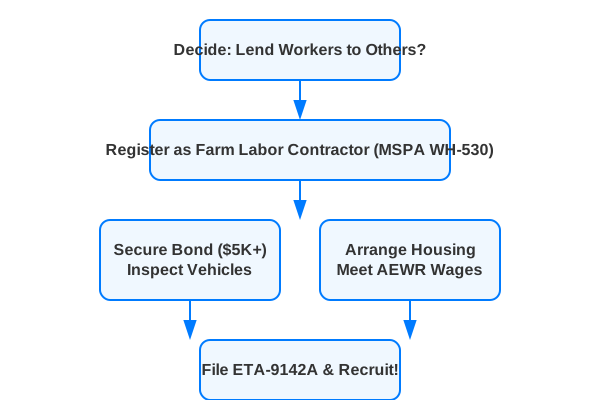
There is a path. It is not simple, but it is coherent, and when the pieces are assembled correctly, it provides real protection for every member of the family — including the husband who is already here. This article explains how refugee and asylum law interact in this scenario, what the strategy looks like in practice, and why the two legal tracks, run in parallel, are stronger together than either would be alone.

The Fundamental Distinction: Refugee Status vs. Asylum

These two forms of protection share the same underlying legal standard — persecution on account of race, nationality, religion, political opinion, or membership in a particular social group — but they operate in entirely different procedural worlds, and that difference is what drives the entire strategy.

Refugee status (governed by INA § 207 and 8 CFR Part 207) is by definition a program for people who are outside the United States. Processing happens at overseas posts — in this case, the U.S. Embassy in Pretoria. The application form is the I-590, and the program is administered under the U.S. Refugee Admissions Program (USRAP). A person cannot obtain refugee status while present in the United States.

Asylum (governed by INA § 208 and 8 CFR Part 208) is a program for people who are physically present in the United States or at a port of entry. The application form is the I-589, filed with USCIS for affirmative cases, and adjudicated either by an asylum officer at an Asylum Office or, if referred, by an immigration judge. A person cannot obtain asylum from abroad.

This clean statutory divide is what creates the scenario: wife and children, present in South Africa, are eligible for refugee status. Husband, present in the United States on an H-2A visa, is eligible for asylum. The two programs are the right tools for the right people — and used in combination, they create a two-track strategy that is more resilient than either track alone.

The Wife’s Track: Refugee Processing in South Africa

Under the current administration’s policy, white South Africans facing persecution on account of race and nationality are eligible to apply for refugee status through the U.S. Embassy in Pretoria. Processing capacity has been substantially expanded — the State Department has announced plans to process approximately 4,500 applications per month, with physical infrastructure (including processing facilities on embassy property) being established to support that volume.

For the wife and children, this means the process is moving. Historically, refugee processing has taken years. Under the current program for this population, credible reports indicate processing times as short as six months. That is an unusual and significant development in U.S. immigration practice, and it changes the strategic calculus considerably.

The wife files the I-590 for herself and the minor children. The husband cannot be included as a processing derivative on her refugee application because he is physically present in the United States — derivative refugee processing requires the family member to also be abroad and processed through the overseas program. His path is different, and it runs in parallel.

Note on the Follow-to-Join Freeze: Executive Order 14163 (January 20, 2025) suspended processing of follow-to-join refugee (FTJ-R) travel eligibility determinations at overseas posts. This freeze applies to derivative refugee relatives of approved principals. It does not affect the husband’s asylum case, which is a separate and independent proceeding. The freeze is also likely to be addressed as the Afrikaner refugee program scales up — it would be administratively incoherent to approve thousands of principals and leave their follow-to-join relatives permanently frozen. Practitioners and clients should monitor this closely.


The Husband’s Track: Asylum in the United States

The husband, present in the United States on an H-2A agricultural worker visa, files a Form I-589 Application for Asylum and for Withholding of Removal. He files this while he is still in valid H-2A status. That timing matters for several reasons discussed below.

His claim rests on the same legal foundation as his wife’s refugee claim: persecution on account of race and nationality as an Afrikaner in South Africa. The nexus to a protected ground is clear. The underlying facts — documented land seizures, farm attacks, government expropriation policy — are matters of public record and official U.S. government recognition. This is not a case where the practitioner is constructing an argument from thin air; the current administration has explicitly adopted the position that this population faces qualifying persecution.

The One-Year Filing Bar — Why It Is Not a Problem

Immigration practitioners are accustomed to flagging the one-year filing bar under INA § 208(a)(2)(B). Under this rule, an applicant who has been in the United States for more than one year generally cannot apply for asylum unless an exception applies.

For the H-2A worker who has been in the United States for more than one year, the exception is clean and well-documented: 8 CFR § 208.4(a)(5)(iv) provides that maintaining lawful nonimmigrant status constitutes an extraordinary circumstance excusing the one-year bar. Because he has been in valid H-2A status throughout his presence in the United States, the period of that lawful status does not count against him. The clock, in practical terms, has not been running.

A secondary argument — changed circumstances — is also available under 8 CFR § 208.4(a)(4). The formal U.S. government recognition of the persecution facing white South Africans arguably constitutes a changed circumstance that materially affects his eligibility, and the application filed promptly after that change would qualify for the exception. But the maintained-status argument is stronger and simpler — it does not depend on the timing of any executive action, only on his own immigration record, which is documentable and clean.

What Happens to His Status While the Asylum Case Is Pending

This is where the strategy becomes practically important for a family that depends on his income. Several legal mechanics interact to protect him.

Out of Status Is Not the Same as Accruing Unlawful Presence

H-2A status is tied to a specific employer and a specific period of authorized employment. When the H-2A period ends, he is out of status — but he is not necessarily accruing unlawful presence for purposes of the three-year and ten-year bars under INA § 212(a)(9)(B).

INA § 212(a)(9)(B)(iii)(II) expressly excludes from the unlawful presence calculation any period during which a bona fide asylum application is pending. As long as the I-589 remains pending, the unlawful presence clock does not run. This means he can remain in the United States after his H-2A status expires without triggering the bars that would otherwise destroy his ability to return through a consulate.

This distinction — out of status, but not accruing unlawful presence — is one that is frequently misunderstood, including by clients and sometimes by practitioners who do not routinely handle asylum matters. It is the legal mechanism that makes the entire strategy workable.

The Asylum-Based EAD: Work Authorization After 180 Days

An asylum applicant becomes eligible to apply for employment authorization once the asylum clock has run for 180 days without a final decision on the I-589. The resulting Employment Authorization Document (EAD), category (c)(8), authorizes him to work for any employer in the United States.

There is a gap to manage: H-2A status may expire before the 180-day asylum clock completes. During that window, he has a pending asylum application (which protects against unlawful presence accrual) but no valid work authorization. Agricultural employers in this situation sometimes retain the worker through the gap, accepting the risk of the interim period. That is a decision for the employer and is common in agricultural communities where long-term relationships with workers are the norm. Once the EAD issues, the work authorization is regularized and he can work through the following season and beyond with legitimate documentation.

It is important to note that unauthorized employment, while it violates the conditions of H-2A status, is not a ground of inadmissibility under INA § 212(a). Grounds of inadmissibility govern who can receive a visa or be admitted at the border. Unauthorized employment does not appear on that list. When the time comes for him to process through a consulate to return to the United States, the employment gap will not bar him.

The I-730: Bridging the Two Tracks After Wife Arrives

When the wife is approved as a refugee and arrives in the United States, a new procedural option opens: the Form I-730, Refugee/Asylee Relative Petition. This form allows a principal refugee or asylee to petition for a spouse or unmarried children under 21 to follow them to the United States. It is, in effect, a third track that becomes available once one member of the family has been granted status.

The wife — now a principal refugee — files the I-730 for her husband immediately upon arrival. The petition must be filed within two years of her admission as a refugee, so there is a meaningful but generous window.

Current USCIS processing times for the I-730 run up to approximately 29 months. That sounds like a long time, but in the context of this strategy, it is not dead time — it is paid working time. He remains in the United States with a pending asylum claim (protecting against unlawful presence), a valid EAD (authorizing work), and is supporting the family that has now arrived. He does not need to leave until there is an actual consular appointment that will produce a visa at the end of it.

The sequence after I-730 approval is: USCIS approves, the approved petition goes to the National Visa Center (NVC) for pre-processing, NVC forwards to the U.S. Embassy in Pretoria for scheduling. He can remain in the United States through USCIS processing and NVC processing entirely. He travels only when the consular appointment is confirmed and ready — a trip measured in days or weeks, not months. He returns as a derivative asylee relative with an immigrant visa. No unlawful presence bars apply. The employment history does not create inadmissibility.

There is no filing fee for the I-730. This is one of the practical advantages of the refugee/asylee relative pathway compared to other family-based immigration routes, where the I-485 adjustment of status carries a substantial filing fee.

The Two-Horse Race: Why Running Both Tracks Is the Right Strategy

At this point the strategy has three active components: wife’s refugee processing in South Africa, husband’s pending I-589 asylum in the United States, and (after wife arrives) the I-730 relative petition. The question is which track pays off first — and the answer is that it almost does not matter, because any of the three outcomes produces a good result.

If wife’s refugee case succeeds first (the most likely scenario given current Pretoria processing times): she arrives, files I-730, husband continues working while the petition processes, makes one brief trip to the consulate when scheduled, returns as a permanent resident. His asylum case can be withdrawn.

If husband’s asylum case is interviewed and granted: he becomes a principal asylee in his own right. He never needs to leave. He can file I-730 petitions of his own for any family members who have not yet arrived. The refugee track becomes irrelevant to his own status, though wife’s case may continue independently.

If the I-730 resolves after wife arrives but before the asylum case is decided: the I-730 pathway produces his immigration status. His asylum case is withdrawn.

The only genuinely difficult scenario is one in which wife’s refugee case stalls and his asylum case is referred to an immigration judge rather than granted by the asylum officer. Even then, he has a full hearing in immigration court, the underlying merits of the Afrikaner persecution claim are strong, and no unlawful presence has accrued throughout the process.

A Word on the Current Asylum Backlog

The U.S. asylum system is processing cases under severe strain as a result of the volume of filings in recent years. The asylum office has shifted to a Last-In, First-Out (LIFO) scheduling policy, which means recently filed cases may be interviewed in approximately 18 months, while cases from the 2019–2022 period remain buried in the queue with no clear resolution timeline. The asylum office is also increasingly issuing referrals to immigration court without an interview for cases that appear to involve economic migration rather than qualifying persecution — a sensible triage that clears meritless cases and, in principle, allows genuine persecution claims to move faster.

An Afrikaner farm family with a well-documented claim based on race and nationality is precisely the kind of case that should perform well in the current screening environment. The claim is legally coherent, the political recognition is explicit, and it presents none of the credibility problems that characterize the volume cases the office is trying to clear. If his case is calendared under LIFO, the conditions for a successful interview are favorable.

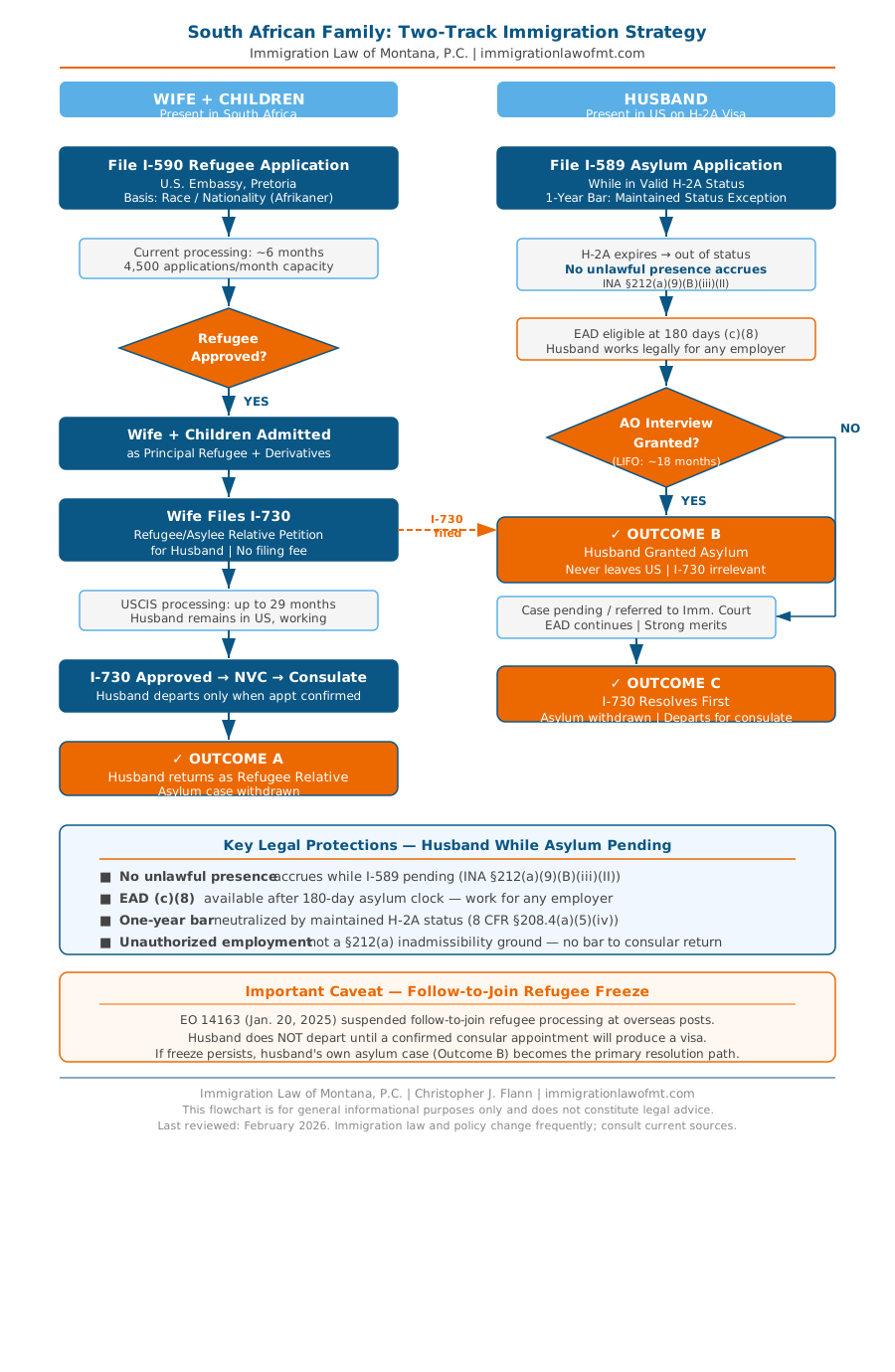
Flowchart showing two-track refugee and asylum strategy for South African H-2A families

Practical Guidance: What to Do Now

For H-2A workers from South Africa who are considering this strategy, the single most important thing is timing. Every aspect of this analysis is cleaner when the I-589 is filed while the applicant is in valid H-2A status:

  • The one-year bar is neutralized by the maintained-status extraordinary circumstances exception, with no need to rely on changed-circumstances arguments.
  • The asylum clock begins running immediately, meaning the 180-day EAD eligibility date arrives sooner.
  • The unlawful presence protection under INA § 212(a)(9)(B)(iii)(II) attaches from the filing date, creating a continuous shield even as H-2A status later expires.
  • Filing in status avoids any argument that the applicant was already out of status at the time of filing, which can complicate the asylum clock calculation.

Do not leave the United States without coordinating carefully with an immigration attorney. Voluntary departure during the pendency of an asylum case has procedural consequences, including potential abandonment of the claim, and travel to South Africa could be interpreted as inconsistent with a fear of return. Any travel while a case is pending requires legal advice specific to the facts of your situation.

Document the basis for the claim thoroughly. Country conditions evidence, news reporting, government reports, and personal declarations should be assembled now, not at the point of interview. The strength of an asylum claim is directly proportional to the quality of the supporting record.

The Situation Is Complicated. The Strategy Is Not.

The intersection of refugee law and asylum law is one of the more procedurally nuanced areas of immigration practice. But the underlying structure of this strategy is not complicated once the pieces are laid out: run the overseas refugee track and the domestic asylum track simultaneously, use the I-730 to bridge the family once the first track succeeds, and allow the legal protections built into the asylum statute — the unlawful presence shield, the EAD, the one-year bar exception — to maintain stability and income continuity for the family throughout.

The current political and legal environment is, for this particular population, unusually favorable. That window exists now. The time to act is before H-2A status expires, before circumstances in South Africa deteriorate further, and while the processing infrastructure in Pretoria is being built out to receive applications.

If you are a South African national currently in the United States on an H-2A visa, or a family member of someone in that situation, this is a conversation worth having with an experienced immigration attorney. The law provides real options. Whether those options fit your specific circumstances requires a detailed review of your individual record.

Immigration Law of Montana, P.C. has been representing clients in complex immigration matters since 1996. If you would like to discuss your situation, contact us at immigrationlawofmt.com or call our office to schedule a consultation.
Filed Under: Blog

Your Refugee Travel Document Expired. Your Status Did Not

February 28, 2026 by Admin-ILM

Recently, a family from Venezuela came to our office with a concern that I hear more often than you might expect. They had been in the United States for just over a year, admitted as refugees. They knew they were eligible to apply for a green card. They had done some research online. And they were frightened.

The document they had used to travel to the United States — their refugee travel document — had expired. Different documents seemed to say different things. They had read about the requirement to “maintain status” to qualify for a green card, and they could not see how their status was being maintained when their main document had a date on it that had already passed.

They were not in trouble. Their status was fully intact. They were exactly where the law expected them to be. But their anxiety was completely understandable, because the information available online is almost entirely written for a different category of immigrant — and applying it to refugees produces the wrong answer.

This article explains why. If you are a refugee who has been in the United States for a year or more and are wondering whether you still have valid status, the short answer is: almost certainly yes. The longer answer requires understanding how two different documents — and two different sections of federal law — actually work.

Two Documents, Two Different Jobs

When a refugee is approved for admission to the United States, two separate documents come into play. Understanding the difference between them is the key to understanding why an expired travel document does not mean expired status.

The Refugee Travel Document

Before a refugee can travel to the United States, the U.S. government issues a travel document. This document — sometimes called a Form I-571 — authorizes the bearer to travel to and seek admission at a U.S. port of entry. It is, in function, a travel authorization. It has an expiration date, typically one year from issuance, because that is the window within which the refugee is expected to complete the journey and present at the border or airport.

Once the refugee arrives and is admitted by a Customs and Border Protection (CBP) officer, the travel document has done its job. It got the person to the door. What happens after that is governed by something else entirely.

The I-94 Arrival/Departure Record

When a refugee is admitted at the port of entry, CBP creates an I-94 Arrival/Departure Record. For most nonimmigrants — visitors, students, workers on temporary visas — the I-94 shows a specific date by which the person must depart. But refugees are not nonimmigrants, and their I-94 does not show a date.

Instead, a refugee’s I-94 is annotated D/S — which stands for Duration of Status. This means the person is authorized to remain in the United States for as long as their refugee status continues. There is no fixed departure date. The I-94 does not expire when the travel document expires. The I-94 does not expire at all, in the ordinary sense, because it is tied to a status rather than a calendar date.

Key distinction: The travel document is a ticket that gets you here. The I-94 marked D/S is the document that governs how long you may stay. When the travel document expires, the ticket has been used. The I-94 — and the status it reflects — remains valid.

Why Online Research Produces the Wrong Answer for Refugees

If you search for “adjustment of status requirements” or “maintain status green card,” you will find accurate information — accurate for a different group of people. The results you see are almost entirely about adjustment of status under INA § 245(a), which is the pathway used by the vast majority of people seeking green cards: H-1B workers, F-1 students, K-1 fiancé(e)s, family members waiting for visa availability, and many others.

Under § 245(a), those requirements are real and strict. The applicant must have been lawfully admitted or paroled. They must have maintained continuous lawful status since entry. They must not have engaged in unauthorized employment. Violating any of these conditions can bar adjustment entirely or require a waiver.

Refugees reading this information naturally assume it applies to them. It does not. Refugees adjust status under a completely separate statute: INA § 209(a). Congress wrote § 209 specifically for refugees and asylees precisely because the ordinary nonimmigrant maintenance-of-status framework does not fit their circumstances. The two sections are parallel tracks, not the same track.

The GIGO Problem in Immigration Research

Computer scientists use the phrase “Garbage In, Garbage Out” to describe what happens when a system receives flawed input. A search engine is a retrieval tool, not a reasoning tool. If a refugee types “do I need to maintain status to get a green card,” the search engine returns accurate answers to that question — answers built for the § 245(a) world, because that is where 90% of adjustment cases live.

The search engine has no way of knowing that the premise embedded in the question is wrong for a refugee. It cannot recognize that the framework assumed by the question does not govern the questioner’s situation. The result is confidently accurate information that leads to the wrong conclusion. The problem is not the internet. The problem is the mismatch between the question and the legal reality.

INA § 209(a): The Refugee Adjustment Statute

Section 209(a) of the Immigration and Nationality Act provides that the status of a refugee who has been physically present in the United States for at least one year shall be adjusted to that of a lawful permanent resident. That is the operative rule. Let’s unpack what it requires — and what it does not.

What § 209(a) Does Require

  • Refugee status: You must have been admitted as a refugee under INA § 207. This is established by the record of admission itself.
  • One year of physical presence: You must have been physically present in the United States for at least one year since your admission as a refugee.
  • Continued refugee status: Your refugee status must not have been terminated. Termination requires an affirmative action by USCIS based on specific grounds (such as changed country conditions or fraud). Simply being present and not filing for a green card does not trigger termination.
  • Admissibility (or a waiver): You must be admissible to the United States as an immigrant, or any grounds of inadmissibility must be waived. USCIS has broad waiver authority for refugees under § 209(c).

What § 209(a) Does Not Require

  • Continuous maintenance of nonimmigrant status — this is a § 245(a) requirement that does not appear in § 209.
  • Filing within a specific window after becoming eligible — there is no deadline by which a refugee must file after reaching the one-year mark.
  • A separately maintained employment authorization document — work authorization flows from refugee status itself (see below).
  • A valid travel document at time of filing — the travel document is the mechanism of entry, not a condition of maintaining status.

The absence of a filing deadline is significant. Unlike the one-year bar applicable to initial asylum applications under INA § 208(a)(2)(B), Congress did not impose a “file by” date for refugee adjustment. A refugee who qualifies can file when their circumstances allow.

Work Authorization: You Never Needed a Separate EAD

One of the most important and least understood aspects of refugee status is that work authorization comes with the status itself. You do not need to separately apply for an Employment Authorization Document (EAD) to work lawfully in the United States as a refugee.

The governing regulation is 8 CFR § 274a.12(a)(3), which lists refugees as a class whose members are “authorized to be employed in the United States incident to status.” That phrase — incident to status — means the authorization comes from holding the status, not from a document you applied for. Your I-94 marked D/S, together with your Social Security number, satisfies the I-9 employment verification requirements as a List A document.

This has a direct consequence for any concern about unauthorized employment. Because your work authorization flows from your refugee status, and your refugee status remains valid until formally terminated, you cannot have engaged in unauthorized employment simply by working while your travel document was expired. The authorization was never conditional on the travel document.

The Asylee Parallel: A Useful Frame of Reference

The situation of a refugee who has been in the United States for several years without yet adjusting status is closely analogous to a situation many practitioners encounter with asylees.

An asylee — someone granted asylum affirmatively by USCIS or defensively by an Immigration Judge — typically receives an I-94 with no expiration date, reflecting their asylum status. Many asylees go years, sometimes a decade or more, without filing for a green card. They work lawfully under 8 CFR § 274a.12(a)(5) (the asylee equivalent of the refugee incident-to-status work authorization provision). They may not have thought about adjustment at all until something prompted it — a family member they wish to sponsor, a desire to naturalize, or a need for an actual U.S. travel document.

When that asylee finally comes to an attorney, they have not violated their status. Their asylum has not expired. Their work authorization was never interrupted. The only question is whether any disqualifying events have occurred in the intervening years. The same analysis applies to a refugee.

The refugee and the asylee share the same structural situation: a grant of humanitarian protection that continues until formally terminated, incident-to-status work authorization, and a right to adjust status that does not expire simply because the person has not yet exercised it. The travel document a refugee uses to arrive is no more a measure of their ongoing status than the initial grant notice an asylee receives. Both are point-in-time documents that do not govern the duration of protection.

What Actually Terminates Refugee Status

Because the continuation of refugee status is the foundation of everything discussed in this article, it is worth being clear about what does — and does not — terminate it.

Under INA § 207(c)(4) and 8 CFR § 207.9, USCIS may terminate refugee status if the refugee no longer meets the definition of a refugee, has obtained protection from another country, or obtained the status through fraud or misrepresentation. Termination requires an affirmative USCIS action with notice to the individual. It does not happen automatically.

The following do not terminate refugee status:

  • Expiration of the refugee travel document
  • Failure to file for adjustment of status after one year
  • Working without a separately issued EAD
  • Extended time inside the United States without interacting with immigration authorities
  • Changed circumstances in your home country (though this could be grounds for USCIS to initiate termination, it is not automatic)

If your status has not been formally terminated and you remain admissible, you remain eligible to file for your green card.

Filing for Your Green Card Under § 209(a): Practical Overview

When you are ready to file, the process is more straightforward than it may appear. Refugee adjustment does not require an immigrant visa petition. There is no waiting for a priority date. You file directly.

The Core Filing: Form I-485

The application for adjustment of status is made on Form I-485, Application to Register Permanent Residence or Adjust Status. On Part 2 of the form, you will select the eligibility category that corresponds to refugee adjustment under § 209.

Supporting Documents

The specific document requirements are set out in the Form I-485 instructions, but typical supporting documents for refugee adjustment include:

  • Copy of your I-94 Arrival/Departure Record showing refugee admission
  • Copy of your refugee travel document (even if expired — it establishes the admission)
  • Passport-style photographs
  • Form I-693 medical examination (completed by a USCIS-designated civil surgeon)
  • Evidence of one year of continuous physical presence (typically established by the I-94 date of admission)
  • Any documents relevant to inadmissibility grounds and waivers if applicable

Biometrics and Interview

USCIS will schedule biometrics (fingerprints and photographs). An interview may or may not be required depending on your USCIS field office and the facts of your case. If there are no complications, many refugee adjustments proceed without a personal interview.

The Filing Fee Question

As of the current USCIS fee schedule, there is a filing fee for Form I-485. However, fee waiver requests (Form I-912) are available and are routinely granted in refugee cases where the applicant demonstrates financial need. An attorney can advise on whether a fee waiver is appropriate in your situation.

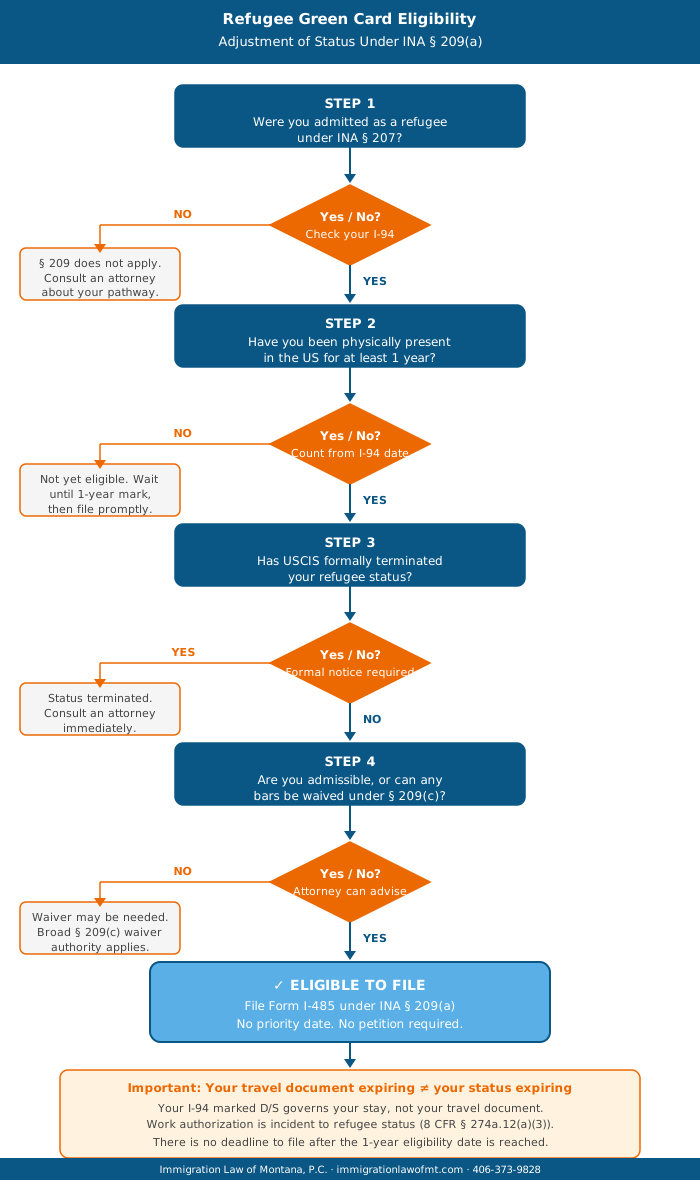
Flowchart: Refugee green card eligibility steps under INA 209a

A Word About Delays and What to Prioritize

While delay does not forfeit your right to adjustment, there are practical reasons not to wait indefinitely. A few worth noting:

  • International travel: A refugee whose status has not been adjusted to LPR cannot obtain a standard U.S. passport. Returning to the United States after international travel requires a Refugee Travel Document (distinct from the initial travel document used to enter), and re-entry can be complicated. LPR status solves this.
  • The path to citizenship: The five-year naturalization clock does not begin running until the date of adjustment to LPR status. Every year you delay filing is a year added to the road to U.S. citizenship.
  • Derivative benefits for family: Adjustment opens additional options for family members. The sooner you adjust, the sooner those options become available.
  • Potential changes in admissibility: The longer the period between arrival and filing, the more opportunity there is for events that could complicate admissibility — arrests, travel issues, changes in civil status. Filing sooner eliminates this exposure.

The bottom line: file when you can, not because you have to, but because LPR status serves your long-term interests and the interests of your family.

The Most Common Mistake: Assuming the Wrong Legal Framework

The concern that brought the Venezuelan family to our office — the worry that an expired travel document meant expired status — is exactly the kind of confusion that well-meaning online research can create when the searcher does not yet know which legal framework governs their situation.

The maintenance-of-status requirements that dominate green card information online are real requirements — for the people they apply to. They do not apply to refugees adjusting under § 209. The work authorization rules that frighten refugees who did not file for a separate EAD are a real concern — for people whose work authorization depends on a filing. Refugees are authorized incident to status. The travel document expiration dates that look alarming are real expiration dates — for the travel document. Not for the status.

Understanding which legal framework governs your situation is the first step, and it is the step where having counsel makes the most difference. If you are a refugee in Montana, Wyoming, North Dakota, Colorado, Utah, or Idaho and you have questions about your status, your eligibility to apply for a green card, or where you are in this process, we are here to help.

Contact Immigration Law of Montana at immigrationlawofmt.com or call 406-373-9828.

Immigration Law of Montana, P.C. • Christopher J. Flann, Attorney • Licensed in Montana

This article is for informational purposes and does not constitute legal advice. Immigration law changes frequently. Consult a licensed immigration attorney about your specific situation

Filed Under: Blog

Using Education and Experience to Qualify for PERM Labor Certification

November 24, 2025 by Admin-ILM

Professional working on laptop with law books, representing education gained during employment for PERM labor certification

When an employer sponsors a foreign worker for permanent residence through the PERM labor certification process, one of the most critical questions becomes: What qualifications can the worker use to meet the position’s requirements?

The answer depends significantly on whether we’re talking about education or experience – and where that qualification was obtained.

Department of Labor’s PERM program page

The Critical Distinction: Education vs. Experience

Under Department of Labor regulations, educational qualifications and work experience are treated very differently when gained during employment with the sponsoring employer.

Educational Qualifications: Generally Acceptable

An employee can use educational credentials earned while working for the sponsoring employer to meet PERM position requirements. This includes degrees, diplomas, and certificates obtained from accredited institutions during the employment relationship.

The regulation at 20 CFR § 656.17(i)(1) prohibits employers from requiring “skills not possessed by the alien at the time the application is filed.” This timing rule is the key: the beneficiary must actually possess the educational credential by the PERM filing date, but there’s no prohibition against obtaining that education while employed by the sponsoring company.

Why Education Is Treated Differently

Educational credentials are standardized, objective qualifications from accredited institutions. A Master’s degree is a Master’s degree regardless of when or where it was earned. The DOL views these as legitimate qualifications that exist independently of the employment relationship.

This policy creates valuable planning opportunities. An employee working toward an MBA, law degree, or other advanced credential can continue their education while the employer prepares the PERM case. Once the degree is conferred, the PERM application can be filed with the employee meeting all stated requirements.

Work Experience: The 50% Different Duties Rule

Experience gained with the sponsoring employer generally cannot be used to meet PERM requirements – with one important exception.

Under 20 CFR § 656.17(i)(3), experience with the sponsoring employer can only be counted if gained in a position that is “not substantially comparable” to the PERM position. The regulation defines “substantially comparable” as requiring performance of the same job duties more than 50% of the time.

Put simply: the two positions must differ by more than 50% in their job duties for the earlier experience to count toward PERM qualifications.

The DOL’s Reasoning

The Department of Labor’s concern is straightforward: if an employer hired someone without certain experience requirements, those requirements may not actually be “actual minimum requirements” for the position. The DOL wants to ensure employers aren’t creating artificially high requirements that U.S. workers couldn’t meet.

If the PERM position requires five years of experience but the beneficiary was hired with only two years, the DOL will question whether five years is truly the minimum needed for the job.

Decision tree flowchart showing whether education, licenses, or experience can be used to meet PERM labor certification requirements

The Critical Timing Rule

Regardless of whether we’re discussing education or experience, one timing rule governs everything:

The beneficiary must meet ALL stated requirements by the date the PERM application (ETA Form 9089) is filed with the Department of Labor.

This is explicitly stated in 20 CFR § 656.17(i)(1), which prohibits requiring skills not possessed by the alien “at the time the application is filed.”

What This Means for Each Stage

Prevailing Wage Determination Filing: The beneficiary does NOT need to meet all requirements yet. The PWD establishes the wage level and can be filed while the employee is still completing education or gaining experience.

Recruitment Period: The beneficiary still does NOT need to meet all requirements. Recruitment can proceed while qualifications are being completed.

PERM Filing Date: The beneficiary MUST meet every stated requirement – education, experience, licenses, certifications – by this date. This is the critical milestone.

This timing structure allows strategic planning. Employers can initiate the PWD process while an employee is finishing their MBA or accumulating the final months of required experience, then file the PERM once all qualifications are actually obtained.

Licensing Requirements: A Special Consideration

Professional licenses occupy a unique position between education and experience requirements.

Under 20 CFR § 656.17(h), licensing requirements can ONLY be included if they are “legally required to perform the job duties.” Unlike education requirements, which employers have discretion to set, licenses can only be required when the law mandates them for that occupation.

Licenses Must Be Obtained Before PERM Filing

Like education, a professional license is an objective credential. An employee can obtain bar admission, medical licensure, or other professional licenses while working for the sponsoring employer – even if that work is in a different capacity (such as a paralegal working toward bar admission).

However, the license must be fully obtained and active by the PERM filing date. Unlike education where “substantially complete” might suffice in some contexts, licensing is binary: you’re either licensed or you’re not.

Practical Consideration: Many jurisdictions allow foreign-trained professionals to petition for permission to sit for licensing exams. An employee working as a paralegal who obtains U.S. bar admission during their employment meets licensing requirements for an attorney position – provided they hold independent work authorization allowing them to work as an attorney.

A Real-World Example

Consider this scenario: A law firm employs a foreign-trained attorney as a paralegal. The attorney has ten years of legal experience from their home country but isn’t admitted to practice in the United States.

While working as a paralegal, the employee petitions their state supreme court for permission to sit the bar exam, passes, and obtains admission to the state bar.

Can the Law Firm Sponsor This Employee for an Attorney Position?

Yes – with careful attention to the details:

Educational Requirement: The foreign law degree meets educational requirements (assuming it’s evaluated as equivalent to a U.S. law degree).

Licensing Requirement: The employee now holds an active U.S. bar license obtained while employed. This satisfies the licensing requirement since it’s held at PERM filing.

Experience Requirement: The firm can count the employee’s ten years practicing law in their home country. This experience was gained before joining the sponsoring employer, so it’s fully usable.

What About Paralegal Experience? The years working as a paralegal for this firm generally cannot be counted, even though paralegal work involves legal knowledge. Unless the firm can demonstrate the paralegal duties were more than 50% different from attorney duties, those years don’t count toward experience requirements.

The Timing Opportunity

This scenario also illustrates the timing planning opportunity. While the employee studies for the bar exam, the employer can:

  1. File the Prevailing Wage Determination (PWD)
  2. Plan and potentially conduct recruitment
  3. Wait for bar exam results and admission

Once the employee is formally admitted to the bar, the firm files the PERM with all requirements met. The employee’s work authorization (H-1B, L-1, EAD, or other status) determines whether they can immediately begin working as an attorney or must wait for adjustment of status.

The Job Availability Question

This example also raises an important strategic consideration that employers should understand: during the extended PERM processing period (currently 12-18 months or more), the attorney continues working. If the firm later promotes this attorney beyond the PERM position, questions about whether the PERM job remains “available to fill” may arise – but that’s a topic for another day.

Employer-Funded Education

One nuance worth noting: DOL regulation 20 CFR § 656.17(h)(4) states that the Department “will not consider any education or training obtained by the alien beneficiary at the employer’s expense unless the employer offers similar training to domestic worker applicants.”

In practice, this primarily addresses company-specific training programs rather than standard tuition reimbursement benefits. If an employer offers tuition reimbursement as a standard employee benefit available to all workers in similar positions, an employee’s use of that benefit to earn a degree doesn’t disqualify the credential.

The concern is narrow: preventing employers from providing special educational opportunities exclusively to foreign workers that aren’t available to U.S. worker applicants.

Strategic Planning Implications

Understanding these rules creates several planning opportunities:

Career Development Alignment: Employees can pursue advanced degrees knowing those credentials will support future PERM applications.

Timeline Management: Employers can initiate PWD requests while employees complete final educational requirements or accumulate needed experience.

Promotion Paths: When promoting employees internally, careful documentation of job duty changes is essential if relying on the 50% different duties exception.

Licensure Planning: Professional employees working toward U.S. licensure in fields like law, medicine, or accounting can pursue PERM once licensed, even if the license was obtained during employment.

Common Pitfalls to Avoid

Assuming “Almost Done” Is Enough: A degree must be fully conferred with official transcripts showing completion. “Expected graduation” or “defense scheduled” doesn’t meet the requirement at PERM filing.

Counting Employer Experience Without Analysis: Don’t assume years with the sponsoring employer count toward experience requirements without carefully analyzing whether job duties were more than 50% different.

Confusing Licensing and Education: While both can be obtained during employment, licensing requirements can only be stated when legally required for the occupation.

Missing the Filing Date Deadline: All requirements must be met by PERM filing – not by PWD filing or during recruitment, but by the actual ETA 9089 submission date.

Conclusion

The PERM process requires careful attention to qualification timing and sources. The key principles to remember:

  • Educational credentials earned during employment with the sponsoring employer can be used
  • Professional licenses obtained during employment can be used (when legally required)
  • Experience with the sponsoring employer generally cannot be used unless gained in positions with more than 50% different job duties
  • All qualifications must be possessed by the PERM filing date
  • The Prevailing Wage Determination and recruitment can begin before qualifications are complete
  • PERM regulations at 20 CFR Part 656

These rules create genuine planning opportunities for both employers and employees navigating the path to permanent residence. With proper timing and documentation, educational advancement during employment can support successful PERM applications.American Immigration Lawyers Association


This article provides general information about PERM labor certification requirements. Every case presents unique facts and circumstances. For specific guidance on your situation, consult with an experienced immigration attorney.

Filed Under: Blog

The Bracero Program – Lessons from America’s First Guest Worker Era

November 13, 2025 by Admin-ILM

As a Montana immigration lawyer since 1996, I’ve guided countless ag employers through H-2A visas. But to understand today’s strict rules—like bonds for labor contractors—look back to the Bracero Program (1942-1964). This WWII-era initiative brought over 4.6 million Mexican workers to U.S. farms, filling labor gaps amid war shortages.

It started strong: Railroads transported “braceros” (arm workers) under bilateral agreements, promising fair wages, housing, and transport. Montana saw braceros in sugar beet fields near Billings.

But abuses mounted. Contractors skimmed wages, provided squalid camps, and charged illegal fees. Workers faced discrimination, pesticide exposure without protection, and deportation for complaints. By the 1950s, scandals erupted—Congressional hearings revealed debt peonage and blacklisting.

Public outcry, led by unions and civil rights groups, ended Bracero in 1964. It paved the way for the 1983 MSPA and modern H-2A safeguards: No recruitment fees, inspected housing, prevailing wages (Montana’s 2025 AEWR: $18.67/hour), and contractor bonding.

These aren’t burdens—they prevent exploitation. In Montana’s remote ranches, they ensure South African and Mexican workers thrive, boosting your operations ethically.

Questions on applying Bracero lessons to your H-2A filing? We’re here.

Contact Us for H-2A Help

Filed Under: Blog

Becoming an H-2A Labor Contractor: A Guide for Montana Agricultural Service Providers

November 10, 2025 by Admin-ILM

As a Montana immigration attorney with nearly 30 years of experience helping farmers, ranchers, and ag businesses navigate the H-2A visa program (starting my practice in September 1996), I’ve seen firsthand how seasonal labor shortages can grind operations to a halt. Montana’s vast ranches and farms often need extra hands for planting, harvesting, fencing, or soil preparation—but what if you’re not just hiring for your own land? What if you provide those services to neighbors or other operators?

Enter the H-2A labor contractor role. If you’re an ag service provider lending workers to third parties, you must register as a Farm Labor Contractor (FLC) under the H-2A program. This isn’t just red tape—it’s a safeguard rooted in history. In this article, we’ll break down:

  • Why become an H-2A labor contractor (versus hiring directly for your own farm).
  • Key qualifications and requirements (with real-world Montana examples).
  • The historical context behind these rules.
  • How my firm can handle the entire application process for you.

Whether you’re prepping soil for seeding across multiple ranches or sharing fencing crews, this guide will help you comply and thrive.

Direct H-2A Hiring vs. Becoming a Labor Contractor: What’s the Difference?

The H-2A program allows U.S. employers to hire foreign workers for temporary agricultural jobs when domestic labor is unavailable. But the rules split based on who the workers serve:

  • Direct Employer (For Your Own Operations): If you need workers solely for your farm or ranch—say, to build fences on your 500-acre spread or plant wheat on your fields—you file as a standard H-2A employer. No extra contractor registration needed.
  • H-2A Labor Contractor (For Third-Party Services): If you supply workers to others—even lending a crew to a neighbor for hay baling or providing custom harvesting services—you’re acting as a labor contractor. This triggers mandatory registration with the U.S. Department of Labor (DOL) as a Farm Labor Contractor under the Migrant and Seasonal Agricultural Worker Protection Act (MSPA).

Why make the switch? As a contractor, you can:

  • Expand your business by offering “crew-for-hire” services.
  • Help neighboring operations without them navigating H-2A paperwork.
  • Charge fees for labor management, turning seasonal help into year-round revenue.

But skip registration, and you risk fines up to $2,500 per violation, worker backpay claims, or program debarment.

Real Montana Examples

  • Fencing Crew Lender: You hire 10 H-2A workers to fence your ranch. Your neighbor needs the same? Lend them out—you’re now a contractor.
  • Soil Prep Provider: Your team does tillage and seeding on your land. Offer it to nearby farms for a fee? Contractor status required.
  • Custom Harvesting: Running combines for multiple ranches? Definitely a labor contractor.

How to Qualify as an H-2A Labor Contractor: Step-by-Step Requirements

Qualifying isn’t overly complex, but it demands proof of reliability. You’ll file Form ETA-9142A with the DOL, plus MSPA registration via Form WH-530. Key hurdles:

  1. Prove Business Legitimacy:
    • Articles of incorporation or DBA registration.
    • Proof of ag focus (e.g., equipment lists, client contracts).
  2. Vehicle Safety Inspections:
    • All transport vehicles must pass DOL-authorized inspections.
    • Example: Your crew van needs valid brakes, seats, and insurance. In Montana, use certified mechanics—I’ve helped clients coordinate with local shops in Billings or Bozeman.
  3. Bonding or Insurance:
    • Minimum $5,000 surety bond (up to $75,000 based on crew size) to cover wage disputes.
    • Example: For 20 workers, expect a $20,000 bond. We shop affordable providers for Montana clients.
  4. Housing and Wage Compliance:
    • Provide DOL-approved housing (inspected rentals or on-site units).
    • Pay at least the Adverse Effect Wage Rate (AEWR)—in Montana for 2025, that’s $18.67/hour.
    • Guarantee 75% of contract hours and cover inbound/outbound travel.
  5. Worker Disclosures:
    • Written statements in workers’ languages detailing pay, hours, and rights.
    • No recruitment fees charged to workers.

Timeline: 60-75 days before need date. File early—Montana’s spring planting waits for no one!

Learn H-2A basics for direct farm hiring

H-2A Labor Contractor Process Flowchart

The Bracero Program Legacy: Why These Rules Exist

I’m old enough to remember stories from the Bracero Program (1942-1964), which brought millions of Mexican guest workers to U.S. farms. It filled WWII labor gaps but spawned abuses: substandard housing, wage theft, and exploitative contractors who deducted phony fees.

When Bracero ended amid scandals, Congress passed MSPA in 1983 to protect workers. Today’s H-2A contractor rules—bonds, inspections, disclosures—stem directly from that era. They’re not “government meddling” for its own sake; they’re lessons learned to prevent history’s repeats. In Montana, where workers travel remote roads, vehicle safety alone has saved lives.

How We Can Help: Full-Service H-2A Filing

At the Law Office of Raymond G. Lahde, we don’t just advise—we do the work:

  • Audit your operations for contractor eligibility.
  • Prepare and file all forms (ETA-9142A, WH-530, recruitment plans).
  • Secure bonds, housing certifications, and prevailing wage data.
  • Represent you in DOL audits or appeals.

We’ve filed dozens of successful H-2A petitions for Montana ag clients, from direct ranch hires to multi-farm contractors. Contact us for a free consultation—let’s get your crew here legally and on time.

Schedule a Call Today

Filed Under: Blog

E-2 Business Changes: Permission, Not Forgiveness

November 7, 2025 by Admin-ILM

E-2 business owner reviewing documents and considering business change options

When E-2 Investors Must Get USCIS Approval Before Changing Their Business Investment

The E-2 treaty investor visa allows foreign nationals to live and work in the United States based on a substantial investment in a U.S. business. But what happens when that business needs to change? Can you sell your original business and buy a different one? What if your business evolves in response to market conditions? When do you need permission from U.S. Citizenship and Immigration Services before making changes, and when can you simply document the evolution and explain it later?

This guidance is particularly important for Canadians who chose the E-2 pathway to relocate to the United States. Learn more about E-2 and other immigration options for Canadians seeking greater freedom.

These questions matter because E-2 immigration follows a fundamental principle that many investors learn too late: permission, not forgiveness. Unlike some areas of law where you can act first and seek approval retroactively, immigration law requires advance authorization for material changes. Making significant business changes without USCIS permission doesn’t just risk a denied extension—it can mean you’ve failed to maintain your E-2 status entirely, making you deportable and forcing you to leave the United States to start over.

This article provides practical guidance on when E-2 business changes require amended petitions, when they don’t, and how to navigate the substantial gray areas in between. After nearly three decades of E-2 practice, I’ve seen what works, what fails, and why the difference matters. This isn’t about theoretical compliance—it’s about protecting your investment and your status.

The Regulatory Framework: What the Law Actually Says

The Ongoing Obligation to Maintain Status

The E-2 regulations establish that treaty investors must maintain the conditions of their nonimmigrant classification. Under 8 CFR 214.2(e)(2)(i), the E-2 investor must be actively in the process of investing a substantial amount of capital in a bona fide enterprise. This isn’t a one-time requirement at approval—it’s an ongoing obligation throughout your E-2 status.

When you need to extend your E-2 status or petition validity, you file Form I-129 with USCIS. The form instructions specify that you must check the “amended petition” box if you’re notifying USCIS of a material change in the terms or conditions of your E-2 classification. The critical question becomes: what constitutes a “material change”?

Defining “Material Change”

The USCIS Policy Manual provides the definition. A fact is material if it would have a natural tendency to influence, or is predictably capable of affecting, the decision. This definition comes from Supreme Court precedent and Board of Immigration Appeals decisions, and it applies across immigration law. In the E-2 context, it means that changes affecting your investment, the nature of your business, or your ability to develop and direct the enterprise are material changes requiring advance USCIS approval.

The Consequences of Unauthorized Changes

The regulations establish strict consequences for making changes without permission:

  • No unauthorized employment: Under 8 CFR 214.2(e)(20), you may not begin new employment or changed employment until the application or petition is approved
  • Failure to maintain status: Making material changes without approval constitutes failure to maintain your E-2 status
  • Deportability: Under 8 CFR 214.1(e), any alien who fails to maintain status is deportable under INA 237(a)(1)(C)(i)
  • Extension denial: When you apply for extension or renewal, USCIS examines whether you maintained status since your last approval

Understanding this framework is essential because it reveals why the “forgiveness” approach fails. You cannot make material changes, implement them without authorization, and then file an amended petition retroactively. By the time you file, you’ve already violated your status. The only remedy at that point is typically to withdraw your petition, leave the United States, and apply for a new E-2 visa from scratch through consular processing.

Clear Material Changes: When You Definitely Need Permission

Changes That Always Require Advance Approval

Some business changes are unquestionably material and require USCIS approval before implementation:

  • Different industry or business type – Package delivery service to commercial roofing company
  • Selling one business and buying another – Sandwich shop to horse training business
  • Fundamental business model transformation – Most service-to-product conversions (with exceptions discussed later)
  • Complete operational change – Restaurant to meal prep facility, retail store to online distribution center

Success Story: Getting Permission First

I once helped an E-2 investor navigate a major business change successfully. The investor had purchased a fifty percent interest in a small package delivery service, but the business was poorly managed and falling apart. The original seller behaved badly and sold the business assets, leaving the investor with little more than a shell company.

Rather than walking away from the investment, the investor bought the remaining fifty percent of the corporate entity and used it as a vehicle for a completely different business—a commercial roofing company that matched his actual skills and experience.

The key to success: We filed an amended petition with a complete business plan before he began operating the roofing business. USCIS approved the change because we sought permission first, not forgiveness after.

Failure Story: The Retroactive Approach

The contrasting scenario demonstrates why timing matters absolutely. An investor obtained E-2 status based on purchasing a sandwich shop. The constant demands of food service proved exhausting—small cafés typically require owner presence every minute the business is open. The investor eventually sold the sandwich shop and began investing in a horse training business, which aligned with his actual interests.

Unfortunately, he made these changes without first consulting immigration counsel or filing an amended petition. By the time counsel attempted to submit an amendment application, USCIS noted that:

  • The investor had already sold the qualifying business
  • He had started working in the new business without authorization
  • He had been operating without proper E-2 status

The amendment was doomed to fail because the investor had already been working without authorization. The petition was withdrawn, and the investor had to leave the United States and apply for a new E-2 visa through consular processing based on the horse training business.

The Critical Lesson

File the amended petition and wait for approval BEFORE implementing material changes. The business plan you submit must demonstrate that the new business meets all E-2 requirements—substantial investment, non-marginal enterprise, and your ability to develop and direct it. USCIS will review the amendment just as thoroughly as an initial E-2 petition. But if approved, you can make the change with confidence that your status remains intact.

Clear Non-Material Changes: Natural Business Growth and Evolution

Changes That Don’t Require Advance Approval

Some changes represent natural business growth or evolution that doesn’t fundamentally alter your qualifying business. These should be documented carefully but don’t require amended petitions:

Same Business Type, Different Location

  • Montana campground → Wyoming campground
  • Hair salon in one city → Hair salon in another city
  • Restaurant relocating within the same market area
  • Why it’s not material: Same business type, similar investment level, same operational model

Opening Additional Locations

  • Second, third, or fourth location of your existing business
  • Why it’s not material: This is the best-case scenario—proves success and job creation
  • E-2 benefit: Shows your investment is creating employment opportunities for U.S. workers

Seasonal Business Adaptations

  • Landscaping business + snow removal in winter
  • Pool installation + winterization services
  • Tourism business + off-season local services
  • Why it’s not material: Related services, same customer base, seasonal logic

Related Product/Service Additions (Supplementary)

  • Hair salon + beauty product sales (20-30% of revenue)
  • Personal training + nutritional supplements for clients
  • Restaurant + catering services
  • Why it’s not material: Complements core business, serves existing customers, remains supplementary

Minor Ownership Changes

  • Reducing from 100% to 85% ownership
  • Why it’s not material: You retain clear control and ability to “develop and direct”

The Connecting Principle

What connects all these non-material changes? Your E-2 business remains recognizable from your original approval. You’re still in fundamentally the same business, serving similar markets, using comparable skills, and maintaining the same operational model. Your business has grown, adapted, or relocated, but it hasn’t transformed into something different.

Documentation Requirements

Even for non-material changes, maintain strong documentation:

  • Business justifications for changes
  • Financial records showing continued investment
  • Employment records demonstrating job creation
  • Updated business plans reflecting evolution
  • Clear narrative explaining why changes are non-material

This documentation becomes critical when you file your next extension or renewal.

The Gray Areas: When You Need to Assess Risk

Business professional weighing risk assessment options for E-2 business changes

Understanding the Challenge

After nearly three decades of E-2 practice, I can tell you that many business changes fall into gray areas where intelligent people could argue either way. These situations require risk assessment based on your personal tolerance and financial circumstances. There are no universal right answers, only informed business decisions about immigration risk.

Gray Area Category 1: Business Model Evolution

Retail → Wholesale Example

The Scenario: You establish an E-2 business operating a retail clothing store. Through business development, you make strong wholesale connections. The wholesale side becomes increasingly profitable. You decide to close your retail storefront and focus exclusively on wholesale clothing distribution.

Arguments It’s Material:

  • Fundamentally changed business model
  • Different customer base (businesses vs. consumers)
  • Different operational structure
  • Different revenue generation approach

Arguments It’s Not Material:

  • Still in the clothing business
  • Same industry and products
  • Natural business evolution responding to market opportunities
  • Same core expertise and capital investment

The Reality: You can argue this either way, which means it’s genuinely a gray area.

Service + Products: Supplementing vs. Replacing

The Supplementing Scenario (Arguably Not Material):

  • Personal training business (70% revenue)
  • Fitness equipment/supplement sales to clients (30% revenue)
  • Stable ratio maintained over time
  • Analysis: Supplementary revenue stream, not business transformation

The Replacing Scenario (Arguably Material):

  • Started: Personal training services
  • Evolution: Equipment sales growing, training declining
  • End state: Exit training entirely, focus 100% on equipment sales
  • Analysis: This is business transformation, not supplementation

The Key Question: Are you ADDING to your business model or REPLACING it?

Gray Area Category 2: The Gradual Change Problem

Hotel → Long-Term Rentals Example

Sudden Change (Clearly Material):

  • Decision: Convert 50% of hotel rooms to apartments
  • Timeframe: Immediate implementation
  • Analysis: Clear material change requiring permission

Gradual Evolution (Gray Area):

  • Year 1: Struggling occupancy, rent 5% of rooms long-term to fill vacancies
  • Year 2: It’s working, expand to 10% long-term rentals
  • Year 3: Now 20% are long-term, helping cash flow
  • Year 4: Continue gradual increase as market dictates
  • Cumulative Result: Now operating substantially different business

The Challenge: Each individual step seemed like reasonable business adaptation. But cumulatively, you’ve moved significantly away from your original business model. At what point does adaptation become transformation?

Gray Area Category 3: Control and Ownership Changes

The “Develop and Direct” Test

Clearly Fine:

  • Own 100% → Sell 15%, retain 85%
  • You got capital to reinvest
  • You’re still clearly in control
  • Can clearly develop and direct

Gray Area:

  • Own 100% → Sell 70%, retain 30% but remain CEO
  • Paper says you’re in control (CEO title)
  • But do you really control with only 30% ownership?
  • Can you still “develop and direct” when others control 70%?
  • Could majority owners remove you as CEO?

Gray Area Category 4: Related But Different

Restaurant → Cooking Classes

Arguments It’s Not Material:

  • Both food business
  • Both service businesses
  • Natural extension (customers love your food, want to learn techniques)
  • Related business in hospitality/food industry

Arguments It’s Material:

  • Different business model (education vs. food service)
  • Different customer relationship (students vs. diners)
  • Different operations (teaching vs. cooking/serving)
  • Revenue ratio flip: restaurant becoming secondary to classes

The Reality: After reviewing these scenarios, you might be frustrated that there isn’t a clear “yes file” or “no don’t file” answer for every situation. Welcome to E-2 immigration law. The regulations give us principles, not percentages. The Policy Manual gives us definitions, not decision trees.

The Decision Framework: Peace of Mind vs. Cash Flow

When You’re in a Gray Area

If you’re in a genuine gray area where intelligent people could argue either way, you’re choosing between:

Option 1: Certainty Through Filing

  • File Form I-129 amended petition
  • Costs: ~$10,000 attorney fees + USCIS filing fees
  • Processing time: Several months (or 15 days with premium processing)
  • Outcome: USCIS approval gives you certainty
  • Reality check: Even if it wasn’t truly material, USCIS keeps the money and approves it
  • You’ll never know if you needed to file, but you’ll know your status is secure

Option 2: Risk Through Documentation

  • Don’t file amended petition
  • Save $10,000+ in filing costs
  • Capital stays in business where it might be critically needed
  • Document changes meticulously
  • Prepare strong business justifications
  • Explain at renewal, defend if questioned
  • Accept the risk that USCIS might disagree

The Core Question

What’s more important to you—the money or the certainty?

There’s no universal right answer. It depends entirely on your circumstances:

Choose Certainty When:

  • Your business is thriving
  • $10,000 won’t materially impact operations
  • You have a nervous disposition about immigration status
  • Peace of mind has real value to you
  • You’re approaching a critical business milestone

Choose Documented Risk When:

  • Cash flow is tight
  • Every dollar matters for business survival
  • You have strong business justifications for evolution
  • Your argument for non-material change is solid
  • You’re comfortable with some uncertainty

Neither Approach Is Wrong

Both are legitimate business considerations. What you cannot do is ignore the question entirely and hope it never comes up. That’s the “forgiveness” approach, and it fails.

Special Circumstances Don’t Create Exceptions

Major Events: COVID, Economic Downturns, Disasters

Wrong Thinking: “COVID destroyed my restaurant business, so I had to pivot to a meal prep/delivery service. It was an emergency, so I didn’t need USCIS permission.”

Correct Thinking: “COVID destroyed my restaurant business. I need to pivot to a meal prep/delivery service. This is a significant change in business model. I need USCIS permission first, even though the change was forced by circumstances beyond my control.”

The Principle:

  • Major events may make your case for change more compelling
  • Compelling circumstances strengthen your amendment petition
  • But they don’t eliminate the requirement to seek approval first
  • Permission, not forgiveness – even for the best excuses

The Correct Process: How to Get Permission

Filing Requirements

When you’ve determined that a business change is material or falls into a sufficiently uncertain gray area that you want USCIS approval:

Form and Process:

  • File Form I-129, Petition for a Nonimmigrant Worker
  • Check “amended petition” box (Part 2, Question 2)
  • Demonstrate new/modified business meets all E-2 requirements

Required Documentation:

  • Comprehensive business plan for new/modified business
  • Evidence of substantial investment
  • Proof business is non-marginal (will generate more than living for you and family)
  • Documentation of your ability to develop and direct the enterprise
  • Financial projections and job creation evidence
  • Ownership and control documentation

The Scrutiny Level

This isn’t a simple notification process. USCIS will review your amended petition with the same scrutiny as an initial E-2 petition. You must demonstrate all requirements as if applying for the first time.

Critical Timing Rule

You must file the amended petition and receive approval BEFORE implementing the material change.

This means:

  • ✗ BEFORE you sell your old business and buy the new one
  • ✗ BEFORE you begin operating under the changed business model
  • ✗ BEFORE you start working in the materially altered enterprise

The regulation is explicit: You may not begin new or changed employment until the application is approved. Working in your materially changed business before approval constitutes unauthorized employment and failure to maintain status.

Processing Considerations

Standard Processing:

  • Timeline: Several months depending on service center workload
  • No guaranteed timeframe
  • Continue operating existing business during processing

Premium Processing:

  • Timeline: 15-day response (where available for E-2 I-129 petitions)
  • Additional fee required
  • USCIS will issue decision, RFE, or NOID within 15 days
  • Note: 15 days is for response, not guaranteed approval

During Processing

  • Continue operating your existing business
  • Maintain your investment consistent with current approval
  • Don’t implement the material change until approved
  • If you receive Request for Evidence (RFE), respond thoroughly
  • If you receive Notice of Intent to Deny (NOID), consult counsel immediately

After Approval

Upon approval, USCIS issues Form I-797 approval notice:

For You:

  • New petition validity period established
  • Can now implement the approved business change
  • Maintain approval notice for future extensions

For Dependents:

  • File Form I-539 separately for family members (if needed)
  • Or ensure they were included in your I-129 filing
  • Their E-2 derivative status must also be extended

For Visa Stamps:

  • If you have valid E-2 visa, continue using it with approved amended petition
  • If visa expired or expiring, apply for new visa at U.S. consulate abroad
  • Bring approved amended petition and supporting documentation

What Happens at Renewal and Extension

The Moment of Truth

Every E-2 investor eventually faces renewal or extension. This is when USCIS or the consular officer reviews whether you maintained your E-2 status since your last approval. If you made material changes without permission, this is when the consequences arrive.

What USCIS Reviews

The extension regulations require demonstrating continued eligibility:

  • Does business still meet substantial investment requirement?
  • Is enterprise still non-marginal?
  • Are you still developing and directing it?
  • Critical question: Did you maintain your status?

If You Made Unauthorized Material Changes

The Consequences:

  • USCIS may deny your extension
  • Failure to maintain status can make you deportable under INA 237(a)(1)(C)(i)
  • You’ll be required to depart the United States
  • Cannot file new E-2 petition from within U.S. after status expired
  • Must leave and apply through consular processing abroad

For Properly Documented Non-Material Changes

Your Preparation:

  • Prepare clear narrative explaining how business changed
  • Document why changes represent natural growth/adaptation
  • Show you continue meeting all E-2 requirements
  • Demonstrate business reasons for changes

Strong Supporting Evidence:

  • Maintained substantial investment levels
  • Continued job creation for U.S. workers
  • Your ongoing development and direction of enterprise
  • Financial records showing business success
  • Updated business plan reflecting evolution

Consular Processing vs. USCIS Extensions

Consular Processing (New Visa Application):

  • Canadians typically receive 5-year E-2 visas
  • Less frequent renewals
  • Consular officer examines whether business changed materially
  • If you made material changes without filing amended petition, officer may refuse visa
  • May require filing amended petition with USCIS before reconsideration

USCIS Extensions (Form I-129):

  • If you obtained E-2 through change of status in U.S.
  • Typically two-year extension periods
  • More frequent review of maintained status
  • Same requirement to show no unauthorized material changes

The Value of Good Recordkeeping

Maintain throughout your E-2 status:

  • Business plans (original and updated)
  • Financial records
  • Employment documentation
  • Clear explanations of business evolution
  • Business justifications for changes
  • Documentation of why changes were non-material (if applicable)
  • Approved amended petitions (if you filed any)

This documentation pays dividends at renewal time.

Practical Guidance: Questions to Ask Before Making Business Changes

Decision Framework Checklist

Before making any significant business change, work through these questions:

1. Growth or Change?

Growth typically means:

  • More of what you’re already doing
  • Additional locations of same business
  • More customers in same market
  • Increased revenue from same activities
  • Additional employees doing similar work

Change typically means:

  • Different industry
  • Different business model
  • Different revenue generation
  • Different operational structure
  • Different customer base

Rule of thumb: Growth rarely requires amended petitions. Change frequently does.

2. Supplementing or Replacing?

Supplementing signals:

  • Adding related products/services
  • Complements your core business
  • Serves existing customer base
  • Remains modest percentage (20-30%)
  • Original business remains primary

Replacing signals:

  • Supplementary activity growing while original shrinks
  • Plan to eventually exit original business
  • New activity becoming primary revenue source
  • Fundamental shift in business focus

Rule of thumb: Supplementing is usually non-material. Replacing is usually material.

3. Can You Still Develop and Direct?

Evaluate:

  • Ownership percentage changes
  • Partnership restructuring
  • Transition to passive vs. active management
  • Control over major business decisions
  • Ability to be removed from management

Rule of thumb: If change affects your control or active management role, higher risk of materiality.

4. What’s the Trajectory?

Stable evolution:

  • Changes stabilize at certain level
  • Natural business adaptation
  • Predictable and sustainable

Ongoing transformation:

  • Incremental steps toward fundamental change
  • Each change leads to next change
  • Pattern shows transformation in progress

Rule of thumb: Stable adaptation is lower risk. Progressive transformation is higher risk.

5. Is Your Business Still Recognizable?

The comparison test: Compare your original E-2 business plan with current operations

If recognizable:

  • Same industry and business type
  • Similar operational model
  • Comparable customer base
  • Related products/services

If transformed:

  • Fundamentally different operations
  • New industry or market
  • Different business model
  • Unrelated products/services

Rule of thumb: If someone couldn’t recognize your business from the original plan, it’s likely material.

Red Flags: File First

These situations strongly suggest filing amended petitions before implementing:

  • Different industry or business type
  • Selling your original business to buy a different one
  • Major ownership restructuring affecting your control
  • Abandoning original business model for new model
  • Service business transforming to product business
  • Cumulative changes making business unrecognizable

When to Consult Immigration Counsel

Consult experienced E-2 immigration counsel BEFORE implementing changes when:

  • You’re uncertain whether changes are material
  • Changes fall into potential gray areas
  • You’re selling significant ownership
  • You’re making multiple concurrent changes
  • Business evolution has been gradual but cumulative
  • You’re facing time pressure for business reasons

The consultation cost is minimal compared to the consequences of getting this wrong.

Your Risk Tolerance Assessment

Ask yourself honestly:

Financial Capacity:

  • Can my business afford $10,000+ in filing costs?
  • Or does every dollar need to stay in operations?
  • What’s the impact on cash flow?

Risk Tolerance:

  • Am I comfortable with uncertainty?
  • Do I need peace of mind for immigration status?
  • What are consequences if USCIS disagrees with my assessment?
  • How close am I to my next renewal?

Business Timing:

  • How urgent is this business change?
  • Can I wait several months for approval?
  • What happens to business if I delay?

Strength of Position:

  • How strong is my argument for non-material change?
  • Do I have excellent documentation?
  • Have I maintained status perfectly otherwise?

There’s no shame in either answer—they’re both legitimate business considerations.

E-2 business change decision flowchart showing material vs non-material change analysis

Conclusion: Permission, Not Forgiveness

The Core Principle

The E-2 treaty investor visa provides remarkable flexibility for foreign nationals to invest in and operate U.S. businesses. But this flexibility comes with continuing obligations:

  • Maintain substantial investment in non-marginal enterprise
  • Continue to develop and direct the business
  • Maintain the conditions under which you were approved

When your business changes in ways that could affect these requirements, you need USCIS permission before implementing those changes—not forgiveness afterward.

The Three Categories

Clear Material Changes:

  • Different industry or business type
  • Selling one business and buying another
  • Fundamental business model transformation
  • Action required: File amended petition and wait for approval

Clear Non-Material Changes:

  • Same business type, different location
  • Opening additional locations
  • Seasonal adaptations
  • Supplementary related products/services
  • Action required: Document well, explain at renewal

Gray Areas:

  • Business model evolution (retail to wholesale)
  • Gradual cumulative changes
  • Supplementary activities growing
  • Ownership changes affecting control
  • Action required: Assess risk, make informed decision

No Shame in Uncertainty

The regulations provide principles, not percentages. They give us definitions, not decision trees. Intelligent, experienced practitioners can disagree about whether particular changes require amended petitions.

When you face that uncertainty, you’re making a business decision:

  • File for certainty (costs money but provides peace of mind)
  • Document for explanation (saves money but accepts some risk)

Both approaches can be reasonable depending on your circumstances.

What Doesn’t Work

Ignoring the question and hoping USCIS never asks. That’s the “forgiveness” approach, and it doesn’t work in E-2 cases. By the time you’re seeking forgiveness, you’ve already failed to maintain status.

The consequences can include:

  • Extension or renewal denial
  • Deportability under INA 237(a)(1)(C)(i)
  • Having to leave the United States
  • Starting your E-2 process over from abroad

Protecting Your Investment and Status

Your E-2 status is too valuable to risk on wishful thinking. Before making significant business changes:

  1. Evaluate whether changes might be material
  2. Consult with immigration counsel when uncertain
  3. File amended petition if analysis suggests material change
  4. Document thoroughly if analysis supports non-material change
  5. Decide based on risk tolerance if you’re in gray area
  6. Wait for approval before implementing material changes

The permission-not-forgiveness principle isn’t designed to trap unwary investors. It’s designed to ensure that E-2 investors maintain the qualifying conditions that justified their nonimmigrant status. By understanding when you need permission and seeking it appropriately, you protect both your investment and your ability to remain in the United States pursuing your business goals.

When in doubt, file. The cost of unnecessary filing is financial. The cost of necessary filing you skipped can be your E-2 status.

Filed Under: Blog

  • Page 1
  • Page 2
  • Page 3
  • Interim pages omitted …
  • Page 5
  • Go to Next Page »

Footer

Our Location

We are located about 20 minutes NE of Billings in a rural community:

Immigration Law of Montana, P.C.
8400 Clark Rd
Shepherd, MT 59079
406-373-9828

Affiliations

Montana State Bar

AILA Member


Social

  • Facebook
  • LinkedIn
  • Tumblr
  • Twitter
  • YouTube
  • Immigration Lawyer Montana
  • Privacy Policy
  • Disclaimer
  • Terms of Service
  • Site Map
  • Contact Us

COPYRIGHT © 2026 Immigration Law of Montana · All Rights Reserved

  • English
  • Español