
You came to the United States from Australia on an E-3 visa. The job didn’t work out. Whether you were laid off, let go for cause, or the relationship simply wasn’t a fit, you now face an urgent immigration question: what happens to your status, and what can you do about it?
The answer is more flexible than many people expect — but flexibility comes with deadlines. What you do in the next 60 days matters.
The 60-Day Grace Period
When your E-3 employment ends, federal regulations give you a 60-day grace period. During that window, you remain in a recognized period of authorized stay — you are not accruing unlawful presence, and you are not required to leave immediately. The grace period exists to give you a realistic chance to respond to the situation.
What you cannot do during the grace period is work. Your authorization to work was tied to your E-3 employer. Once that employment ends, the work authorization ends with it. The 60 days is time to decide and act — not time to keep working.
This 60-day grace period is the same one that applies to H-1B workers under 8 C.F.R. § 214.1(l)(2). E-3 workers are covered under the same regulatory framework.
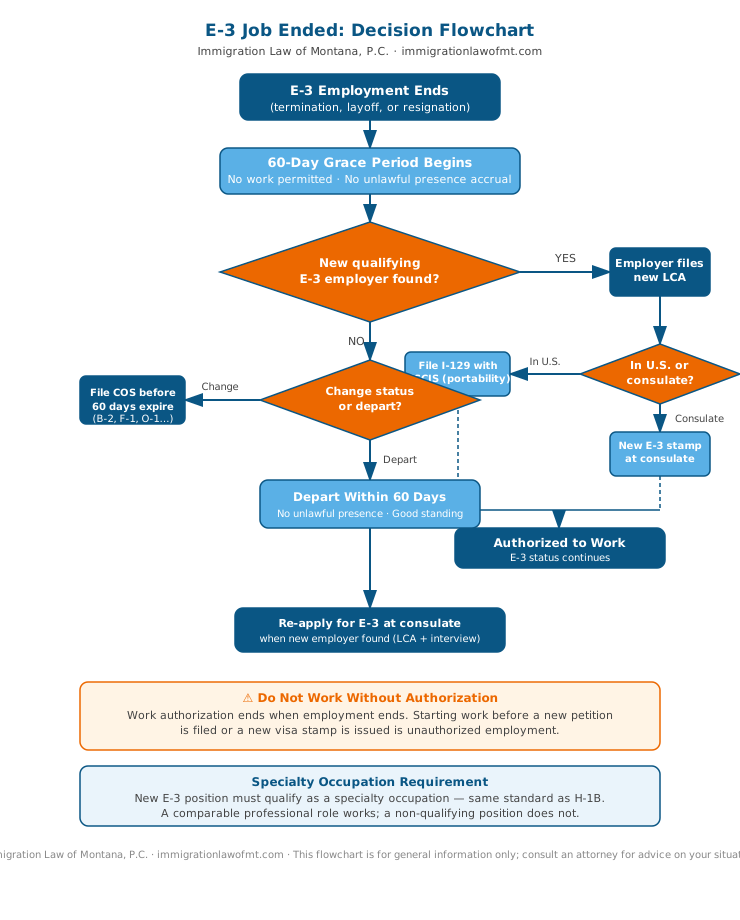
Three Paths Forward
Once employment ends, you have three realistic options: find a new E-3 employer, change to another nonimmigrant status, or depart the United States. Each has different requirements, timelines, and consequences.
Option 1: Find a New E-3 Employer
The most straightforward path for most people is to find a new position with a new U.S. employer and continue in E-3 status. The catch: the new job must also qualify as a specialty occupation.
The Specialty Occupation Standard: Same as H-1B
The E-3 visa uses the same specialty occupation standard as the H-1B. A qualifying position must normally require at least a U.S. bachelor’s degree — or its equivalent — in a specific field of study, and you must hold that degree or its equivalent. INA § 214(i) defines specialty occupation for both visa categories identically.
This means you cannot simply take any available job. If you held an E-3 as a software engineer, an accountant, or a civil engineer, your replacement position must also fall within the specialty occupation category. A lateral move to a comparable professional role generally works. A move to a position that does not require your degree — even a well-paying one — will not support a new E-3.
Think of it this way: you brought professional credentials to the U.S. and the E-3 is tied to those credentials being put to use. The requirement is not punitive — it simply reflects that the visa exists to fill professional-level positions that could not easily be filled domestically.
The Process for Changing E-3 Employers
To change E-3 employers, the new employer must first obtain a Labor Condition Application (LCA) from the Department of Labor. The LCA certifies that the employer will pay the prevailing wage for the position in the geographic area, and that hiring you will not adversely affect the wages and working conditions of similarly employed U.S. workers. LCA processing is typically fast — often a matter of days.
Once the LCA is certified, you have two practical ways to proceed.
- File an I-129 petition with USCIS while remaining in the United States. If approved, you will have new E-3 status and can begin working for the new employer. Note that you will need a new E-3 visa stamp the next time you travel internationally, since your original stamp was tied to the old employer. But you do not need to travel to get the status change itself.
- Travel to a U.S. consulate and apply for a new E-3 visa stamp directly. This is often the faster and simpler route — E-3 consular appointments at posts in Australia and elsewhere are generally available without long wait times, and consular processing can frequently be completed in a single day. Many practitioners prefer this path because it produces both the new status and the new visa stamp in one step.
If you are currently in E-3 status and change employers via the I-129 route, USCIS regulations allow you to begin working for the new employer once the petition is filed, not merely upon approval. This portability applies while the petition is pending, so long as your underlying status remains valid.
Option 2: Change to Another Nonimmigrant Status
If you cannot find a new qualifying E-3 employer within the grace period — or if your circumstances have changed — changing to a different nonimmigrant status is an option. Common choices include:
- B-2 visitor status, if you need additional time in the U.S. for personal reasons and do not intend to work
- F-1 student status, if you plan to pursue further education
- O-1 status, if your achievements in your field support an extraordinary ability petition
- H-1B status, if an employer is willing to sponsor you — though H-1B cap constraints and timing make this a more complex option
A change of status application must be filed before your authorized period of stay expires — meaning within the 60-day grace period. Filing timely preserves your authorized presence while the application is pending.
Option 3: Depart the United States
Departing within the 60-day grace period is a clean exit. You leave in good standing, without accruing unlawful presence. If you later find a new U.S. employer who can sponsor an E-3, you can apply for a new E-3 visa at a U.S. consulate — the process resets cleanly from Australia or any other post.
A Note for Australians on a Different Visa
Everything above assumes you are currently in valid E-3 status. If you are in the United States on a different nonimmigrant visa — a B-2, an F-1, or anything else — and you want to begin working for a U.S. employer in E-3 status, the process is different.
While a change of status to E-3 through USCIS may be technically available in some circumstances, the standard and well-established path is consular processing. Your employer obtains the LCA; you take it to a U.S. consulate and apply for the E-3 visa stamp directly. For most Australians, this means a trip to Sydney, Melbourne, Canberra, or Perth — or to any other U.S. consular post with available appointments.
The consular route is typically fast. E-3 does not require an approved USCIS petition before the interview — you present the LCA, your credentials, and the job offer documents, and the consular officer adjudicates on the spot. Many applicants walk in and walk out with a visa the same day.
What Not to Do
The 60-day grace period is not a license to work. Starting work for a new employer — or doing any compensated activity — before the new E-3 petition is filed or the new visa stamp is issued is unauthorized employment. The consequences are serious: a bar on future benefits, potential removal grounds, and lasting damage to your immigration record.
Do not assume that a verbal offer or a signed employment agreement starts the clock on work authorization. It does not. Work authorization begins when USCIS accepts the new I-129 petition (for in-country changes) or when the new visa stamp is issued and you enter with it.
Also: do not let the 60 days slip by without taking action. The grace period ends whether or not you have found a solution. Overstaying it accrues unlawful presence, which carries its own serious consequences.
A Practitioner’s Perspective
In practice, the most common successful outcome in this situation is a quick pivot to a new E-3 employer in a comparable specialty occupation role. Australians on E-3 tend to be in professional fields — engineering, finance, IT, healthcare, law — where the market for qualified candidates is active. The visa is portable, the process is manageable, and employers who have worked with E-3 before know what to do.
The question I always ask clients in this situation is simple: do you have a new position in mind? If the answer is yes, and the position qualifies, we can almost always get it done within the grace period. If the answer is uncertain, we talk through the other options so nothing is decided by default.
If you are facing the end of E-3 employment and you have questions about your specific situation, contact our office. The 60 days moves quickly, and options narrow as the deadline approaches.