Your wife and children are on a farm in South Africa. You are in Montana, working a legal agricultural job on an H-2A visa. The situation at home has become dangerous — the kind of danger that the United States government has now formally recognized as grounds for refugee protection. You want to know: is there a legal path for your family? And what happens to you?
There is a path. It is not simple, but it is coherent, and when the pieces are assembled correctly, it provides real protection for every member of the family — including the husband who is already here. This article explains how refugee and asylum law interact in this scenario, what the strategy looks like in practice, and why the two legal tracks, run in parallel, are stronger together than either would be alone.
The Fundamental Distinction: Refugee Status vs. Asylum
These two forms of protection share the same underlying legal standard — persecution on account of race, nationality, religion, political opinion, or membership in a particular social group — but they operate in entirely different procedural worlds, and that difference is what drives the entire strategy.
Refugee status (governed by INA § 207 and 8 CFR Part 207) is by definition a program for people who are outside the United States. Processing happens at overseas posts — in this case, the U.S. Embassy in Pretoria. The application form is the I-590, and the program is administered under the U.S. Refugee Admissions Program (USRAP). A person cannot obtain refugee status while present in the United States.
Asylum (governed by INA § 208 and 8 CFR Part 208) is a program for people who are physically present in the United States or at a port of entry. The application form is the I-589, filed with USCIS for affirmative cases, and adjudicated either by an asylum officer at an Asylum Office or, if referred, by an immigration judge. A person cannot obtain asylum from abroad.
This clean statutory divide is what creates the scenario: wife and children, present in South Africa, are eligible for refugee status. Husband, present in the United States on an H-2A visa, is eligible for asylum. The two programs are the right tools for the right people — and used in combination, they create a two-track strategy that is more resilient than either track alone.
The Wife’s Track: Refugee Processing in South Africa
Under the current administration’s policy, white South Africans facing persecution on account of race and nationality are eligible to apply for refugee status through the U.S. Embassy in Pretoria. Processing capacity has been substantially expanded — the State Department has announced plans to process approximately 4,500 applications per month, with physical infrastructure (including processing facilities on embassy property) being established to support that volume.
For the wife and children, this means the process is moving. Historically, refugee processing has taken years. Under the current program for this population, credible reports indicate processing times as short as six months. That is an unusual and significant development in U.S. immigration practice, and it changes the strategic calculus considerably.
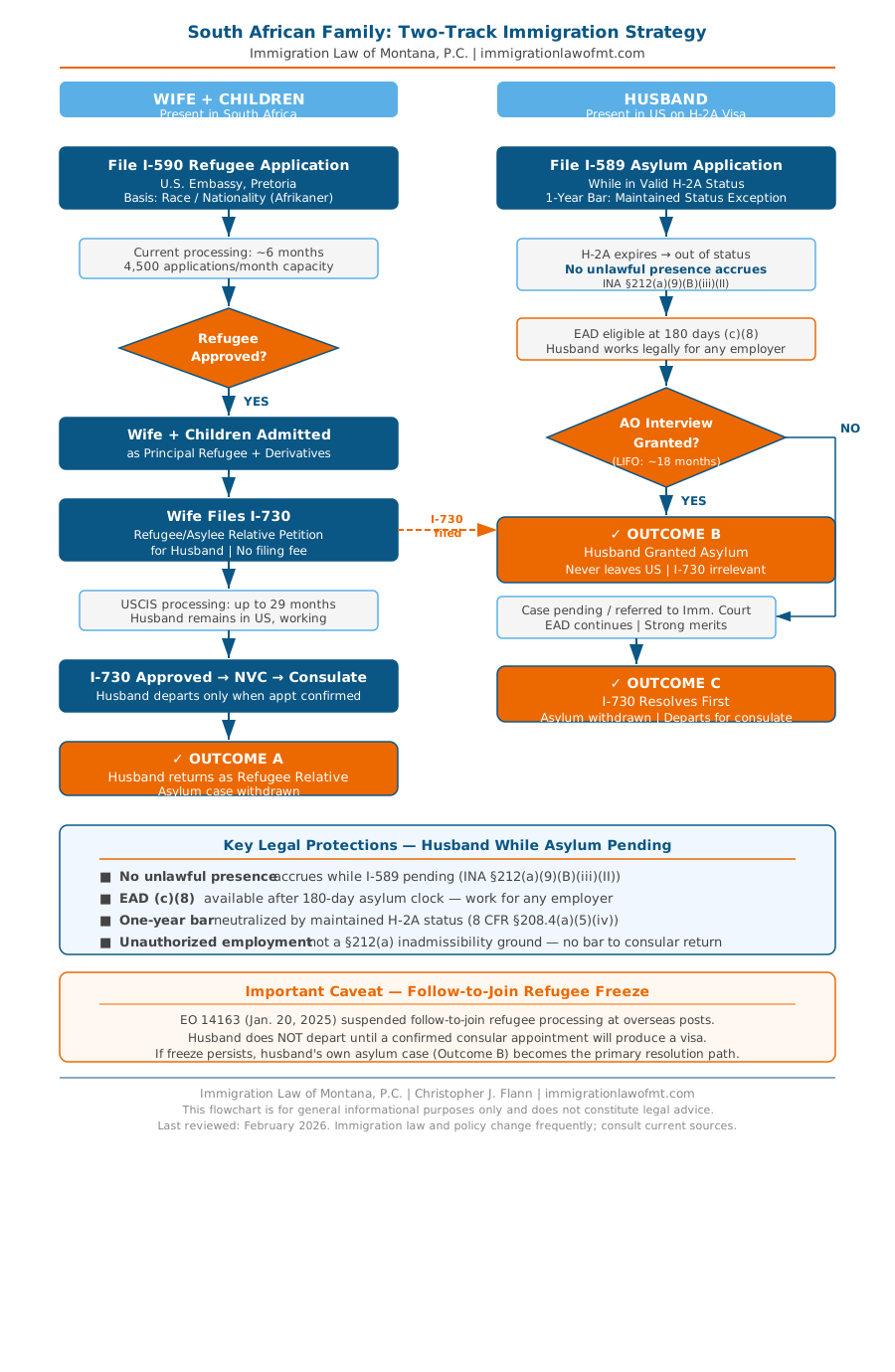
The wife files the I-590 for herself and the minor children. The husband cannot be included as a processing derivative on her refugee application because he is physically present in the United States — derivative refugee processing requires the family member to also be abroad and processed through the overseas program. His path is different, and it runs in parallel.
Note on the Follow-to-Join Freeze: Executive Order 14163 (January 20, 2025) suspended processing of follow-to-join refugee (FTJ-R) travel eligibility determinations at overseas posts. This freeze applies to derivative refugee relatives of approved principals. It does not affect the husband’s asylum case, which is a separate and independent proceeding. The freeze is also likely to be addressed as the Afrikaner refugee program scales up — it would be administratively incoherent to approve thousands of principals and leave their follow-to-join relatives permanently frozen. Practitioners and clients should monitor this closely.
The Husband’s Track: Asylum in the United States
The husband, present in the United States on an H-2A agricultural worker visa, files a Form I-589 Application for Asylum and for Withholding of Removal. He files this while he is still in valid H-2A status. That timing matters for several reasons discussed below.
His claim rests on the same legal foundation as his wife’s refugee claim: persecution on account of race and nationality as an Afrikaner in South Africa. The nexus to a protected ground is clear. The underlying facts — documented land seizures, farm attacks, government expropriation policy — are matters of public record and official U.S. government recognition. This is not a case where the practitioner is constructing an argument from thin air; the current administration has explicitly adopted the position that this population faces qualifying persecution.
The One-Year Filing Bar — Why It Is Not a Problem
Immigration practitioners are accustomed to flagging the one-year filing bar under INA § 208(a)(2)(B). Under this rule, an applicant who has been in the United States for more than one year generally cannot apply for asylum unless an exception applies.
For the H-2A worker who has been in the United States for more than one year, the exception is clean and well-documented: 8 CFR § 208.4(a)(5)(iv) provides that maintaining lawful nonimmigrant status constitutes an extraordinary circumstance excusing the one-year bar. Because he has been in valid H-2A status throughout his presence in the United States, the period of that lawful status does not count against him. The clock, in practical terms, has not been running.
A secondary argument — changed circumstances — is also available under 8 CFR § 208.4(a)(4). The formal U.S. government recognition of the persecution facing white South Africans arguably constitutes a changed circumstance that materially affects his eligibility, and the application filed promptly after that change would qualify for the exception. But the maintained-status argument is stronger and simpler — it does not depend on the timing of any executive action, only on his own immigration record, which is documentable and clean.
What Happens to His Status While the Asylum Case Is Pending
This is where the strategy becomes practically important for a family that depends on his income. Several legal mechanics interact to protect him.
Out of Status Is Not the Same as Accruing Unlawful Presence
H-2A status is tied to a specific employer and a specific period of authorized employment. When the H-2A period ends, he is out of status — but he is not necessarily accruing unlawful presence for purposes of the three-year and ten-year bars under INA § 212(a)(9)(B).
INA § 212(a)(9)(B)(iii)(II) expressly excludes from the unlawful presence calculation any period during which a bona fide asylum application is pending. As long as the I-589 remains pending, the unlawful presence clock does not run. This means he can remain in the United States after his H-2A status expires without triggering the bars that would otherwise destroy his ability to return through a consulate.
This distinction — out of status, but not accruing unlawful presence — is one that is frequently misunderstood, including by clients and sometimes by practitioners who do not routinely handle asylum matters. It is the legal mechanism that makes the entire strategy workable.
The Asylum-Based EAD: Work Authorization After 180 Days
An asylum applicant becomes eligible to apply for employment authorization once the asylum clock has run for 180 days without a final decision on the I-589. The resulting Employment Authorization Document (EAD), category (c)(8), authorizes him to work for any employer in the United States.
There is a gap to manage: H-2A status may expire before the 180-day asylum clock completes. During that window, he has a pending asylum application (which protects against unlawful presence accrual) but no valid work authorization. Agricultural employers in this situation sometimes retain the worker through the gap, accepting the risk of the interim period. That is a decision for the employer and is common in agricultural communities where long-term relationships with workers are the norm. Once the EAD issues, the work authorization is regularized and he can work through the following season and beyond with legitimate documentation.
It is important to note that unauthorized employment, while it violates the conditions of H-2A status, is not a ground of inadmissibility under INA § 212(a). Grounds of inadmissibility govern who can receive a visa or be admitted at the border. Unauthorized employment does not appear on that list. When the time comes for him to process through a consulate to return to the United States, the employment gap will not bar him.
The I-730: Bridging the Two Tracks After Wife Arrives
When the wife is approved as a refugee and arrives in the United States, a new procedural option opens: the Form I-730, Refugee/Asylee Relative Petition. This form allows a principal refugee or asylee to petition for a spouse or unmarried children under 21 to follow them to the United States. It is, in effect, a third track that becomes available once one member of the family has been granted status.
The wife — now a principal refugee — files the I-730 for her husband immediately upon arrival. The petition must be filed within two years of her admission as a refugee, so there is a meaningful but generous window.
Current USCIS processing times for the I-730 run up to approximately 29 months. That sounds like a long time, but in the context of this strategy, it is not dead time — it is paid working time. He remains in the United States with a pending asylum claim (protecting against unlawful presence), a valid EAD (authorizing work), and is supporting the family that has now arrived. He does not need to leave until there is an actual consular appointment that will produce a visa at the end of it.
The sequence after I-730 approval is: USCIS approves, the approved petition goes to the National Visa Center (NVC) for pre-processing, NVC forwards to the U.S. Embassy in Pretoria for scheduling. He can remain in the United States through USCIS processing and NVC processing entirely. He travels only when the consular appointment is confirmed and ready — a trip measured in days or weeks, not months. He returns as a derivative asylee relative with an immigrant visa. No unlawful presence bars apply. The employment history does not create inadmissibility.
There is no filing fee for the I-730. This is one of the practical advantages of the refugee/asylee relative pathway compared to other family-based immigration routes, where the I-485 adjustment of status carries a substantial filing fee.
The Two-Horse Race: Why Running Both Tracks Is the Right Strategy
At this point the strategy has three active components: wife’s refugee processing in South Africa, husband’s pending I-589 asylum in the United States, and (after wife arrives) the I-730 relative petition. The question is which track pays off first — and the answer is that it almost does not matter, because any of the three outcomes produces a good result.
If wife’s refugee case succeeds first (the most likely scenario given current Pretoria processing times): she arrives, files I-730, husband continues working while the petition processes, makes one brief trip to the consulate when scheduled, returns as a permanent resident. His asylum case can be withdrawn.
If husband’s asylum case is interviewed and granted: he becomes a principal asylee in his own right. He never needs to leave. He can file I-730 petitions of his own for any family members who have not yet arrived. The refugee track becomes irrelevant to his own status, though wife’s case may continue independently.
If the I-730 resolves after wife arrives but before the asylum case is decided: the I-730 pathway produces his immigration status. His asylum case is withdrawn.
The only genuinely difficult scenario is one in which wife’s refugee case stalls and his asylum case is referred to an immigration judge rather than granted by the asylum officer. Even then, he has a full hearing in immigration court, the underlying merits of the Afrikaner persecution claim are strong, and no unlawful presence has accrued throughout the process.
A Word on the Current Asylum Backlog
The U.S. asylum system is processing cases under severe strain as a result of the volume of filings in recent years. The asylum office has shifted to a Last-In, First-Out (LIFO) scheduling policy, which means recently filed cases may be interviewed in approximately 18 months, while cases from the 2019–2022 period remain buried in the queue with no clear resolution timeline. The asylum office is also increasingly issuing referrals to immigration court without an interview for cases that appear to involve economic migration rather than qualifying persecution — a sensible triage that clears meritless cases and, in principle, allows genuine persecution claims to move faster.
An Afrikaner farm family with a well-documented claim based on race and nationality is precisely the kind of case that should perform well in the current screening environment. The claim is legally coherent, the political recognition is explicit, and it presents none of the credibility problems that characterize the volume cases the office is trying to clear. If his case is calendared under LIFO, the conditions for a successful interview are favorable.
Practical Guidance: What to Do Now
For H-2A workers from South Africa who are considering this strategy, the single most important thing is timing. Every aspect of this analysis is cleaner when the I-589 is filed while the applicant is in valid H-2A status:
- The one-year bar is neutralized by the maintained-status extraordinary circumstances exception, with no need to rely on changed-circumstances arguments.
- The asylum clock begins running immediately, meaning the 180-day EAD eligibility date arrives sooner.
- The unlawful presence protection under INA § 212(a)(9)(B)(iii)(II) attaches from the filing date, creating a continuous shield even as H-2A status later expires.
- Filing in status avoids any argument that the applicant was already out of status at the time of filing, which can complicate the asylum clock calculation.
Do not leave the United States without coordinating carefully with an immigration attorney. Voluntary departure during the pendency of an asylum case has procedural consequences, including potential abandonment of the claim, and travel to South Africa could be interpreted as inconsistent with a fear of return. Any travel while a case is pending requires legal advice specific to the facts of your situation.
Document the basis for the claim thoroughly. Country conditions evidence, news reporting, government reports, and personal declarations should be assembled now, not at the point of interview. The strength of an asylum claim is directly proportional to the quality of the supporting record.
The Situation Is Complicated. The Strategy Is Not.
The intersection of refugee law and asylum law is one of the more procedurally nuanced areas of immigration practice. But the underlying structure of this strategy is not complicated once the pieces are laid out: run the overseas refugee track and the domestic asylum track simultaneously, use the I-730 to bridge the family once the first track succeeds, and allow the legal protections built into the asylum statute — the unlawful presence shield, the EAD, the one-year bar exception — to maintain stability and income continuity for the family throughout.
The current political and legal environment is, for this particular population, unusually favorable. That window exists now. The time to act is before H-2A status expires, before circumstances in South Africa deteriorate further, and while the processing infrastructure in Pretoria is being built out to receive applications.
If you are a South African national currently in the United States on an H-2A visa, or a family member of someone in that situation, this is a conversation worth having with an experienced immigration attorney. The law provides real options. Whether those options fit your specific circumstances requires a detailed review of your individual record.
Immigration Law of Montana, P.C. has been representing clients in complex immigration matters since 1996. If you would like to discuss your situation, contact us at immigrationlawofmt.com or call our office to schedule a consultation.