You came to the United States as the spouse or child of a Cuban national who qualified for adjustment under the Cuban Adjustment Act. The relationship ended—through divorce, separation, or death—but the end came after battery or extreme cruelty. You may have thought your path to permanent residence ended with the relationship. Under Violence Against Women Act amendments to the Cuban Adjustment Act, that is not necessarily true.
The intersection of VAWA and the Cuban Adjustment Act creates a unique procedural path that differs substantially from standard VAWA cases. This article explains how these protections work, when they apply, and why the filing process offers significant advantages over traditional VAWA petitions.For a complete overview of how the standard VAWA self-petition works — including the Form I-360 process, bona fide marriage requirements, and current processing conditions — see our VAWA self-petition guide
The Traditional Cuban Adjustment Act Residency Requirement
Section 1 of the Cuban Adjustment Act allows certain Cuban nationals and their dependents to adjust to lawful permanent resident status after one year of physical presence in the United States. For non-Cuban spouses and children, eligibility depends on the existence of a qualifying relationship with a Cuban principal who meets the statute’s requirements.
Historically, the Cuban Adjustment Act required that derivative spouses and children currently reside with the qualifying Cuban principal. This residency requirement created hardship in cases where domestic violence made continued cohabitation unsafe or impossible. An abused spouse or child faced a stark choice: remain in an abusive household to preserve immigration eligibility, or leave and lose the ability to adjust status.
VAWA Amendments: Continued Eligibility After Separation
The Victims of Trafficking and Violence Protection Act of 2000 and the Violence Against Women and Department of Justice Reauthorization Act of 2005 amended the Cuban Adjustment Act to address this problem. These amendments, implemented through USCIS Policy Memorandum PM-602-0110 and codified in the Adjudicator’s Field Manual Chapter 23.11(e)(2), eliminate the current residency requirement when battery or extreme cruelty has occurred.
An abused spouse or child of a qualifying Cuban principal may now seek adjustment under the Cuban Adjustment Act without demonstrating current residency with the principal. The only requirement is that the derivative resided with the Cuban principal at some point during the relationship.
This protection extends to three specific scenarios where the relationship has been disrupted:
Divorce or Legal Termination of Marriage: An abused spouse remains eligible if the marriage was legally terminated within the past two years due to abuse-related reasons, provided the application is filed within two years of the termination and the spouse resided with the Cuban principal at some point during the marriage.
Death of the Cuban Principal: If the Cuban principal dies, the abused spouse or child can file within two years after the death, as long as they resided together at some point during the relationship.
Loss of Lawful Permanent Resident Status: If the Cuban principal loses LPR status due to an incident of domestic violence, the abused spouse or child can apply within two years of the loss of status.
These time windows parallel the provisions in standard VAWA cases under INA § 204(a)(1)(A)(iii) and (B)(ii), creating consistency across the VAWA statutory framework.
The Gateway Question: Qualifying Cuban Principal Status
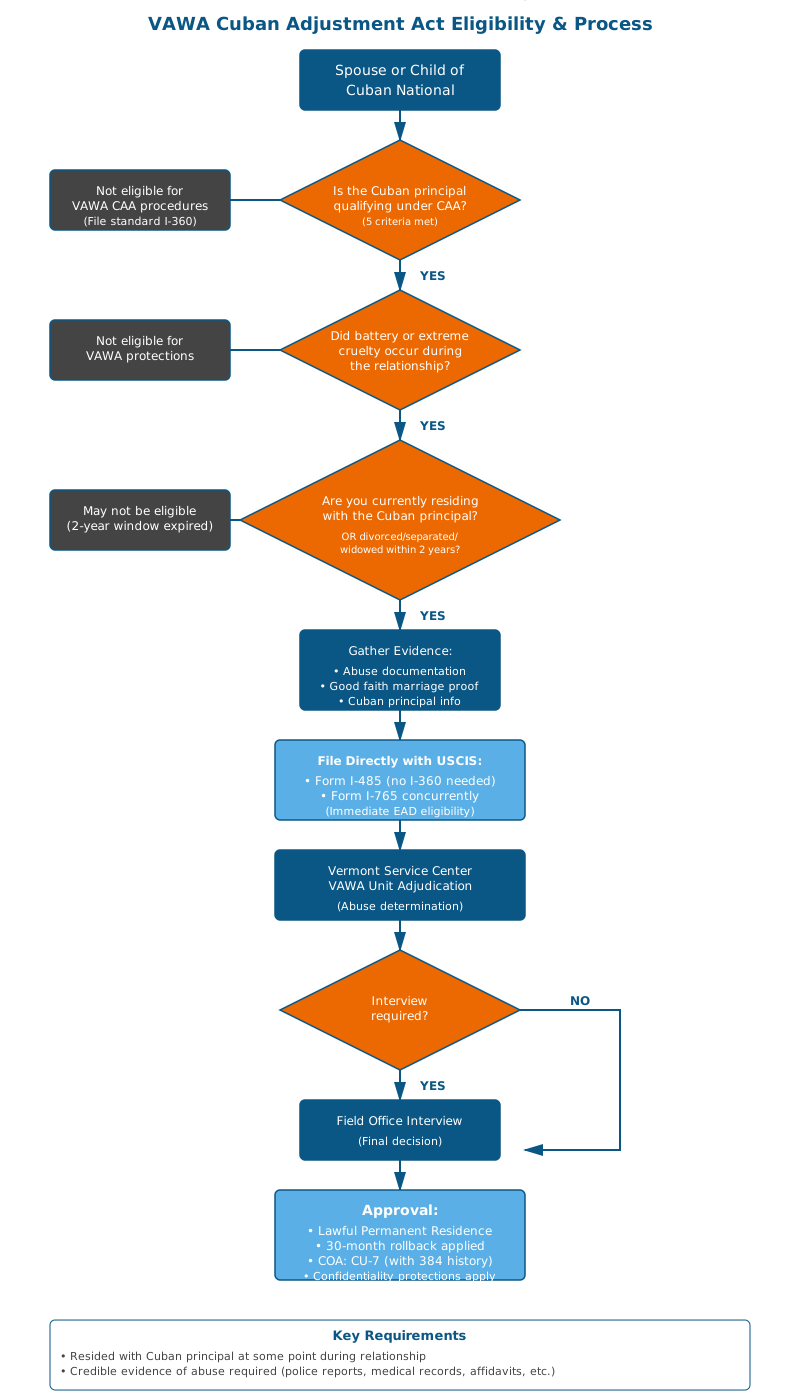
Before examining VAWA CAA procedures, a threshold question determines eligibility: Does the alleged abuser qualify as a “qualifying Cuban principal”? If not, the derivative cannot use Cuban Adjustment Act procedures at all and would instead need to file a standard Form I-360 VAWA self-petition.
A qualifying Cuban principal is an individual who meets all five of these criteria:
- Was inspected and admitted or paroled into the United States after January 1, 1959
- Has been physically present in the United States for at least one year
- Is eligible to receive an immigrant visa
- Is admissible to the United States for lawful permanent residence (or waiver-eligible under INA § 212(g), (h), or (i))
- Has applied for adjustment of status and is eligible for such adjustment, or has already adjusted status (whether under the Cuban Adjustment Act or another provision)
The fifth criterion is particularly important. The Cuban principal need not have adjusted specifically under the Cuban Adjustment Act—adjustment under any provision of law satisfies this requirement, as long as all other CAA criteria are met.
If the Cuban principal does not meet these five criteria, VAWA CAA procedures do not apply. The derivative would pursue relief through standard VAWA channels: filing Form I-360, waiting for approval, then filing Form I-485 for adjustment of status.
Standard VAWA Process vs. VAWA CAA Process
Understanding the procedural differences between standard VAWA cases and VAWA CAA cases clarifies why the Cuban Adjustment Act path offers significant advantages.
Standard VAWA Process:
- File Form I-360, Petition for Amerasian, Widow(er), or Special Immigrant, checking the VAWA self-petitioner box
- Submit evidence of the qualifying relationship (marriage certificate, birth certificate)
- Submit evidence of battery or extreme cruelty
- Submit evidence of good faith marriage (for spousal cases)
- Wait for I-360 approval or prima facie determination
- After I-360 approval, file Form I-485, Application to Register Permanent Residence or Adjust Status
- USCIS issues a bona fide determination on the I-485
- After bona fide determination, the applicant becomes eligible to file Form I-765, Application for Employment Authorization
- Work authorization typically arrives 6–12 months after filing the I-485, depending on processing times
VAWA CAA Process:
- File Form I-485 directly, selecting “I am the husband, wife, or minor unmarried child of a Cuban…” as the application type
- Submit evidence of the qualifying relationship to the Cuban principal (same as standard VAWA)
- Submit evidence of battery or extreme cruelty (using “any credible evidence” standard)
- Submit evidence verifying the Cuban principal’s status or pending application
- File Form I-765 concurrently with the I-485
- Work authorization eligibility begins immediately based on the pending I-485, not dependent on a separate bona fide determination
- Case is adjudicated by the Vermont Service Center VAWA Unit
The critical difference is procedural efficiency and work authorization timing. In standard VAWA cases, employment authorization depends on a multi-step process: I-360 filing, approval or prima facie determination, I-485 filing, then bona fide determination before EAD eligibility. In VAWA CAA cases, the I-765 can be filed concurrently with the I-485, and work authorization eligibility is based on the pending adjustment application itself.
This difference matters practically. An individual fleeing domestic violence often needs immediate work authorization to achieve financial independence. The VAWA CAA process provides that authorization months earlier than the standard VAWA route. In standard VAWA cases, petitioners must prove abuser citizenship or LPR status—for guidance on proving abuser citizenship, see proving abuser citizenship. Cuban nationals using CAA avoid this requirement entirely.
No Form I-360 Required
Perhaps the most significant procedural distinction is that VAWA CAA applicants do not file Form I-360 at all. The Policy Memorandum states this explicitly: “A VAWA self-petition is not required.”
Instead, the applicant files Form I-485 directly, using the same application type that non-abused spouses and children of Cuban principals use. On the current form, this means selecting “I am the husband, wife, or minor unmarried child of a Cuban…” even though the applicant is no longer residing with the Cuban principal.
This creates an apparent contradiction—the form asks whether the applicant is the spouse or child of a Cuban national, and residency is typically implied by that relationship category. But the VAWA amendments specifically allow abused spouses and children to use this application type even when they are no longer residing with the Cuban principal at the time of filing.
The absence of an I-360 requirement means there is no separate approval step before adjustment. Evidence of battery or extreme cruelty is submitted directly with the I-485, and USCIS adjudicates both the abuse determination and the adjustment application as part of a single proceeding.
Evidence of Battery or Extreme Cruelty
USCIS applies the “any credible evidence” standard from INA § 204(a)(1)(J) to VAWA CAA cases. This is the same flexible evidentiary standard used in traditional VAWA self-petitions. The applicant does not need to meet a specific evidentiary checklist—any credible evidence that demonstrates battery or extreme cruelty during the relationship is sufficient.
Examples of credible evidence include:
– Police reports documenting domestic violence incidents
– Orders of protection or restraining orders
– Medical records showing injuries consistent with abuse
– Photographs of injuries
– Affidavits from the applicant describing the abuse
– Affidavits from witnesses who observed the abuse or its effects
– Psychological evaluations or counseling records
– Documentation of controlling behavior (financial records showing economic control, correspondence showing isolation from family)
The adjudicator has sole discretion to determine whether evidence is credible and what weight to give it. In weighing evidence, USCIS considers several issues as particularly salient:
– Whether the abuse occurred in the relationship
– Whether the applicant resided with the Cuban principal at some point during the relationship
– Whether, if the marriage terminated other than by death, the termination was connected to the claimed abuse
– Whether, if the principal has died, the applicant filed Form I-485 within two years of the principal’s death
– Whether, if the principal has lost LPR status, the loss of status was due to an incident of domestic violence
The Policy Memorandum clarifies that while evidence similar to what would support a Form I-360 VAWA petition is relevant, a formal I-360 is not required. The burden rests with the applicant to demonstrate eligibility by a preponderance of the evidence.
The Good Faith Marriage Requirement
One aspect of VAWA CAA cases that differs subtly from standard VAWA petitions is the treatment of the good faith marriage requirement. The Policy Memorandum and implementing guidance in AFM 23.11 do not explicitly restate a good faith marriage requirement for VAWA CAA cases, though this requirement is central to traditional VAWA petitions.
This apparent omission is not an oversight. The good faith marriage requirement is already embedded in Cuban Adjustment Act eligibility for derivative spouses. AFM 23.11(h) requires non-Cuban spouses to provide “evidence that the marriage has not been entered into solely to convey immigration benefits (i.e., with fraudulent intent).”
Because VAWA CAA applicants are seeking adjustment under the Cuban Adjustment Act—just with the residency requirement waived due to abuse—the underlying CAA eligibility criteria still apply. The marriage must have been valid and entered into in good faith. The VAWA amendments waive the requirement of current residency when abuse has occurred, but they do not waive the requirement that the marriage itself was bona fide.
In practice, this means VAWA CAA applicants must satisfy two distinct standards:
- The Cuban Adjustment Act standard for derivative spouses (valid marriage entered into in good faith, not solely for immigration benefits)
- The VAWA standard for abused spouses (battery or extreme cruelty occurred during the relationship)
Evidence of a bona fide marriage—joint financial accounts, joint lease agreements, photographs together, evidence of commingling lives—remains relevant in VAWA CAA cases just as it is in standard CAA cases. The VAWA amendments address the abuse element and the residency requirement; they do not eliminate the underlying marriage validity requirement.
Vermont Service Center VAWA Unit Jurisdiction
All VAWA CAA applications are adjudicated by the Vermont Service Center’s VAWA Unit, regardless of where the applicant resides. This specialized unit handles all VAWA-related adjustment applications and has expertise in evaluating evidence of battery and extreme cruelty.
The Vermont Service Center may refer a VAWA CAA application to the appropriate field office for an interview. If VSC decides to relocate the application, the adjudicating officer at VSC will first render an opinion on the abuse determination, then relocate the individual’s A-file to the field office for a final decision on the adjustment application.
This bifurcated process means the abuse determination—the core VAWA issue—remains within the specialized VAWA Unit’s expertise, even if the adjustment interview occurs at a local field office.
Class of Admission and Confidentiality Protections
VAWA CAA applications receive special handling within USCIS systems. When a VAWA CAA application is filed, the adjudicating officer updates the Central Index System with Class of Admission code 384. This code identifies the case as specially protected under VAWA confidentiality provisions.
If the application is approved, the final Class of Admission becomes CU-7 (the standard code for non-Cuban spouses and children adjusting under the Cuban Adjustment Act). However, the CIS history screen maintains the previous 384 code, preserving the record of VAWA protection.
VAWA confidentiality requirements under 8 U.S.C. § 1367 apply to VAWA CAA applicants exactly as they do to all VAWA cases. The Policy Memorandum makes an important clarification on this point: an abused spouse or child with a pending or approved VAWA CAA application is considered a “VAWA self-petitioner” as defined at INA § 101(a)(51)(D), even though no Form I-360 was filed.
This means all confidentiality protections apply: USCIS cannot disclose information about the application to the abuser, and if the application is denied, confidentiality protections continue until all final appeal rights are exhausted. These protections are not dependent on filing a separate I-360 petition—they attach automatically to the VAWA CAA adjustment application.
The 30-Month Rollback Provision
One of the most valuable benefits of Cuban Adjustment Act cases is the “rollback” provision. When USCIS approves an I-485 under the Cuban Adjustment Act, the alien’s admission for permanent residence is backdated to 30 months prior to filing the application, or the date of last arrival in the United States, whichever is later.
VAWA CAA cases preserve this rollback benefit. The non-Cuban spouse or child receives the full 30-month rollback, even if that means the individual becomes a lawful permanent resident before the date on which they became the Cuban principal’s spouse or child. This rule was confirmed in Silva-Hernandez v. USCIS, 701 F.3d 356 (11th Cir. 2012).
The practical effect is that a VAWA CAA applicant who files three years after arriving in the United States will have a permanent residence date that is 30 months earlier than the application filing date—potentially predating the marriage itself. This earlier permanent residence date accelerates eligibility for naturalization and other time-dependent immigration benefits.
Previously Filed VAWA Self-Petitions
In some cases, an abused spouse or child may have already filed a Form I-360 VAWA self-petition before learning about VAWA CAA procedures, or may have filed an I-360 because the Cuban principal’s status was uncertain. The existence of a prior I-360 does not prevent filing a VAWA CAA application, but the adjudicating officer must review the entire record.
A previously approved I-360 based on the same relationship may be considered persuasive evidence that abuse occurred. However, the adjudicator should not assume the alleged abuser and the basis for the I-360 claim are identical to the basis for the VAWA CAA application.
Similarly, a previously denied I-360 is not necessarily proof that the VAWA CAA claim is unfounded. The I-360 may have been denied because the abuser was not an LPR at the time of filing, or for other reasons unrelated to whether abuse actually occurred. In such cases, the adjudicating officer must request the complete A-file and review the evidence and reason for denial before making a decision on the VAWA CAA application.
If an I-360 is pending at the time a VAWA CAA application is filed, the adjudicator has discretion to wait for a final decision on the I-360 before rendering a decision on the adjustment application. The adjudicator may also contact VSC to request expedited processing of the I-360.
Providing Information About the Cuban Principal
Unlike traditional derivative Cuban Adjustment Act cases where the spouse or child files jointly with or after the principal’s adjustment, VAWA CAA applicants may be filing independently. They are not required to provide a copy of the Cuban principal’s adjustment application, but they must provide sufficient information to enable USCIS to verify the principal’s status or pending application.
This verification information may include:
– The Cuban principal’s full name
– Date of birth
– Place of birth
– Parents’ names
– Alien registration number (A-number)
– Form I-94 information
– Social security number
– Other identifying information that allows USCIS to locate the principal’s immigration record
The purpose of this information is purely administrative—to confirm that the person who subjected the applicant to abuse is in fact a qualifying Cuban principal as defined by statute and regulation.
Current Enforcement Environment and Case Evaluation
In December 2025, USCIS issued Policy Alert PA-2025-33, updating Volume 3 of the USCIS Policy Manual in response to what the agency characterized as “rampant fraud” in VAWA filings. Between fiscal years 2020 and 2024, USCIS reported a 360 percent increase in Form I-360 VAWA self-petitions, with particularly sharp increases in filing patterns that historically represented a small fraction of VAWA cases.
While VAWA CAA cases do not require filing Form I-360, the heightened scrutiny USCIS now applies to VAWA evidence affects all VAWA-related applications, including those filed under the Cuban Adjustment Act. USCIS has made clear that “any credible evidence” does not mean “any evidence at all”—adjudicators retain full discretion to determine credibility and weight, and applications lacking substantial support may be denied without a Request for Evidence.
This enforcement environment makes careful case evaluation essential. Not every marital conflict constitutes battery or extreme cruelty under VAWA standards. Not every brief or troubled marriage demonstrates the good faith relationship required under the Cuban Adjustment Act. Filing a case that lacks evidentiary support wastes the applicant’s time and filing fees, contributes to processing backlogs that delay legitimate cases, and—under current USCIS practice—may result in denial and issuance of a Notice to Appear in removal proceedings.
Our office evaluates VAWA CAA cases using the same careful analysis we apply to all VAWA matters. We review the evidence of abuse to determine whether it meets the “any credible evidence” standard, assess whether the marriage demonstrates good faith under Cuban Adjustment Act requirements, and evaluate whether the case can be presented with sufficient documentary support to withstand heightened scrutiny. We would rather advise a prospective client honestly about evidentiary weaknesses at the consultation stage than proceed with a case unlikely to succeed.
When VAWA CAA Protection Matters
The intersection of VAWA and the Cuban Adjustment Act addresses a specific problem: protecting individuals who came to the United States as derivatives of Cuban principals, suffered abuse during the relationship, and can no longer reside safely with the abuser. The statutory framework recognizes that forcing victims to choose between immigration status and personal safety undermines both the Cuban Adjustment Act’s humanitarian purpose and VAWA’s protective intent.
For individuals in this situation, the procedural advantages matter. The ability to file Form I-485 directly, without first obtaining I-360 approval, streamlines the process. The immediate eligibility for work authorization based on a pending I-485, rather than waiting for a bona fide determination, provides financial independence months earlier. The preservation of the 30-month rollback accelerates long-term immigration benefits.
But these advantages only help individuals whose cases satisfy the substantive requirements: a qualifying Cuban principal, battery or extreme cruelty during a bona fide relationship, and credible evidence to support both elements. VAWA CAA protection is not automatic, and it is not available to everyone who experienced a difficult marriage or separation from a Cuban spouse.
If you are the abused spouse or child of a Cuban national who has applied for or received lawful permanent residence under the Cuban Adjustment Act, VAWA amendments to the CAA may preserve your ability to adjust status even after the relationship has ended. The procedural path differs from standard VAWA cases in ways that offer significant practical advantages, but the evidentiary requirements remain substantial and the current enforcement environment demands careful preparation.
___
Christopher J. Flann has practiced immigration law across the Rocky Mountain West since 1996. His office serves clients in Montana, North Dakota, Wyoming, and neighboring states. For questions about VAWA protection under the Cuban Adjustment Act or other Cuban immigration matters, contact Immigration Law of Montana, P.C.