What PERM Actually Is — and What It Isn’t
The Department of Labor describes PERM—Program Electronic Review Management—as a test of the labor market. The theory is straightforward: before an employer sponsors a foreign national for a green card, the employer must demonstrate that no qualified U.S. worker is available and willing to take the job at the prevailing wage. If the test comes back negative, the government issues a labor certification, and the employer can proceed with the immigrant petition.
In practice, PERM functions as something else: a technical compliance exercise. The government does not evaluate whether you genuinely recruited. It evaluates whether each of dozens of regulatory requirements was met precisely. The correct wage. The correct publications. The correct number of advertising steps. The correct duration of posting. The correct documentation of each applicant and a lawful reason for each rejection. Fail any of these requirements and the application is denied—regardless of whether the recruitment was real and thorough.
Most employers who encounter PERM for the first time do not understand this. They reasonably assume that if they ran a good-faith search and found no qualified applicants, they have done what the law requires. This assumption produces a disproportionate share of the denials we see.
One illustration: an employer came to us after receiving a denial on a PERM application he had filed himself. The denial letter listed six separate reasons. He was, by any measure, a sophisticated person—the kind of employer who had done significant research before attempting the application on his own. After reviewing the denial with him, the lesson was not that he had recruited badly. The lesson was that PERM’s technical requirements are not intuitive, and the consequence of getting any of them wrong is the same as getting all of them wrong.
This is why employers who approach PERM as a paperwork exercise tend to have better outcomes than those who approach it as a recruitment exercise. The paperwork has to be exactly right. The recruitment, of course, also has to be real.
Which Green Card Categories Require PERM
Not every employment-based green card requires labor certification. Understanding where PERM fits in the preference system prevents misallocated effort.
Categories that require PERM:
- EB-2, Second Preference: advanced degree professionals and persons of exceptional ability (when not applying under National Interest Waiver)
- EB-3, Third Preference: professionals with a bachelor’s degree, skilled workers requiring at least two years of training or experience, and unskilled workers
Categories that do not require PERM:
- EB-1A: aliens of extraordinary ability (self-petition)
- EB-1B: outstanding professors and researchers
- EB-1C: multinational managers and executives
- EB-2 National Interest Waiver: PERM waived by USCIS where the petitioner demonstrates the waiver is in the national interest
For most employers in the Rocky Mountain West sponsoring skilled workers or professionals, the EB-2 and EB-3 categories—and therefore PERM—are the path. The distinction between EB-3 skilled worker (requiring at least two years of training or experience) and EB-3 other worker (less than two years of training or experience) is not merely semantic: other worker has carried a significant visa backlog for years. An employer whose position genuinely warrants a two-year experience requirement will be sponsoring someone into the skilled worker category, with meaningfully shorter wait times.
This reality creates a temptation that we address directly with clients. If the EB-3 skilled worker category produces faster results, why not write requirements that reach the two-year threshold? The answer is that DOL’s occupational classification system will not support requirements that exceed what the position actually warrants. Attempting to inflate requirements to reach the skilled worker category—when the position’s O*NET Specific Vocational Preparation (SVP) rating supports only three to twelve months of training—produces applications that are structurally unsound. The anti-tailoring regulations catch exactly this, and a denial is the typical result.
Before Recruitment Begins: Getting the Job Description Right
The job description is the foundation of the PERM application, and it is where most of the attorney’s practical work gets done. Everything that follows—the prevailing wage determination, the recruitment, the evaluation of applicants, the final filing—flows from what the job description says.
The governing rule is that requirements must reflect the employer’s genuine minimum qualifications for the position, not the beneficiary’s credentials, not the employer’s wish list, and not requirements engineered to match the alien uniquely. 20 C.F.R. § 656.17(h) prohibits tailoring requirements to the beneficiary. This is not a difficult concept in the abstract. It is surprisingly difficult to apply when the employer has been working with a particular individual for years and has conflated what they need with what that person has.
A useful example from agricultural practice: an employer wishes to sponsor a ranch hand who has worked for the operation for a decade. When asked to describe the job requirements, the employer naturally says the job requires ten years of experience—because that’s how long the employee has been there. Setting aside the self-referential nature of that requirement, it also has no regulatory support. DOL’s occupational classification for a ranch hand carries an SVP of 3 to 4, which translates to three months to one year of training or experience as the supportable maximum. Requiring ten years invites an immediate challenge to business necessity, and “my employee has ten years” is not a business necessity argument the regulations will accept.
The attorney’s job at this stage is to help the employer understand how the government sees their position—what the occupational classification says, what experience level that classification supports, and what the difference is between what they want to state and what they can defensibly state. That conversation requires time and occasionally requires convincing an employer to accept a job description that feels like a downgrade. It protects the application.
The same analysis governs educational requirements, training requirements, and any special requirements the employer wants to add. Each requirement must have a defensible business rationale. Requirements that exist solely to match the beneficiary’s profile will not survive scrutiny.
For a detailed analysis of how educational credentials and prior experience are evaluated under the PERM regulations—including the specific rules that apply when the beneficiary has worked for the sponsoring employer—see our article on PERM education and experience requirements.
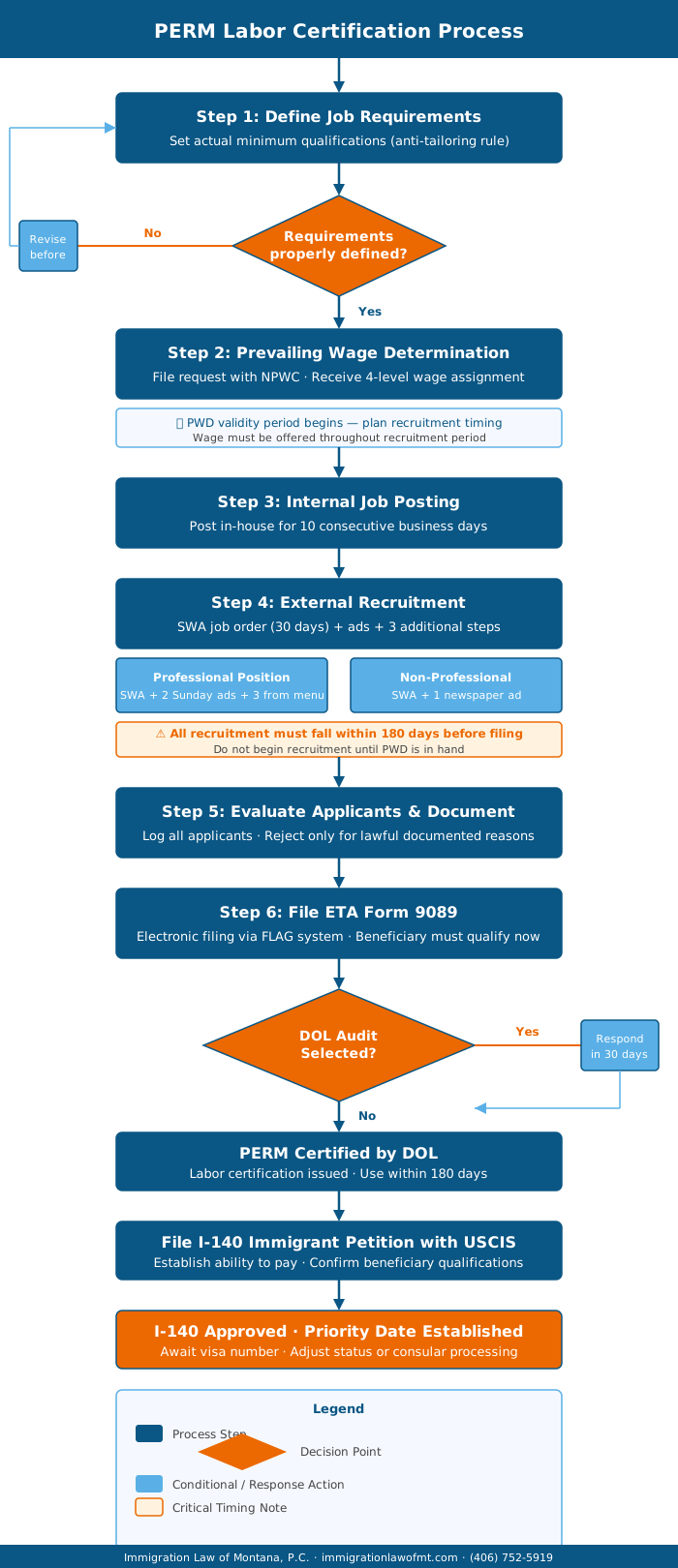
Step 1 — Prevailing Wage Determination
The employer cannot begin recruitment until it has a prevailing wage determination (PWD) from DOL’s National Prevailing Wage Center. The PWD establishes the minimum wage the employer must offer and reflects O*NET occupational classification and OEWS survey data for the geographic area of employment.
Wages are assigned at four levels: Level I (entry), Level II (qualified), Level III (experienced), Level IV (fully competent). The level flows from the complexity and supervision level specified in the job description. The more complex and autonomous the stated requirements, the higher the assigned level. This creates a direct cost feedback loop: employers who write requirements calling for complex independent judgment receive high wage levels. Employers whose positions are correctly classified at entry or qualified level receive more modest wage assignments.
The PWD has a validity period, and all recruitment must be completed while it remains valid. If the determination expires before the application is filed, a new request is required.
The Combination of Duties Problem
One of the more consequential and underappreciated aspects of prevailing wage determination is how DOL handles positions that involve duties drawn from multiple occupational classifications. This is most visible in agricultural and rural employment contexts, but it can arise in any position where the job does not map cleanly to a single O*NET code.
Agricultural employment provides the clearest illustration. A position in Montana or North Dakota that involves fieldwork during the growing season cannot state only agricultural duties—seasonal work alone does not constitute a permanent position, and DOL historically challenged agricultural PERMs on precisely this ground. The employer must describe what the employee does during the winter months when field operations are not possible. In this region, common winter duties include farm equipment maintenance, repairs, and storage preparation; hauling grain or other commodities; and general facility maintenance.
The problem is that these winter duties may carry their own occupational classifications. Farm mechanic work and over-the-road trucking are not the same occupational category as agricultural equipment operator. When a position involves significant duties from a higher-wage classification, DOL may designate the position as a combination-of-duties case and assign the wage from the higher-paying occupational category—or, in some interpretations, an automatic Level III wage to reflect the complexity of a multi-classification role.
We have seen this pattern in recent prevailing wage determinations. A position where truck driving accounts for five to fifteen percent of the total duties—hauling grain to the elevator a few times a month during harvest, or delivering equipment parts during the off-season—has received a prevailing wage based on the truck driver classification rather than the agricultural worker classification. The wage differential can be significant and can make an otherwise viable sponsorship economically impractical.
This does not mean positions with mixed duties cannot be sponsored. It means they require careful attention to how duties are described, what percentage of time each duty occupies, and how the position is classified in the PWD request. Getting this right before filing the PWD request is substantially easier than challenging an assigned wage level after it arrives.
Step 2 — Internal Job Posting
Before external recruitment begins, the employer must post a notice of the job opportunity in-house for at least ten consecutive business days. The posting must state the wage or wage range, the job duties, the location, the minimum requirements, and that the employer is sponsoring a foreign national for permanent residence in connection with the position.
Current employees who meet the minimum requirements and express interest cannot be disregarded. DOL expects genuine consideration of domestic applicants at every stage, and the internal posting requirement is not a formality. If the employer is subject to a collective bargaining agreement covering the occupation, the union must also receive notice.
Step 3 — External Recruitment
External recruitment requirements differ by whether the position is classified as professional (requiring a bachelor’s degree or higher) or non-professional.
Professional Positions
Professional positions require a State Workforce Agency (SWA) job order maintained for at least 30 consecutive calendar days, two Sunday newspaper advertisements in a paper of general circulation in the area of employment, and at least three additional steps selected from the regulatory menu at 20 C.F.R. § 656.17(e)(1)(ii). That menu includes job fairs, the employer’s website, job search websites, on-campus recruiting, trade or professional organizations, private employment firms, employee referral programs, campus placement offices, and local and ethnic newspapers.
The selection of the three additional steps should reflect the nature of the position. A physician sponsorship calls for sourcing through medical professional channels; a software engineer position calls for technology-specific job boards. The goal is channels where qualified candidates actually search.
Non-Professional Positions
Non-professional positions require a SWA job order and one newspaper advertisement, which may appear in a trade or professional publication if appropriate for the occupation.
Timing
All recruitment must fall within the 180-day period immediately before the PERM application is filed. Recruitment should not begin until the PWD is in hand, to ensure the offered wage in the advertising meets or exceeds the determination throughout the recruitment period.
Step 4 — Evaluating Applicants and Documenting Results
After recruitment closes, the employer logs every applicant and documents the disposition of each application. Rejection reasons must be based on the applicant’s failure to meet the stated minimum requirements—not on comparisons to the beneficiary and not on criteria absent from the job description.
The regulations enumerate permissible rejection grounds. Any reason outside that list creates audit exposure. This documentation is not submitted with the initial application but must be retained for five years and produced promptly on audit request.
Step 5 — Filing the ETA Form 9089
With recruitment complete and documentation in order, the employer files ETA Form 9089 electronically through DOL’s FLAG system. The beneficiary must satisfy all stated job requirements as of the filing date. There is no amendment process.
Particular care is required for: qualifications that depend on a pending credential; degrees earned during employment with the sponsoring employer (which carry specific regulatory restrictions on their use); and the 180-day window, which begins from the start of recruitment. For the full analysis of qualification rules, see our article on using education and experience to qualify for PERM.
DOL Review: Audits, RFIs, and How Practice Has Changed
The process by which DOL reviews PERM applications has changed meaningfully over the years, and understanding current practice helps employers calibrate their expectations.
The Historical Pattern
In earlier years, DOL’s pre-certification scrutiny focused heavily on the recruitment itself—whether the employer actually conducted the required advertising, whether the steps were completed in the right order, and whether applicants were evaluated fairly. Agricultural PERMs in particular attracted consistent pre-certification audit activity around two issues: whether the position was genuinely permanent given the seasonal nature of the work, and how an employer who had previously relied on temporary H-2A workers could now claim a permanent year-round need. These were substantive questions that required substantive documentation and legal argument to answer.
Current Practice: RFIs and the Ability-to-Pay Emphasis
DOL now refers to pre-certification inquiries as Requests for Information (RFIs) rather than audits, though the practical effect—a request for documentation before a certification will issue—is similar. What has changed is the focus of the inquiries.
Current RFIs frequently raise ability-to-pay questions: can the employer demonstrate the financial capacity to pay the offered wage? This question sits somewhat awkwardly in the PERM framework, which is principally concerned with the existence and good-faith execution of recruitment rather than the employer’s balance sheet. The I-140 petition that follows PERM is the traditional venue for ability-to-pay analysis.
DOL’s stated rationale is that a job opportunity is not real if the employer cannot pay the wage, and an unreal job opportunity is not a genuine labor market test. That framing is defensible, and the practical response is to anticipate the question. Employers who are small businesses, newer operations, or agricultural enterprises with seasonal revenue patterns should be prepared with financial documentation before the question is asked.
The agricultural-specific questions that formerly generated frequent pre-certification scrutiny—year-round employment and the seasonal-to-permanent transition—have become less common in recent RFI practice. Whether this reflects a shift in DOL’s priorities or simply the result of those issues being well-litigated in earlier cases is difficult to say with certainty.
A Note on Patterns in Audit Selection
One observation from extended practice in this area: there is a noticeable pattern in how audit and RFI activity concentrates. Applications from attorneys who have a track record of responding to inquiries with complete, organized documentation—producing recruitment records, prevailing wage determinations, job posting evidence, and applicant logs on request, every time—appear to draw less scrutiny over time than applications from sources with a less consistent record.
Whether DOL maintains informal practitioner profiles, or whether this pattern reflects something else, is not something the government confirms publicly. What can be said is that honest, careful practice—where every recruitment step is genuine, every document is retained, and every RFI is answered fully—builds a record that speaks for itself over time.
After PERM Certification: The Path to a Green Card
An approved labor certification must be used promptly. The employer files the I-140 immigrant petition with USCIS upon receiving the certification. The priority date—the beneficiary’s place in the visa queue—is set when DOL accepts the PERM application, not when USCIS approves the I-140. Filing the I-140 quickly after PERM approval protects the priority date without extending the wait.
The I-140 petition establishes the employer’s ability to pay the offered wage and confirms the beneficiary’s qualifications. Once approved and a visa number is available, the beneficiary applies for adjustment of status (Form I-485, if present in the United States) or an immigrant visa through consular processing.
For Canadian nationals, most EB-2 and EB-3 categories do not carry per-country backlog waits. Canadian professionals in the Rocky Mountain West who are already working in TN or H-1B status typically move from I-140 approval to adjustment of status without significant delay—making PERM-based sponsorship a realistic path when the employment is stable and the employer is willing to commit to the process.
Common Reasons PERM Applications Fail
- Inflated or tailored requirements. Requirements that exceed what the occupational classification supports, or that match the beneficiary’s specific credentials, invite challenge under the anti-tailoring regulations.
- Combination-of-duties wage problems. Positions with duties from multiple occupational classifications—particularly those mixing agricultural, mechanical, or transportation duties—can receive unexpectedly high prevailing wage assignments if not structured carefully.
- Recruitment process errors. Missing a required step, using incorrect publications, or failing to maintain the posting for the required duration can void the recruitment period entirely.
- Inadequate applicant documentation. Failing to log applicants systematically, or using rejection reasons not supported by the stated requirements, creates serious exposure on audit.
- Prevailing wage errors. Offering a wage below the PWD, using an expired determination, or misclassifying the occupational category are grounds for denial that require complete refiling.
- Timing errors. Filing outside the 180-day recruitment window, or after the PWD expires, invalidates the application regardless of how well the recruitment was conducted.
- Beneficiary qualification errors. Certifying that the beneficiary meets the requirements when they do not—a particular issue when advanced degrees were earned during employment with the sponsor—is both a denial risk and a potential misrepresentation issue.
Planning a Realistic Timeline
End-to-end, a PERM application with no audit or RFI typically takes twelve to twenty-four months from sponsorship decision to certified labor certification, depending on DOL workload. Add I-140 processing and any wait for a visa number, and the full timeline from decision to available visa is two or more years for most beneficiaries.
Status maintenance during this period requires attention. TN visa status is compatible with a pending PERM application—TN does not carry an affirmative nonimmigrant-intent requirement. H-1B status carries statutory portability protections that preserve employment authorization while the green card process moves forward. The intersection of current status and the PERM timeline is a planning question to address at the beginning of sponsorship, not after the certification arrives.
What an Attorney Actually Does in a PERM Case
The technical compliance picture described above explains why PERM is not a do-it-yourself project for employers who are not specialists. The consequences of getting requirements wrong, timing wrong, or documentation wrong are severe, and most of the errors that produce denials are invisible to employers who are not familiar with the regulatory framework.
The practical work of a PERM attorney is front-loaded. Before a single advertisement is placed, we work through the job description with the employer: what the government’s occupational classification says about the position, what SVP rating that classification carries, what experience and educational requirements that rating will support, and whether the requirements the employer wants to state are defensible or need to be modified. Sometimes that conversation requires redirecting an employer who has arrived with a job description built around their current employee rather than around the position.
Position complexity varies considerably across practice areas. A physician sponsorship presents a clear example of a well-defined professional PERM. The requirements for a beginning physician—medical degree, residency completion, state licensure—are standard, well-documented, and align precisely with what O*NET expects of the occupation. There is no experience inflation problem and no combination-of-duties issue. Physician PERMs, handled competently, tend to move through the process smoothly.
Agricultural PERMs sit at the other end of the complexity spectrum. The year-round employment requirement, the combination-of-duties analysis, the need to anticipate how winter duties will affect the prevailing wage determination, and the documentation intensity that rural employment typically involves all require careful advance planning. The same is true for specialized industrial, research, and technical positions where duties cross classification boundaries.
Across all of these, the core attorney function is the same: build an application that is correct from the start, because PERM offers very limited opportunity to repair errors after they occur. The employer who invests time in the job description conference, and who retains complete documentation through the process, will experience PERM as a slow bureaucratic procedure with a predictable outcome. The employer who approaches it as a form-filling exercise will sometimes have a different experience.
Our office has handled PERM sponsorships across the Rocky Mountain West for employers in agriculture, healthcare, technical industries, and other fields, including for Canadian professionals whose status makes PERM-based sponsorship a practical long-term path. If you have questions about a specific sponsorship situation, we welcome the conversation.
Contact Immigration Law of Montana, P.C. — Montana: (406) 752-5919