If you are a Canadian national who has received E-2 investor visa status to operate a trucking company in the United States, you have almost certainly seen the headlines. Fatal crashes. Senate hearings. An executive order on English proficiency. A proposed federal law named after a five-year-old girl who was catastrophically injured when an undocumented trucker lost control of his rig in California. The Trump administration’s campaign against unsafe foreign commercial drivers has been aggressive, and it is accelerating.
The natural question, if you hold an E-2 or are in the process of applying for one, is whether any of this touches you. The short answer is no — but understanding why requires a closer look at what the administration is actually targeting. The regulations are not directed at lawfully admitted investors operating businesses. They are directed at a specific and well-documented abuse: undocumented individuals and asylum applicants using Employment Authorization Documents to obtain commercial driver’s licenses without the immigration screening that any visa holder goes through as a matter of course.
This article explains each of the administration’s regulatory actions, identifies exactly what problem each one addresses, and explains why E-2 trucking entrepreneurs are structurally outside the target zone of every measure currently in effect or proposed.
What the Administration Has Actually Done
The regulatory response has unfolded in layers since early 2025. Each layer addresses a different piece of the same underlying problem.
Executive Order on English Proficiency — April 28, 2025
President Trump’s April 2025 Executive Order reactivated strict enforcement of English language proficiency requirements that were already on the books at the Federal Motor Carrier Safety Administration (FMCSA). The longstanding rule at 49 CFR § 391.11 requires commercial drivers to be able to converse with law enforcement, read English road signs, respond to official inquiries, and complete driver logs without assistance. A 2016 FMCSA memo had effectively neutered enforcement by advising inspectors not to place drivers out of service for language violations alone. That memo is now reversed.
Since June 2025, inspectors conducting roadside checks have been placing non-English-proficient drivers out of service immediately. Secretary Duffy subsequently directed that CDL written tests be administered in English only — closing a loophole that California and a handful of other states had used to allow testing in Spanish and other languages.
Emergency Action on Non-Domiciled CDLs
A non-domiciled commercial driver’s license is a CDL issued by a U.S. state to a person whose legal home — their domicile — remains in a foreign country. These licenses were designed primarily for cross-border truckers from Canada and Mexico who operate into the United States without establishing U.S. residence. The FMCSA launched a nationwide audit of non-domiciled CDL issuance and found systemic problems, most severely in California, where more than 25% of non-domiciled CDLs reviewed were improperly issued. In some cases, California had issued licenses that remained valid years after the holder’s lawful U.S. presence had expired.
Secretary Duffy issued an emergency rule restricting non-domiciled CDL eligibility to holders of employment-based visas and requiring states to query the Systematic Alien Verification for Entitlements (SAVE) system to confirm every applicant’s immigration status before issuing a license.
That emergency rule was stayed by the U.S. Court of Appeals for the D.C. Circuit in November 2025 pending further review. However, the Department of Transportation has since issued a final rule with the same requirements, which supersedes the stayed interim rule and takes effect 30 days after Federal Register publication.
Proposed Dalilah Law
Named after Dalilah Coleman, a young girl severely injured in a 2024 California crash caused by an undocumented trucker, the proposed Dalilah Law would prohibit any state from issuing a CDL to an undocumented immigrant. This bill has not been introduced in Congress and is not yet law. It would require legislation to take effect.
State Enforcement Actions
California, Washington, and New Mexico have received formal notices threatening suspension of federal Motor Carrier Safety Assistance Program funding if they do not demonstrate compliance with English language proficiency requirements. California faces additional scrutiny for its non-domiciled CDL practices. Illinois received a letter citing over a dozen cases of CDLs issued to drivers from Ukraine, Russia, and Venezuela whose lawful presence had expired or was never verified. These enforcement actions reflect the administration’s willingness to use federal funding leverage against non-compliant states.
The Core Problem the Administration Is Solving
To understand why none of this affects E-2 investors, you need to understand what problem these measures are designed to fix. The administration’s stated concern, supported by FMCSA audit findings, involves three overlapping failures:
- The EAD loophole — An Employment Authorization Document proves work authorization but does not prove that the holder entered the United States legally, passed any consular screening, or has a verifiable driving record in their home country. Asylum applicants — many of whom arrived without inspection or with no prior visa — could present an EAD to a state DMV, take a CDL test (sometimes in their native language), and receive a commercial license to operate an 80,000-pound vehicle, without any immigration background check.
- Non-domiciled CDL abuse — Some states, particularly California, issued non-domiciled CDLs to individuals whose lawful presence had already expired, effectively creating a class of commercial drivers with no current legal status and no ability to be verified against U.S. or foreign driving records.
- No foreign driving record access — Unlike U.S. citizen applicants, states have no ability to query foreign driving records. An individual from India or Venezuela with a history of serious traffic violations could obtain a U.S. CDL with a clean slate simply because there is no data pipeline between U.S. DMVs and foreign motor vehicle authorities.
| Every measure in the administration’s CDL crackdown is aimed at this specific pathway: unauthorized or insufficiently screened individuals using EADs or expired status documents to obtain commercial licenses without the background scrutiny that any visa applicant receives as a matter of course. An E-2 investor passed through that scrutiny before ever setting foot in the United States. |
Why E-2 Trucking Investors Are in a Different Category
Domicile: The Most Important Distinction
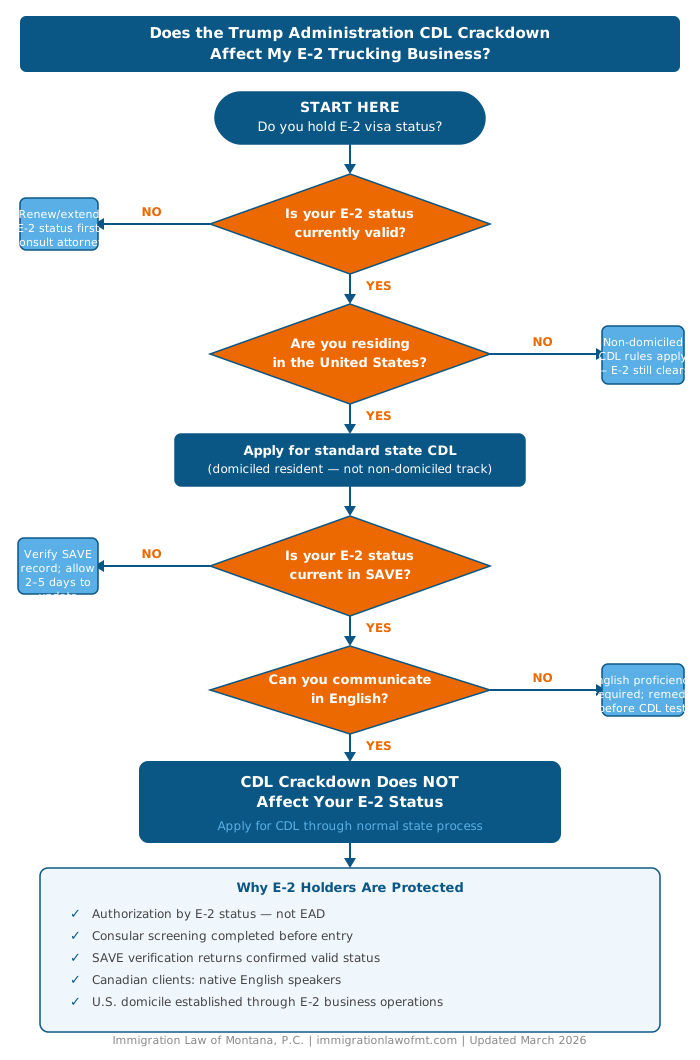
The non-domiciled CDL framework is the source of most of the administration’s enforcement activity. A non-domiciled CDL is issued to someone whose legal home remains abroad. Once you have established residence in the United States — which your E-2 business investment requires — you are domiciled here and apply for a standard state CDL through the same process as any U.S. resident. You never enter the non-domiciled framework at all.
E-2 status requires the investor to be present in the United States to develop and direct the enterprise. In practice, this means establishing a U.S. address, leasing or purchasing business premises, and building the operational infrastructure that USCIS will scrutinize in any extension or status review. An E-2 trucking investor who is genuinely operating their business is by definition domiciled in the United States.
Authorization by Status, Not by EAD
The EAD loophole exists because an Employment Authorization Document can be issued to people across a very wide range of immigration statuses — including asylum applicants who may have entered without inspection and have no verifiable prior history. An E-2 visa holder’s work authorization is not derived from an EAD. It is inherent in the E-2 status itself. Your authorization to work in the United States — specifically, to direct your E-2 enterprise — comes from the visa stamp in your passport and the I-94 record confirming your admission.
When a state DMV runs a SAVE query on your CDL application (as the new rules require), the query does not return an ambiguous result tied to a pending asylum claim. It returns confirmation of a valid, employment-based nonimmigrant status issued through consular processing. That is exactly the result the new rules are designed to produce.
Consular Screening
Every E-2 applicant — whether applying at the U.S. Consulate in Calgary, Vancouver, or Saskatoon — goes through a structured review before the visa is issued. The consular officer examines the investment, the business plan, the investor’s background, and confirms that the treaty investor qualifies under the Canada–U.S. treaty relationship. Biometrics are collected. Background checks are run. The officer exercises discretionary judgment about whether to issue the visa.
This is the screening that the CDL enforcement measures are trying to replicate on the back end for people who bypassed it on the front end. E-2 investors did not bypass it. They went through it.
English Proficiency
Your Canadian clients are native English speakers. The English language proficiency requirements — whether at the roadside inspection, the CDL written test, or the logbook completion standard — are non-issues.
One Situation Worth Monitoring: The Setup Phase
There is one scenario where a Canadian E-2 investor might briefly intersect with the non-domiciled CDL framework, and it is worth flagging even though it is fully resolvable.
During the initial setup phase of the trucking business — particularly if the investor is commuting between Alberta and Montana or spending significant time establishing operations while not yet having fully relocated — a state CDL office might classify them as non-domiciled if they cannot yet demonstrate established U.S. residence. Under the new rules, non-domiciled CDL applicants must hold an employment-based visa (E-2 qualifies) and clear a SAVE verification (which will confirm valid status).
In practice, this means the E-2 investor clears both requirements with no difficulty. The E-2 visa is explicitly an employment-based nonimmigrant visa. The SAVE query returns a clean, confirmed status. The investor gets the CDL.
Where you need to be careful as the attorney is ensuring that the investor’s E-2 status is current and correctly reflected in SAVE before they apply for the CDL. SAVE works off USCIS and CBP databases. An investor who recently extended their status or received a new I-94 should verify that the SAVE record is updated before the CDL application goes in. A mismatch between the investor’s documents and the SAVE record — even a temporary one — can cause delays at the DMV that are frustrating but not permanent.
What This Means Practically for Your Business
If you are an E-2 investor already operating a U.S. trucking company, no regulatory change currently in effect or proposed requires any action on your part with respect to your CDL eligibility. The rules that are tightening are not the rules that govern your situation.
What the crackdown does affect is the market you operate in. With thousands of improperly licensed truckers being sidelined — FMCSA estimates the enforcement actions could affect more than 194,000 CDL holders — demand for qualified drivers is increasing and driver compensation is rising in high-enforcement states. An E-2 trucking company with properly documented, English-proficient drivers and clean FMCSA compliance records is positioned to pick up freight contracts from carriers whose fleets are being audited.
The enforcement environment also means that FMCSA roadside inspections are more frequent and more likely to include a SAVE verification component for drivers who are foreign-born. Making sure your drivers’ work authorization documents are current, correctly reflected in SAVE, and readily available during inspections is basic compliance hygiene that was always good practice and is now more important.
A Note on the Proposed Dalilah Law
The proposed Dalilah Law has received significant press coverage because President Trump mentioned it by name in his February 2026 State of the Union address. It would ban states from issuing CDLs to undocumented immigrants — people who have no lawful immigration status whatsoever. This has no application to E-2 visa holders, who hold nonimmigrant status issued by the State Department through a formal consular process.
As of this writing, the Dalilah Law has not been introduced as legislation in Congress. It is a policy proposal, not an enacted rule.
The Bottom Line
The Trump administration’s CDL enforcement campaign is real, it is aggressive, and it has already resulted in the sidelining of thousands of drivers and the threatened defunding of non-compliant states. The problem it is solving — unauthorized individuals obtaining commercial licenses through a screening-free pathway — is a legitimate safety concern backed by a documented pattern of fatal crashes.
None of it, however, was designed to reach the E-2 investor who went through a U.S. consulate, invested substantial capital in a U.S. trucking enterprise, established U.S. domicile, and is operating a legitimate business under lawful nonimmigrant status. The regulatory architecture distinguishes exactly this person from exactly the person the crackdown targets.
If you are a Canadian national considering an E-2 application for a U.S. trucking business, or an E-2 investor who wants to understand how the current enforcement environment affects your compliance obligations, my office handles E-2 applications and business immigration matters throughout the Rocky Mountain West, including regular work with Canadian clients from Alberta, British Columbia, and Saskatchewan. We are familiar with the specific issues that arise at the Montana–Canada border and in the cross-border trucking industry.
Contact Immigration Law of Montana, P.C. at immigrationlawofmt.com to schedule a consultation.