What the B-2 can do, what it cannot, and why the difference between a visa and the Visa Waiver Program may be one of the most important decisions you make.
Most people think of the B-2 visitor visa as a simple tourist visa. Come to the United States, spend some time, go home. In practice, the B-2 is a versatile nonimmigrant status with applications that go well beyond tourism — and with limitations that can have serious, lasting consequences if misunderstood.
This article explains what the B-2 visa actually is, how it works, and how it applies to three situations that we encounter regularly in our practice: agricultural workers whose families want to visit during work seasons, H-2A workers who need to bridge between seasonal assignments, and foreign nationals exploring business opportunities who may be tempted to rely on the Visa Waiver Program instead.
Understanding the distinction between a B-2 visa and Visa Waiver Program entry is not a technicality. For nationals of visa-waiver countries, it may be the difference between preserving a lifetime of easy U.S. travel and permanently foreclosing it.
The B-2 bridge can work, but it requires actual tourism. For a detailed analysis of this strategy, see our guide on H-2A workers staying longer than one season.
What the B-2 Visitor Visa Actually Covers
The B-2 nonimmigrant classification covers temporary visitors coming to the United States for pleasure, tourism, visiting family or friends, or medical treatment. Unlike some nonimmigrant categories that are narrowly defined by statute, the B-2 category is intentionally broad.
Common lawful purposes for B-2 admission include:
- Tourism, sightseeing, and recreational travel
- Visiting U.S. citizen or lawful permanent resident family members
- Medical treatment and recovery
- Short courses of study that do not lead to a degree (less than 18 hours per week and shorter than “short-term” defined by USCIS)
- Participation in social events, amateur sports competitions, or cultural events for which no compensation is received
What the B-2 does not permit is just as important: no employment of any kind, no work for hire, no business activities that go beyond what a visitor would reasonably do. A B-2 visitor may attend a business meeting to receive information, but may not negotiate contracts or perform services that would constitute “work” under immigration law. The line between B-1 business visitor activity and unauthorized employment is genuinely ambiguous in some fact patterns, which is one reason consulting an attorney before taking action is wise.
How Long Can You Stay on B-2?
When a B-2 visitor is admitted at a U.S. port of entry, Customs and Border Protection (CBP) stamps the passport and — critically — also creates an electronic record in the I-94 arrival/departure system. The I-94 record establishes the authorized period of admission, not the visa stamp itself. Visitors are typically admitted for a period of up to six months, though CBP officers have discretion to admit for shorter periods.
Once inside the United States, a B-2 visitor who wants more time can fileForm I-539 (Application to Extend/Change Nonimmigrant Status) with USCIS to request an extension. Extensions are generally granted in six-month increments if the request is filed before the current authorized period expires and the visitor demonstrates a legitimate need. USCIS does not rubber-stamp extension requests — a credible reason for the continued stay is required, along with evidence of financial support and intent to depart.
The upper limit on B-2 stay is not stated as a fixed number in the regulations, but USCIS and immigration courts have historically been skeptical of B-2 visitors who accumulate very long U.S. stays through repeated extensions. At some point, an extended stay becomes difficult to reconcile with a “temporary visitor” classification.
The Visa Waiver Program: A Fundamentally Different Category
Citizens of approximately 42 countries can enter the United States without a visa through the Visa Waiver Program (VWP). These include nationals of the United Kingdom, Germany, France, Australia, Japan, South Korea, and many other countries. VWP travelers must obtain advance authorization through the Electronic System for Travel Authorization (ESTA) before departure.
On the surface, VWP entry looks similar to B-2 entry: you arrive at the airport, CBP processes you, you get an I-94. The purposes are the same — tourism, visiting family, brief business activity. But underneath the surface, VWP entry is governed by an entirely different legal framework, and the restrictions are severe.
What VWP Does Not Allow
VWP travelers may stay for a maximum of 90 days. There are no extensions. With extremely limited exceptions (such as obtaining a different nonimmigrant status in rare circumstances), there is no change of status from VWP. A VWP entrant who wants to stay longer than 90 days must depart the United States and return, or — if eligible — apply at a U.S. consulate abroad for a visa that permits the longer stay or status change they need.
For someone thinking about B-2 extension, change of status to pursue a business investment, or remaining while a visa petition is approved, VWP entry simply does not work. And there is no correcting it after arrival — unlike B-2 visitors, VWP entrants generally cannot file I-539 to extend or change status.
The ESTA Question That Changes Everything
Here is where nationals of visa-waiver countries face a critical choice, and where I see people make serious strategic errors.
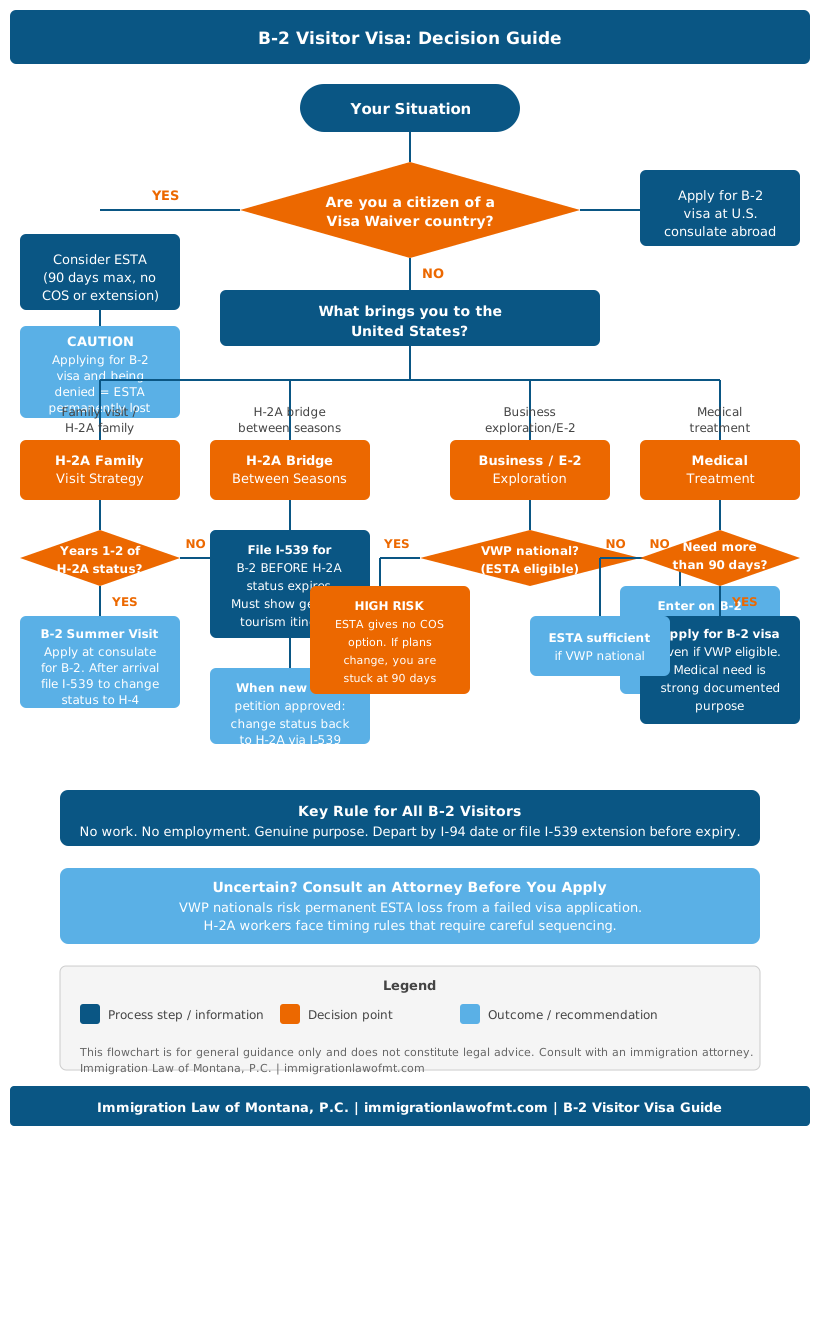
When applying for ESTA, the application asks several questions that affect eligibility. One of those questions is whether you have ever been refused a U.S. visa or been denied admission to the United States. If the answer is yes, ESTA authorization will be denied. And the consequences of ESTA denial are not temporary — the denial follows you. A VWP national who is denied a visa at a U.S. consulate has permanently lost the ability to use ESTA unless they subsequently obtain a visa.
I sometimes think about this with an old saying: if you try to kill the king, you must succeed. Applied here: a VWP national who applies for a B-2 visa and is denied has traded their effortless access to the United States for a consular denial stamp. If the application succeeds, fine. If it fails, the consequences may be permanent.
Practical rule: If you hold citizenship in a visa-waiver country and currently have ESTA access, think carefully before formally applying for a B-2 visa unless you have a specific purpose that makes the visa necessary and you are confident of approval. Speculative or exploratory visa applications are high-risk for VWP nationals.
When a VWP National Might Rationally Apply for B-2
There are situations where a VWP national has a genuine reason to want a B-2 visa despite the risk. Medical treatment is the clearest example.
The United States has medical institutions and specialists that people from around the world choose specifically for their quality. If you need a complex procedure or extended treatment and recovery, 90 days may not be enough. A VWP national who needs three to four months in the United States for treatment, recovery, and follow-up appointments has a legitimate reason to apply for a B-2 visa rather than rely on ESTA.
In that situation, the calculus is different: the person has a real medical need, a documented purpose, financial resources to support an extended stay, and a reason USCIS or a consular officer can understand. The risk of denial exists, but it is not a case where someone is applying speculatively or for a weak purpose.
Other situations where a B-2 visa application might be rational for a VWP national include cases where the 90-day limit is insufficient for the specific visit (extended family care, ongoing medical appointments) or where the person has reason to believe they may want to change status later and wants the flexibility that B-2 entry provides.
B-2 Strategy for H-2A Agricultural Worker Families
Agricultural workers who come to the United States on H-2A temporary worker visas are entitled to bring their spouse and minor children as H-4 dependents. H-4 status allows spouses to reside legally in the United States alongside the H-2A worker, and H-4 children can be enrolled in U.S. public schools. This can be a significant benefit for workers who plan to spend several consecutive seasons in the United States.
The challenge is that getting H-4 status approved is not automatic. It requires a consular officer at the U.S. embassy in the worker’s home country to issue H-4 visas to the family members, and consular officers scrutinize these applications carefully for signs that the applicants do not genuinely intend to return home at the end of the H-2A period.
Why the Consulate is More Skeptical in Year One
There is an old saying that nothing succeeds like success. In immigration, this maxim has a specific meaning: the best evidence that a foreign national will return home as required is that they have done exactly that in the past. A worker who has come to the United States for three or four H-2A seasons and returned home each time has built a record. That record makes it much easier for a consular officer to believe that this time, too, the worker and family will comply with the terms of admission.
A worker in Year One or Year Two of H-2A status has no such record. For a worker newly arrived in the United States, asking a consulate to approve H-4 visas for a spouse and children is a significant ask. The consular officer may reasonably wonder: does this family intend to come visit, or are they looking for a path to remain?
In my practice, I counsel workers in early H-2A seasons differently than workers who have built a multi-year track record. For a worker in Year One or Year Two, particularly one with a spouse who has no established U.S. immigration history, I often recommend considering the B-2 route for an initial family visit rather than applying directly for H-4 visas.
The Summer B-2 Strategy
Here is how it works. During the summer months, when school is out, the worker’s spouse and children can apply for B-2 visitor visas at the U.S. consulate. The purpose is straightforward and easy to explain: visiting a family member who is lawfully working in the United States. This is a recognized and legitimate B-2 purpose.
The summer timing matters strategically. One concern consular officers have about spouses and children visiting is whether they intend to enroll the children in school and remain beyond their authorized period. During summer, there is no school to enroll in, which removes that concern from the equation. The visit looks like what it is — a family reunion during the agricultural season.
Once the spouse and children arrive on B-2 status, we have options. If the H-2A worker’s petition has been approved and the family intends to remain through the harvest season, we can file Form I-539 with USCIS to change the family members’ status from B-2 to H-4. This is a significantly easier process than obtaining H-4 visas from a consulate, for a simple reason: USCIS is deciding whether to change status for people already present in the United States who are complying with immigration law, not deciding whether to issue a visa to people abroad whose intent is harder to evaluate.
Key point: Change of status from B-2 to H-4 is handled by USCIS, not a consular officer. USCIS applies a different standard than a consulate does, and the fact that the family members are already lawfully present and compliant tends to work in their favor.
For workers who have been coming for three or more seasons, the situation is often different. The track record of compliance — the returns home, the record of H-2A renewals — makes the direct H-4 consular application more realistic. Workers in Year Four, Five, or Six of H-2A employment often have little difficulty getting H-4 visas for family members who apply at the same consulate where the worker originally obtained H-2A status.
B-2 as a Bridge Between H-2A Seasons
H-2A agricultural work is by definition seasonal. Employers certify that they need workers for specific agricultural periods, and H-2A petitions are approved for those periods. When one season ends, the worker’s H-2A status expires, and the worker is generally expected to depart the United States within a grace period.
For workers who have found good employment relationships and want to return the following season — or who have a second H-2A position lined up for a different season — there is a question: can the worker remain in the United States between the two positions rather than returning home?
The answer is sometimes yes, but it requires doing it correctly. A worker who simply overstays after an H-2A period ends is unlawfully present, which creates serious immigration consequences. The legal path is to change status to B-2 visitor before the H-2A period expires, remain as a genuine B-2 visitor while waiting for the next H-2A period, and then change back to H-2A status when the new petition is approved and the new season begins.
What Genuine B-2 Status Requires
USCIS does not approve B-2 change of status applications automatically. The agency expects to see actual visitor activity — not a worker who filed the paperwork and then stayed in the employer’s housing doing nothing until the next planting season.
What makes a B-2 bridge application credible:
- A detailed itinerary showing genuine tourism plans during the B-2 period
- Evidence of financial resources to support the visit
- A defined endpoint — the approved H-2A petition for the next season, or a departure date
- Actual travel within the United States during the B-2 period
What gets workers into trouble:
- Filing for B-2 and remaining in the same employer housing without traveling
- No credible tourism plan
- Applications that appear designed to circumvent the departure requirement rather than to facilitate genuine visitor activity
USCIS is experienced at identifying B-2 bridge applications that are cover stories. Workers who attempt this strategy need to actually do it — travel, see the country, visit family if they have it, document what they did.
For a detailed analysis of B-2 bridge strategies in the context of H-2A multi-season planning, including how they fit with three-year maximum stay rules and green card timing, see our comprehensive guide on
For a detailed analysis of B-2 bridge strategies in the context of H-2A multi-season planning — including how they fit with three-year maximum stay rules and green card timing — see our comprehensive guide: Options for H-2A Workers Staying Longer Than One Season.
B-2 for Business Exploration: The E-2 Pathway and the VWP Trap
The United States attracts foreign investors and entrepreneurs who want to establish or purchase businesses in the American market. The E-2 treaty investor visa is a common path for people from countries with qualifying treaties. But before someone commits to the E-2 investment — which typically requires a substantial, at-risk commitment of capital — they often want to come to the United States first to evaluate the opportunity.
This is where the choice between B-2 and Visa Waiver Program entry has real consequences.
B-2 Entry Preserves Options
A foreign national who enters the United States on a B-2 visa is, in legal terms, a nonimmigrant who has been inspected and admitted in a lawful status. If circumstances change — they find a business to acquire, they decide to proceed with an investment, they need more time to complete due diligence — they have options. They can file to change status to B-1 for certain business activities, or ultimately to E-2 status if the treaty investor requirements are met, without necessarily departing the United States. The B-2 entry is a foundation that supports further immigration steps.
VWP Entry Leaves You Without Options
A VWP entrant who comes to explore a business opportunity and then finds themselves wanting to stay longer, change status, or stabilize a business situation they have already entered into is in a genuinely difficult position. VWP does not permit extensions. It does not permit change of status in the normal course. The 90-day clock is running from the moment they land, and there is no mechanism to stop it.
I have seen this situation in practice. Someone comes on ESTA planning to spend a few weeks looking at a business. The business opportunity turns out to be more interesting — or more complicated — than expected. They get drawn in. They start taking steps that may constitute “work” under immigration law. And then they realize they are 60 days into a 90-day admission with no status to change into and no extension to file for.
The consequences can range from a difficult consular appointment abroad to immigration violations that complicate future U.S. entries. The person who entered on B-2 has a path: file the change of status, stabilize the business situation, comply with immigration law, and then — when ready — depart to the home country for the E-2 consular appointment with a clean immigration record. The person who entered on VWP has no equivalent path.
If you are a national of a visa-waiver country and you are thinking about coming to the United States to explore an investment or business opportunity, think carefully about whether to use ESTA or to apply for a B-2 visa. ESTA is faster and simpler, but the 90-day hard limit and inability to change status may leave you without options at the worst possible moment.
Common B-2 Pitfalls That Create Immigration Problems
The B-2 visa is more flexible than many people realize, but it is also more regularly misused. These are the patterns we see most often:
Overstaying the Authorized Period
The authorized period of admission is stated on the I-94, not on the visa stamp. A five-year B-2 visa does not mean you can stay for five years — it means you can use the visa for multiple trips, each of which carries its own authorized period stated on the I-94. Staying beyond the I-94 date triggers unlawful presence, which carries serious consequences including multi-year bars to re-entry if the overstay is long enough.
Working Without Authorization
Working while in B-2 status is a violation of status regardless of whether the work is paid or unpaid, formal or informal. A B-2 visitor who helps a family member’s business, drives for a ride-share service, or freelances online is violating their visa status. The enforcement risk is real, and violations can affect future visa and immigration applications.
Failing to Document the Purpose of the Visit
B-2 visitors who cannot explain what they did during an extended U.S. stay create credibility problems at re-entry. Keeping records of hotel stays, tourist activities, medical appointments, or other B-2-purpose activities is important both for future entry and for any extension applications.
Multiple Extensions Raising Red Flags
USCIS grants B-2 extensions when there is a legitimate need. But a pattern of repeated extensions without a clear path to departure starts to look less like temporary visitor status and more like an attempt to remain indefinitely. At some point, USCIS will want to see that there is actually a plan to leave.
When B-2 Is Not the Right Answer
The B-2 is a visitor category. It is not a holding pattern for people waiting to become eligible for another status, a substitute for employment authorization, or a vehicle for remaining in the United States indefinitely while immigration plans mature.
B-2 status is probably not the right answer when:
- You want to work in any capacity during your stay
- You want to enroll in a full course of academic study (that requires F-1 status)
- You have already decided to remain permanently and are just waiting for the paperwork (this creates immigrant intent problems that can affect future applications)
- The real purpose of the stay is something USCIS would not recognize as a legitimate B-2 purpose
If you are in any of these situations, the conversation needs to be about the right status for your actual situation — not about how to make B-2 work for something it was not designed for.
B-2 and Immigration Strategy: The Bigger Picture
The B-2 visitor visa is genuinely useful. It is flexible in its purposes, adjustable through change of status, and — for the right situations — a smart first step in a longer immigration strategy. The family visit that becomes a change of status to H-4. The business exploration trip that becomes the foundation for an E-2 application. The seasonal worker’s family that arrives in summer and is properly documented before fall.
What the B-2 requires is honesty about your situation and actual compliance with its requirements. USCIS and CBP are experienced at identifying applicants whose B-2 purposes are pretextual or whose intent is to remain regardless of authorized period. The cases that work are the ones where the purpose is real, the documentation supports it, and the applicant genuinely follows through.
For nationals of visa-waiver countries, the B-2 question carries an additional layer of analysis: whether applying for the visa itself creates a risk you cannot afford. That analysis — whether to apply or to use ESTA, and what the consequences of each choice are — is exactly the kind of strategic question that benefits from attorney review before you file anything.
If you have questions about B-2 status, whether it fits your situation, or how it fits into a longer immigration plan, we are happy to discuss it. Contact
If you have questions about B-2 status, whether it fits your situation, or how it interacts with H-2A, H-4, or E-2 planning, we are glad to help. Contact Immigration Law of Montana, P.C. to schedule a consultation.
Christopher J. Flann is an immigration attorney with Immigration Law of Montana, P.C. He has practiced immigration law since 1996 and holds a Ph.D. in synthetic organic chemistry. His practice serves clients across the Rocky Mountain West and Western Canada.