Important — March 2026: The follow-to-join refugee and asylee program has been significantly disrupted by executive action. Travel authorization for many approved I-730 beneficiaries has been suspended. If you have a pending or approved I-730 case, read the section on current policy before taking any action.
You came to the United States as a refugee or were granted asylum. You are building a life here. And you have a spouse, or a child, who is still abroad — still in danger, or simply waiting to join you. The law provides a mechanism for this: Form I-730, the Refugee/Asylee Relative Petition. It is sometimes called the “follow-to-join” benefit, and it is one of the most important — and currently one of the most disrupted — family reunification tools in U.S. immigration law.
What the I-730 Is and Who Can File
The I-730 is filed by a principal refugee or asylee — the person who was granted status in the United States — on behalf of a qualifying family member abroad. The statute authorizing it is INA § 207(c)(2) for refugees and INA § 208(b)(3) for asylees.
Who can file: A person who has been granted refugee status or asylum in the United States, and who has not yet been admitted as a lawful permanent resident (or, for asylees, has been a permanent resident for less than two years at the time of filing).
Who can be petitioned: A spouse or unmarried child under 21 who was part of the principal’s family unit at the time of the refugee or asylum grant. The relationship must have existed at the time of the principal’s admission or grant of asylum — spouses married after the grant, and children born after the grant, do not qualify under the I-730. They may have other options, but not this one.
The I-730 is not a visa petition in the traditional sense — there is no visa category, no priority date, and no waiting in a preference queue. If the petition is approved and the beneficiary clears all processing steps, they receive derivative refugee or asylee status and are authorized to travel to the United States.
The Filing Window: Two Years and What It Means
For refugees, the I-730 must be filed within two years of the principal’s admission to the United States as a refugee, unless the delay was caused by humanitarian reasons. For asylees, the two-year clock runs from the date of the asylum grant.
This filing window is strict and not automatically extended. An asylee who waits three years to petition for a spouse will be outside the window and will need to demonstrate humanitarian reasons for the delay — which USCIS does not grant liberally. If you were recently granted asylum or arrived as a refugee, and you have family members abroad you intend to petition for, the time to act is now, not later.
Filing the I-730 does not mean the family member will arrive quickly. It means the process has started. The processing timeline from filing to travel authorization has historically been measured in years, not months.
How the Process Works: From Filing to Travel
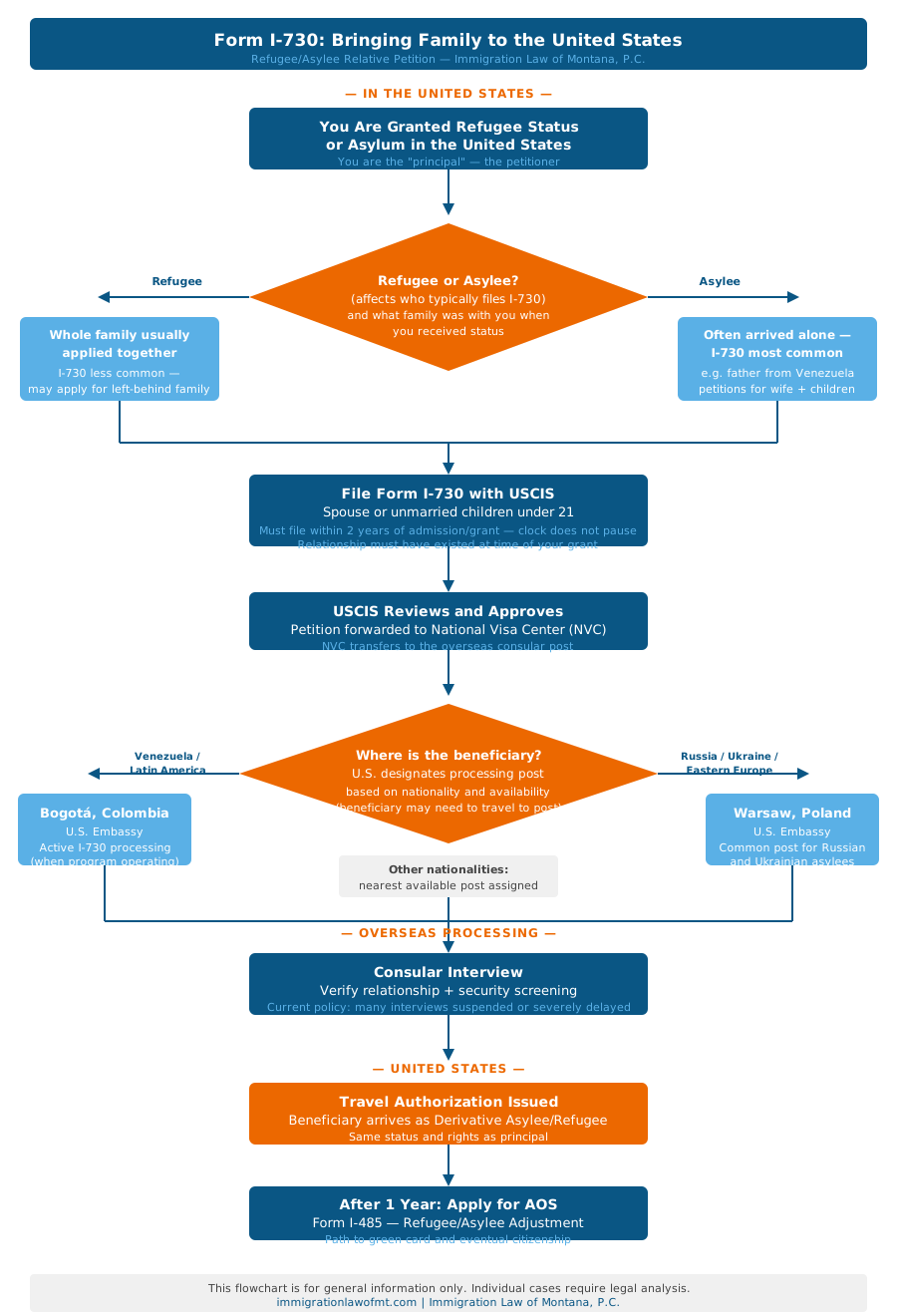
Step 1: File the I-730 with USCIS
The principal files Form I-730 with USCIS along with evidence of the qualifying relationship — a marriage certificate, birth certificate, or other documentation — and proof of the principal’s refugee or asylee status. USCIS reviews the petition and, if approved, forwards it to the National Visa Center (NVC) for overseas processing.
Step 2: NVC and the Overseas Post
The NVC transfers the approved petition to the U.S. embassy or consulate in the country where the beneficiary is located — or in some cases, a third country where the beneficiary has traveled for safety or accessibility reasons. The overseas post then schedules the beneficiary for an interview.
Step 3: Overseas Interview and Security Screening
The beneficiary attends an interview at the U.S. consular post. The officer verifies the qualifying relationship, confirms that the beneficiary does not have independent grounds of inadmissibility, and ensures that all required security checks have cleared. This is where most of the delay in I-730 processing has historically occurred — security screening timelines are not publicly disclosed and can extend for months or years without explanation.
Our office has direct experience with I-730 cases processed in Bogotá, Colombia, which has served as an important processing post for Venezuelan family members of asylees and refugees. The interview process there has generally been thorough but workable — when the broader program was functioning. That is no longer a reliable assumption in the current policy environment.
Step 4: Travel Authorization and Arrival
If the beneficiary passes the interview and security screening, the consular post issues travel authorization. The beneficiary then travels to the United States and is admitted as a derivative refugee or asylee. Upon arrival, they have the same pathway to adjustment of status as the principal.
The Current Policy Situation: What Has Actually Changed
This section reflects the policy environment as of March 2026. Given the pace of change in this area, consult an attorney before making any decisions based on this information.
The follow-to-join program has been one of the most directly affected areas of immigration law since January 2025. Multiple executive orders have restructured or suspended components of the refugee and asylee family reunification process. The practical effects include:
The 75-country travel restriction. A presidential proclamation suspended entry of nationals from certain countries — currently approximately 75 — on various national security grounds. If a beneficiary is a national of one of the restricted countries, travel authorization may be withheld even if the I-730 has been approved. The list of covered countries has changed through litigation and executive amendment; verify current status before acting on any assumption about whether a specific nationality is affected.
Suspension of follow-to-join processing. Executive orders issued in 2025 suspended refugee admissions broadly, and implementing agency guidance paused action on I-730 petitions for refugee beneficiaries — including cases that were already in the pipeline and had cleared prior processing steps. Some suspensions have been modified following court intervention; others remain in place. Approved-but-paused cases have not been automatically denied, but travel authorization has been withheld.
The previous administration’s admissions practices under review. The current administration has cited concerns about the integrity of the prior administration’s refugee and asylee adjudications as a basis for heightened review of I-730 cases. This has resulted in additional scrutiny at the overseas interview stage and, in some cases, re-examination of the underlying asylum or refugee grant.
Consular interview availability. At some posts, refugee and asylee follow-to-join interview scheduling has been suspended or significantly delayed even for cases not covered by nationality-based restrictions. Beneficiaries who had scheduled interviews have had them cancelled. New scheduling is not available at some posts as of the date of this writing.
What this means if you have a pending case: your petition has likely not been denied. But it may be in a queue that is not currently moving. The legal status of the suspension has been contested in federal courts, and the situation may change — in either direction — on relatively short notice.
What this means if you have not yet filed: the filing window continues to run. The two-year clock does not pause because the program has been disrupted. If you are within the filing window, filing now preserves your position even if processing is delayed. Waiting until the program “normalizes” may mean your window closes.
Beneficiaries Already in the United States
Some I-730 beneficiaries entered the United States through other means — on a visitor visa, as an H-2A worker, or through other temporary status — while their petition was pending. If you are in this situation, you may be eligible to have your status adjusted in the United States without traveling back through the overseas process, provided you meet the eligibility requirements for adjustment.
This is a fact-specific analysis. The interaction between a pending I-730, an existing nonimmigrant status, and unlawful presence rules requires careful review before any action is taken. Contact our office to discuss your specific situation.
What to Do If Your Case Is Stuck
If you have an approved I-730 and your beneficiary’s case has stalled at the consular post, the options are limited but not zero. A congressional inquiry through your U.S. representative or senator’s office can sometimes prompt a status update from the State Department or USCIS. A mandamus lawsuit in federal district court — an action to compel a federal agency to act on an unreasonably delayed case — has been used in some circumstances, with varying results. Neither approach is guaranteed, but both have been used successfully.
Our office handles refugee adjustment of status and has experience navigating delayed I-730 processing. If your case involves a beneficiary who has been waiting an unreasonable length of time, contact us to discuss what options, if any, are available.
The I-730 process was not designed for the current environment. It was designed for a functioning refugee admissions program with predictable processing timelines and a good-faith commitment to family reunification. None of those assumptions hold without qualification today. That does not mean the process is over — but it does mean that navigating it requires current, specific legal advice, not reliance on general information that may already be out of date.