• Skip to main content
  • Skip to footer

Immigration Law of Montana

Christopher J. Flann, Attorney

406-373-9828
  • Make an Appointment
  • Client Log In
  • Home

Immigration Law of Montana

  • About
    • Christopher Flann, Attorney
    • Collette Layton, Legal Assistant
    • Rockwell “Rock” Hinkle, Legal Assistant
    • ILM Scholarships
    • Reviews and Testimonials
    • Gabriela Veroes Legal Assistant
    • Maryangel Aguilera Legal Assistant
    • Fidel Villegas, Legal Assistant
    • Gabriel Chávez, Legal Assistant
    • Erwin Noguera, Legal Assistant
  • US Citizenship
    • Citizenship through Adoption
    • Citizenship through Naturalization
    • Citizenship through Military
    • Derivative US Citizenship
  • Green Cards
    • Adjustment of Status
    • Asylee Green Card
    • Conditional Green Card Renewal
    • Employment Based Green Card
    • Consular Processing
    • Family Based Green Card
    • Green Card for Religious Worker
    • Green Card through Marriage
    • Green Card through Refugee or Asylee Status
    • Parole in Place Green Card
    • Green Card Renewal
    • Humanitarian Green Card
    • Refugee Green Card
    • Sheepherder Green Card
    • Marrying an Illegal Immigrant
    • For American Indians Born in Canada
    • Special Immigrant Visa
    • When Your LPR Spouse Dies
    • When Your USC Spouse Dies
    • Derivative Beneficiaries When Petitioners Die
  • Immigration Guides
    • Immigration for Employers
    • Immigration for Investors
    • Immigration for Farmers and Ranchers
    • Immigration for Religious Organizations
  • US Visas
    • The B-2 Visitor Visa: A Practical Guide
    • B-1 Visa Montana North Dakota Wyoming
    • E-1 Visa Treaty Trader Montana North Dakota Wyoming
    • E-2 Visa Treaty Investor Montana Wyoming North Dakota
    • H-1B Visa Montana North Dakota Wyoming
    • E-3 Visa Montana North Dakota Wyoming
    • H-2A Visa Montana North Dakota Wyoming
    • H-2B Visa Montana North Dakota Wyoming
    • H-3 Visa Montana North Dakota Wyoming
    • K-1 Fiancé Visa Montana North Dakota Wyoming
    • K-3 Spouse Visa Montana North Dakota Wyoming
    • O-1 Visa for Artists, Scientists, Educators, Businesspeople and Athletes
    • P-3 Visa Montana North Dakota Wyoming
    • R-1 Visa Montana North Dakota Wyoming
    • TN Visa Montana North Dakota Wyoming
    • U Visa Montana North Dakota Wyoming
    • Change of Status: Montana, North Dakota, Wyoming
    • Visa Extension Extension of Stay
    • Process for US Visa Application Through Admission and Stay
    • Entry into United States
    • I-94 Admission Record
    • Volunteer Visa USA
    • Humanitarian Parole
    • Leaving the United States
  • Immigration Services
    • RFE Response Help in Montana: When Immigration Requests Can Be Fixed (And When They Can’t)
    • Apostille Services
    • Document Translation Services
    • Illegal Immigrant Arrested in Montana
    • Why A Strategy Consultation
  • Removal Defense
  • Service Area
    • Immigration Lawyer North Dakota
    • Immigration Lawyer Wyoming
  • Contact
  • Blog
  • English
    • Español
You are here: Home / Category Blog Page

Category Blog Page

Overcoming Income Requirements When a USC Marries Someone with Children: Strategic Solutions for Stepparent Immigration Cases

October 10, 2025 by Admin-ILM

When love crosses borders and involves children, immigration law can present significant financial challenges. This scenario plays out frequently in our practice: a U.S. citizen marries someone who has children from a previous relationship. While the marriage may qualify the spouse for lawful permanent residence, the U.S. citizen often lacks sufficient income or assets to sponsor both the spouse and the stepchildren under the Form I-864 Affidavit of Support requirements.

This article examines strategic solutions for overcoming income deficiencies in stepparent immigration cases, focusing on timing, household dynamics, and proper use of joint sponsors.

The Common Challenge: Not Enough Income for Everyone

Under immigration law, when a U.S. citizen petitions for a spouse who has children, separate I-130 petitions must be filed for each family member. More critically, the financial requirements can become overwhelming. The petitioner must demonstrate income at 125% of the Federal Poverty Guidelines for each beneficiary they’re sponsoring.

Real-World Example

Consider this common scenario: A U.S. citizen earning $35,000 annually marries someone with two children. The spouse can adjust status or apply for consular processing, but the children need separate sponsorship. The income requirement jumps significantly when sponsoring multiple people, and many families find themselves caught in this financial gap.

The petitioner’s income alone may be sufficient for one person but falls short when calculated for a larger household size that includes all the stepchildren.

Strategic Solution: The Working LPR Strategy

One effective approach involves strategic timing and the use of the new lawful permanent resident’s earning capacity. Here’s how it works:

Step 1: Priority Processing for the Spouse

If time permits and the children are not at risk of aging out (turning 21), prioritize the spouse’s case first. Whether through adjustment of status or consular processing with an I-601A provisional unlawful presence waiver, getting the spouse to lawful permanent resident status enables them to work legally in the United States.

Step 2: Joint Tax Filing Creates New Income Base

Once the spouse becomes an LPR and begins working, the couple can file joint tax returns. This joint income can then be used to support additional Form I-864 obligations for the stepchildren.

Step 3: Household Member vs. Sponsored Immigrant Distinction

This is where understanding the nuances of Form I-864 becomes crucial. According to 8 CFR 213a.1, the sponsor’s spouse can serve as a joint sponsor using Form I-864A when they are part of the same household but are not themselves the sponsored immigrant.

However, when the LPR spouse is sponsoring their own children (the stepchildren), they typically cannot use Form I-864A because they would be in the same household as the sponsored immigrants (their children). In this scenario, the LPR spouse would need to file a separate Form I-864 as the primary sponsor for their children, using their combined household income with their U.S. citizen spouse.

Critical Timing Considerations

Age-Out Protection

The most important factor in determining whether this strategy is viable is the children’s ages. Children who turn 21 during the process may “age out” and lose their eligibility for immediate relative status. The Child Status Protection Act (CSPA) provides some protection, but careful timing is essential.

Work Authorization Timeline

Consider how quickly the spouse can obtain work authorization:

  • Adjustment of Status cases: Work authorization typically available 90-150 days after filing I-485
  • Consular Processing cases: Immediate work authorization upon entry as an LPR

Alternative Approaches When Time is Limited

If children are approaching age 21 or immediate action is required, consider these alternatives:

Joint Sponsors

A financially qualified joint sponsor can execute Form I-864 for some or all family members. Joint sponsors must meet the same income requirements and accept the same legal obligations as the primary petitioner.

Asset-Based Qualification

Assets can sometimes substitute for income shortfalls. The required asset value is typically three times the income deficiency (five times for sponsors who are not U.S. citizens).

Legal Authority and Documentation Requirements

The authority for using spousal income in immigration sponsorship comes from several sources:

  • INA § 213A(f)(5): Defines household members and their income contribution
  • 8 CFR 213a.1(c)(1): Specifies when household member income can be counted
  • 8 CFR 213a.2(c)(2): Details requirements for Form I-864A usage

Required Documentation

When implementing the working LPR strategy, ensure proper documentation:

  1. Joint tax returns demonstrating combined household income
  2. Employment verification for the LPR spouse
  3. Proof of household membership showing shared residence
  4. I-864 or I-864A forms properly executed based on household relationships

Practical Implementation Steps

Before Filing Children’s Petitions

  1. Calculate total income requirements for all intended beneficiaries
  2. Assess spouse’s earning potential in their field
  3. Evaluate timing against children’s ages and CSPA protection
  4. Consider regional employment markets and realistic salary expectations

During the Process

  1. Monitor spouse’s work authorization and employment status
  2. Prepare joint tax filing as soon as eligible
  3. Maintain detailed financial records for USCIS review
  4. Track children’s ages and CSPA calculations continuously

When This Strategy May Not Work

This approach has limitations:

  • Insufficient time before children age out
  • Limited earning capacity of the LPR spouse
  • Employment market challenges in the local area
  • Other inadmissibility issues requiring additional time and resources

Conclusion

The working LPR strategy offers a viable path for many families facing income deficiencies in stepparent immigration cases. Success depends on careful timing, realistic income projections, and thorough understanding of Form I-864 requirements.

Every family’s situation is unique, and immigration law provides multiple pathways to achieve the same goal. The key is identifying which approach best fits your specific circumstances while minimizing risk to all family members.


Immigration law is complex and constantly evolving. This article provides general information and should not be construed as legal advice for any specific situation. We try to come up with ways to solve problems and help you. This article is an example of that. If you have an immigration problem and need help thinking this through, we can offer a consultation to help you, and implement a plan once you’ve considered your options.

Filed Under: Blog

The Truth About Lying on Form I-485: How Minor Omissions Can Destroy Your Green Card Dreams

October 7, 2025 by Admin-ILM

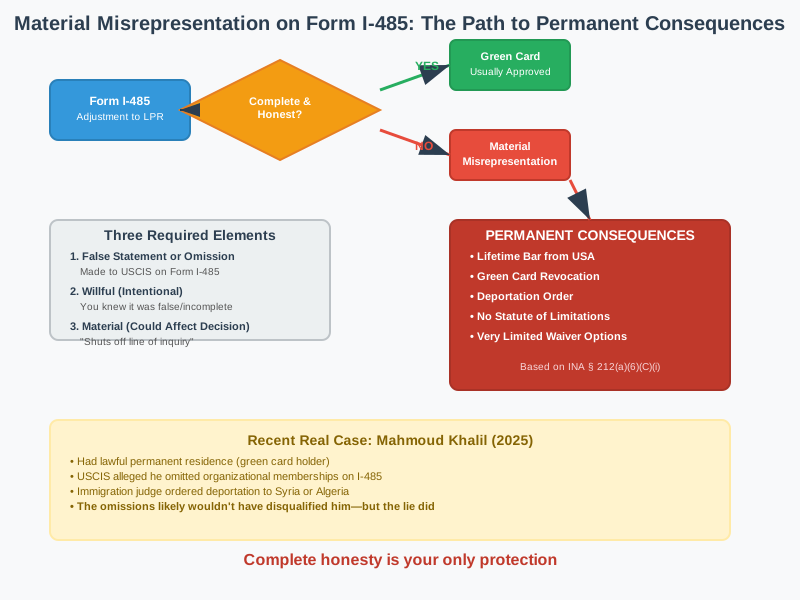
Bottom Line Up Front: One lie on your I-485 adjustment of status application—even about something that wouldn’t have disqualified you—can result in the permanent loss of your green card and deportation, sometimes years later.

A recent high-profile case demonstrates this harsh reality. Immigration Judge Jamee Comans ordered the deportation of Mahmoud Khalil, a lawful permanent resident, after finding he made material misrepresentations on his Form I-485. The specifics of what he allegedly omitted aren’t important—what matters is the legal principle his case illustrates: the cover-up is always worse than the crime in immigration law.

What Really Happened: USCIS Revoked His Green Card

Here’s what the news stories buried: Khalil already had his green card. He was a lawful permanent resident. But USCIS requested revocation of his permanent residence because they alleged he lied on his I-485 application about his organizational memberships and work history. The judge found these omissions were “willful misrepresentations” made “for the sole purpose of circumventing the immigration process.”

This case perfectly illustrates a fundamental truth I’ve learned in 29 years of practice: it’s not about what you did—it’s about whether you were honest about what you did.

The Legal Framework: Why Immigration Law Is Unforgiving About Lies

Under Section 212(a)(6)(C)(i) of the Immigration and Nationality Act, any person who “by fraud or willfully misrepresenting a material fact, seeks to procure…a visa, other documentation, or admission into the United States or other benefit provided under this chapter is inadmissible.”

Let me break down what this means:

Material Misrepresentation Has Three Elements

For the government to revoke your green card or deny your application, they must prove:

  1. You made a false statement (or omitted information)
  2. It was willful (you knew it was false or incomplete)
  3. It was material (it could have affected the decision)

The State Department defines materiality as a misrepresentation that “tends to shut off a line of inquiry which is relevant to the alien’s eligibility and which might well have resulted in a proper determination that he or she be inadmissible.” This is known as the “Rule of Probability.”

The Consequences Are Severe and Permanent

If found inadmissible under 212(a)(6)(C)(i):

  • Permanent bar from the United States (with very limited waiver options)
  • Revocation of existing green cards (as happened in Khalil’s case)
  • No statute of limitations—they can come after you decades later

As the USCIS Policy Manual states: “The alien will be barred from admission for the rest of his or her life unless the alien qualifies for and is granted a waiver.”

Waiver Options: Very Limited but Sometimes Available

Under INA Section 212(i), a waiver of inadmissibility (Form I-601) may be available, but only in very specific circumstances:

Who Can Apply for an I-601 Waiver:

  • You must be the spouse, son, or daughter of a U.S. citizen, OR
  • You must be the spouse, son, or daughter of a lawful permanent resident

Requirements for Approval:

  • You must demonstrate that your qualifying U.S. citizen or permanent resident relative would suffer “extreme hardship” if you were denied admission
  • The hardship must go far beyond normal separation difficulties
  • Financial, medical, emotional, and other factors are considered

Important Limitations:

  • Parents and siblings of U.S. citizens are not eligible for this waiver
  • Children cannot serve as qualifying relatives for their parents
  • Proving “extreme hardship” requires extensive documentation and legal expertise
  • Even with a qualifying relative, approval is never guaranteed

Form I-485 Part 8: Where Most People Get Into Trouble

Based on the allegations in Khalil’s case, I suspect the issues arose from Part 8 of Form I-485, which asks about membership in organizations. This section trips up many applicants because they think certain memberships or activities “don’t count” or “weren’t important.”

Every question on Form I-485 is important. The form asks these questions for a reason—USCIS wants to conduct a complete background investigation.

Real-World Examples: When Honesty Would Have Helped

In my 29 years of practice, I’ve seen countless cases where complete honesty would have resulted in approval, but attempts to hide minor issues led to disaster:

  • Employment without authorization: Working a few shifts without proper documentation is usually manageable with proper explanation. Lying about it can end your case.
  • Traffic violations: Three speeding tickets won’t prevent you from getting a green card. Failing to disclose them might.
  • Previous immigration issues: Most prior violations can be addressed with waivers. Concealing them cannot.

The Current Reality: USCIS May Be Using AI for Background Checks

While I cannot definitively confirm this, there are increasing indications that USCIS may be employing artificial intelligence and enhanced database cross-referencing to identify inconsistencies in applications. This means:

  • Information you think is “hidden” may be easily discoverable
  • Cross-referencing between government databases is more sophisticated than ever
  • Social media and public records are increasingly scrutinized

The prudent approach is to assume that USCIS will eventually discover any information you omit.

My Professional Advice: Painful Honesty Is Your Best Strategy

After nearly three decades representing clients before USCIS, I always counsel painful honesty about everything on immigration forms. Here’s why:

Minor Issues Are Usually Manageable

  • Most traffic violations, brief unauthorized employment, or organizational memberships won’t disqualify you
  • USCIS officers are human beings who understand that life is complicated
  • There are waivers and explanations available for most issues

Lies Are Not Manageable

  • Material misrepresentation creates a permanent bar
  • There are very limited I-601 waiver options (only for spouses, sons, and daughters of U.S. citizens and permanent residents, requiring proof of extreme hardship)
  • The discovery can happen years later, destroying established lives

During Your I-485 Interview: Tell the Truth

When you sit across from the USCIS officer for your adjustment interview:

  • Answer every question completely and honestly
  • Don’t volunteer unnecessary information, but don’t lie
  • If you’re unsure about something, say so
  • Bring documentation for anything remotely questionable

When Litigation Becomes the Only Option

Unfortunately, I’m seeing more employers and individuals turn to federal litigation when facing material misrepresentation allegations. This is expensive, time-consuming, and reflects the high stakes involved. Some are filing mandamus lawsuits to force USCIS action on stalled cases, while others are challenging adverse determinations in federal court.

The fact that people are investing tens of thousands of dollars in litigation rather than accepting deportation shows how devastating these findings can be.

What This Means for Rocky Mountain Residents

If you’re in Colorado, Montana, Wyoming, Utah, Idaho, North or South Dakota, understand that:

  • Distance doesn’t protect you—USCIS’s reach is national
  • Rural location doesn’t matter—federal databases work everywhere
  • Getting it right the first time is crucial—fixing mistakes later is exponentially harder

Take This Seriously: Your Future Depends on It

The Khalil case should serve as a wake-up call. This wasn’t someone who committed serious crimes or posed a genuine threat—this was allegedly about failing to fully disclose organizational memberships and work history.

If someone with a graduate degree from Columbia University can lose their green card over organizational memberships, anyone can face these consequences.

Before you submit any immigration application:

  1. Review every question carefully
  2. Gather complete documentation
  3. Disclose everything, even if you think it’s minor
  4. Consider professional help for complex situations

The Bottom Line

Immigration law does not reward attempts to game the system. It punishes them severely and permanently. The minor embarrassment of disclosing a speeding ticket or brief unauthorized work pales in comparison to losing your right to live in the United States.

Your honesty today protects your future tomorrow. Don’t let fear of minor issues destroy your American dream—let fear of permanent banishment motivate you to tell the complete truth.


If you’re facing questions about prior omissions, need guidance on completing immigration applications honestly and thoroughly, or require assistance with I-601 waivers for material misrepresentation cases, contact Immigration Law of Montana. We’ve helped clients throughout the Rocky Mountain West navigate these complex issues successfully, including securing waivers in seemingly impossible situations. Don’t let fear make the decision for you—let experience guide you toward the right path.

Legal Citations:

  • Immigration and Nationality Act § 212(a)(6)(C)(i), 8 U.S.C. § 1182(a)(6)(C)(i)
  • Immigration and Nationality Act § 212(i), 8 U.S.C. § 1182(i) (Waiver provisions)
  • 9 FAM 302.9-4(B), State Department Foreign Affairs Manual
  • Matter of S- and B-C-, 9 I. & N. Dec. 436 (1961)
  • USCIS Policy Manual, Volume 8, Part J, Chapters 2-3

Filed Under: Blog

Should You File Separate I-130 Petitions for Each Child? A Strategic Guide for LPR Parents

October 3, 2025 by Admin-ILM

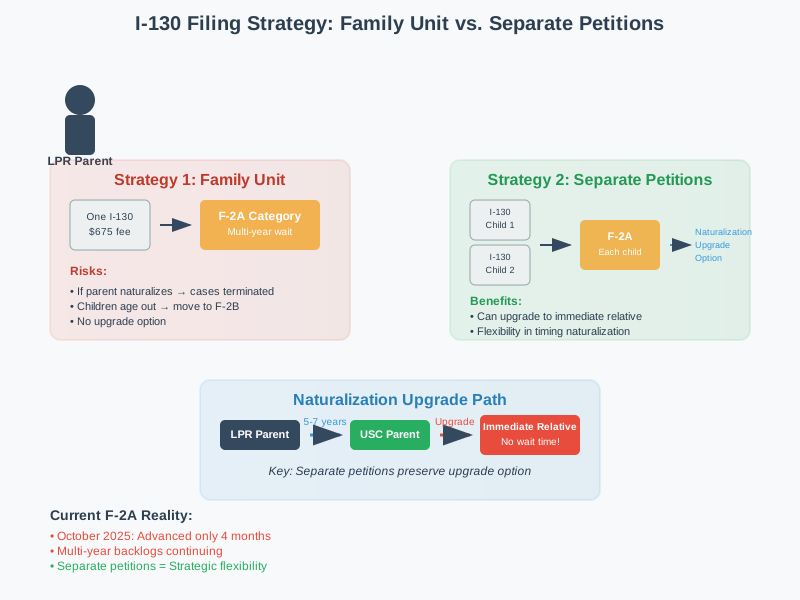
As a Lawful Permanent Resident (LPR) planning to petition for your spouse and children, you’ve likely discovered that USCIS allows you to include your family members on a single Form I-130 petition. This raises an important question: should you file one petition for the entire family, or separate petitions for each person?

For years, the answer seemed obvious. One petition meant one filing fee, one set of paperwork, and a streamlined process. But immigration realities have shifted dramatically, and what once made perfect sense may no longer serve your family’s best interests.

Understanding Your Options Under Current Law

As an LPR, you may petition for certain family members to immigrate to the United States as permanent residents. Specifically, you can file for:

  • Your spouse
  • Your unmarried children under 21 years of age

The traditional approach allowed LPR parents to file a single Form I-130 petition covering the spouse and all unmarried minor children as derivatives in the F-2A category (spouses and children of permanent residents).

Who Always Requires Separate Petitions

Some family members must have individual petitions filed regardless of your preference:

  • Children over 21: Must file separate petitions for the F-2B category (unmarried adult children of LPRs) per INA § 203(a)(2)(B)
  • Married children: Cannot benefit from LPR petitions at all – there is no preference category for married children of permanent residents
  • Stepchildren over 18: The step-relationship must be established before the child’s 18th birthday under INA § 101(b)(1)(B)

But for your spouse and minor children – the family members who can be included together – you face a strategic choice.

The Traditional Wisdom: One Petition Made Sense

Historically, filing a single I-130 petition for your family unit was the logical approach, and immigration attorneys routinely recommended it. The reasons were compelling:

Cost savings: One filing fee ($675 as of 2025) instead of multiple fees Simplified process: One petition, one set of supporting documents, one approval process Family unity: Everyone processed together in the F-2A category

This approach worked well because the F-2A category was current or nearly current. Families could file their single petition and expect to receive their immigrant visas within a reasonable timeframe, often within 1-2 years.

But that fundamental assumption no longer holds true.

What’s Changed: F-2A Processing Times Today

The F-2A category has experienced dramatic backlogs that transform the strategic calculation. Consider these current realities:

Current processing delays: F-2A moved ahead only 4 months in October 2025, representing progress on cases filed years earlier Multi-year waits: Current F-2A petitions face waits of 3-5 years or more Unpredictable movement: Unlike the historical pattern of steady progress, F-2A now moves irregularly

The Naturalization Timeline Factor

Here’s the crucial element that changes everything: Most LPRs become eligible for naturalization after 5 years of permanent residence (3 years if married to a U.S. citizen). The naturalization process typically takes an additional 6-18 months.

This means you could become a U.S. citizen and petition for immediate relatives within 5-7 years of obtaining your green card.

Immediate relatives of U.S. citizens face no numerical limitations or waiting periods under INA § 201(b)(2)(A)(i). They can process immediately.

The Critical Question: Is the Cheapest Route Still the Best Route?

When F-2A was current, saving money by filing one petition made perfect sense. Your family would process quickly together, and the cost savings were pure benefit.

But what if that’s no longer true?

If F-2A now requires a 4-year wait, but you could naturalize and upgrade your family to immediate relative status in 6 years, does the single-petition approach still serve your family’s interests?

Consider what happens under each scenario:

Scenario 1: Traditional Family Unit Approach

  • File one I-130 petition ($675)
  • Family enters F-2A category
  • Risk: 4-year wait that could extend longer
  • Major risk: If you naturalize while the petition is pending, your family members lose their derivative status and their cases are terminated
  • Result: You’d have to start over, losing years of waiting time

Scenario 2: Separate Petitions Strategy

  • File separate I-130 petitions for spouse and each child ($675 × 3 = $2,025 for family of three)
  • Each family member gets their own F-2A case
  • Advantage: If you naturalize, you can upgrade each case to immediate relative status without losing their place in line
  • Flexibility: You can choose optimal timing for naturalization based on F-2A movement

A Real-World Example

Consider a current client situation: An LPR father wants to petition for his wife and two children, ages 8 and 12.

Traditional approach: One petition, $675, family waits together in F-2A Strategic approach: Three separate petitions, $2,025, each family member maintains independent status

The key question: Is saving $1,350 today worth the risk of losing years of waiting time if F-2A backlogs continue to worsen?

The “Two Horses in the Race” Strategy

Filing separate petitions essentially gives your family two paths forward:

  1. Path 1: If F-2A processing improves, your family processes under the original petitions
  2. Path 2: If F-2A continues to backlog, you naturalize and upgrade everyone to immediate relative status

This approach provides maximum flexibility. You’re not locked into hoping F-2A improves – you have options.

Additional Benefits of Naturalization

Once you become a U.S. citizen, you can also petition for:

  • Your parents (immediate relatives)
  • Your adult children (if any)
  • Your siblings (though with longer waits in the F-4 category)

The separate petition strategy preserves all these options.

Legal Authority and Citations

The strategic approach rests on established immigration law principles:

  • INA § 201(b)(2)(A)(i): Immediate relatives are not subject to numerical limitations
  • INA § 203(a)(2)(A): F-2A category definition and processing requirements
  • 8 CFR § 204.2(a)(4): Requirements for family-based petitions
  • Matter of Velarde-Pacheco, 23 I&N Dec. 253 (BIA 2002): Principles governing priority date retention

When Separate Petitions Are Essential

Beyond strategic considerations, some situations require separate petitions:

The Aging Out Problem

If a child turns 21 while the F-2A petition is pending, they “age out” and must convert to the much slower F-2B category. While the Child Status Protection Act (CSPA) provides some protection, filing separate petitions eliminates this risk entirely.

Family Changes

Separate petitions provide protection if family circumstances change – divorce, death, or other life events that might affect one family member don’t impact the others’ cases.

Cost-Benefit Analysis: When Does the Strategy Make Sense?

The separate petition strategy makes sense when:

  • You can afford the additional filing fees without hardship
  • Your children are young (reducing aging-out risk)
  • You plan to naturalize within 5-7 years
  • F-2A backlogs appear likely to continue

The traditional approach might still work when:

  • Additional fees create genuine financial hardship
  • You plan to naturalize very soon (within 1-2 years) regardless
  • F-2A processing dramatically improves (unlikely based on current trends)

Our Professional Assessment

Given current F-2A processing delays and the unpredictability of immigration policy changes, we recommend filing separate I-130 petitions for each family member if you can afford the additional fees.

This strategy:

  • Provides maximum flexibility for your family’s future
  • Creates insurance against continued F-2A backlogs
  • Enables strategic timing of naturalization
  • Prevents the devastating loss of years of waiting time

The additional cost today – roughly $1,350 for a typical family – represents insurance against potentially losing years of your family’s time together.

Making the Right Choice for Your Family

Every family’s situation is unique. The decision involves weighing:

  • Your current financial situation
  • Your children’s ages and aging-out risk
  • Your naturalization timeline and intentions
  • Your tolerance for uncertainty in F-2A processing

Is the traditional “cheapest” approach still the best approach when the circumstances that made it logical have changed? For most families in 2025, the answer is no.

Getting Professional Guidance

These strategic decisions will impact your family for years to come. Immigration law provides the framework, but applying it strategically to your specific circumstances requires careful analysis of multiple variables.

If you’re facing these choices, consider a consultation to explore your options. Understanding the trade-offs between cost savings today and flexibility tomorrow can help you make the decision that best serves your family’s long-term interests.

The attorneys at Immigration Law of Montana, P.C. have helped families throughout the Rocky Mountain region navigate these complex strategic decisions. We combine deep knowledge of immigration law with practical understanding of how families actually experience the immigration process.


This article is for informational purposes only and does not constitute legal advice. Immigration law is complex and fact-specific. Consult with a qualified immigration attorney for advice about your particular situation.

Filed Under: Blog

Understanding H-2A Seasonality: Why Some Agricultural Operations Can Secure Year-Round Workers While Others Cannot

September 12, 2025 by Admin-ILM

Split image showing summer crop harvesting operations on left and winter cattle operations on right, illustrating H-2A two season strategy

As an agricultural employer, you may have heard conflicting information about the H-2A temporary agricultural worker program. Some say you can only get workers for 9.5 months maximum. Others claim that certain operations somehow manage to secure H-2A workers year-round. The truth is more nuanced than either extreme, and understanding this distinction could be crucial for your operation’s labor planning.

The Foundation: H-2A’s Seasonal Requirement

The H-2A program is designed for temporary or seasonal agricultural work. The Department of Labor (DOL) interprets this strictly: if your operation needs the same number of workers year-round for the same tasks, you likely don’t qualify for H-2A assistance.

The regulation at 20 CFR 655.103(d) defines seasonal employment as work that “is tied to a certain time of year by an event or pattern, such as a short annual growing cycle or a specific aspect of a longer cycle, and requires labor levels far above those necessary for ongoing operations.”

The Classic Example: Why Dairy Farms Can’t Use H-2A

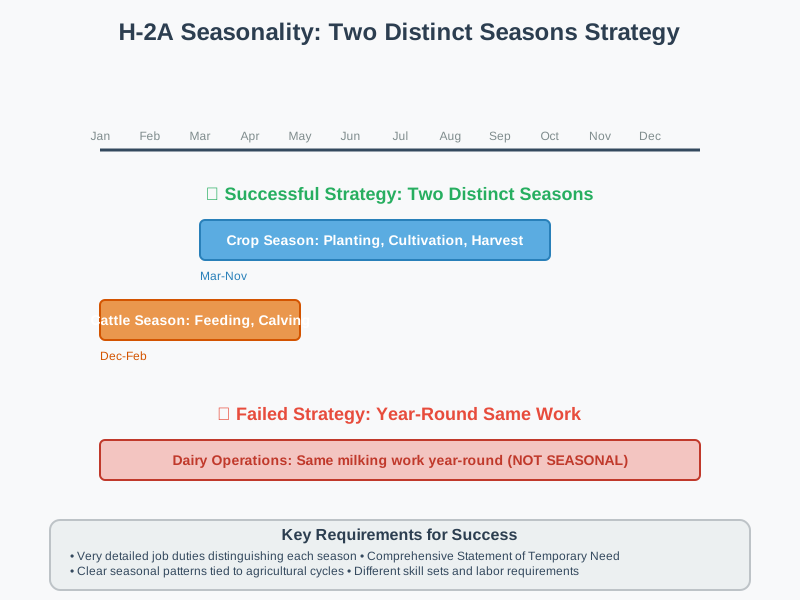
Dairy operations provide the clearest illustration of work that doesn’t qualify for H-2A. Cows need to be milked every day, year-round. There’s nothing seasonal about milking – you need the same number of workers in January as you do in July. The workload doesn’t fluctuate based on seasons or agricultural cycles.

This is why the dairy industry has been advocating for years to modify the H-2A program to include year-round agricultural work. Currently, dairy farms that employ 51% of the U.S. dairy workforce (who are foreign-born) cannot access this legal pathway for workers.

The Strategic Solution: Two Distinct Seasons

Here’s where it gets interesting for mixed agricultural operations. If your business has genuinely distinct seasonal needs for different types of agricultural work, you may be able to obtain separate H-2A certifications that effectively provide workers throughout most of the year.

Consider this scenario: Your agricultural operation grows crops (hay, wheat, or corn) from March through November, requiring additional workers for planting, cultivation, and harvest. During December through February, your operation shifts focus to cattle management – feeding, calving, and other livestock care that requires different skills and labor patterns.

Because these represent two legitimately distinct seasonal activities – crop production season and cattle management season – you can potentially apply for separate temporary labor certifications. The key is that each season involves different work tied to specific agricultural cycles, not just a desire to keep the same workers busy year-round.

The Legal Foundation: Building Precedent Through Administrative Decisions

Initially, DOL was skeptical of “two season” approaches, often denying them as attempts to circumvent the seasonal requirement. However, agricultural employers have successfully challenged DOL’s interpretation through the administrative appeals process, establishing important precedents.

Vermillion Ranch Ltd. Partnership established the foundational principle that employers can demonstrate legitimate seasonal differences in their operations. According to administrative decisions, Vermillion involved a range operation that successfully obtained both year-round range worker certification and separate seasonal H-2A worker certification – demonstrating that employers with genuinely distinct seasonal needs could access H-2A workers for different types of agricultural activities.

Building on this precedent, Mammoser Farms, Inc. (2017-TLC-00001) provides the strongest authority for regular agricultural operations. In this landmark Administrative Law Judge decision, Mammoser Farms successfully reversed DOL’s denial of their winter maintenance H-2A application.

Mammoser had two genuinely distinct seasons:

  • Crop season (March-November): “Drive tractors/trucks and perform a variety of crop (hay and corn) raising duties… Plow, harrow, plant, fertilize, cultivate, spray and harvest using a variety of farm machinery”
  • Winter maintenance season (December-March): “Perform general winter maintenance… snow removal from pathways, roadways and roads. De-ice and repair manure/water pipes/bunker silos”

DOL initially denied the winter certification, arguing that both positions involved equipment use and represented “an impermissible year round need for the same job opportunity.” However, the ALJ found the positions were “separate and distinct,” noting:

  • Different job duties: The winter position involved “primarily winter maintenance including snow removal and deicing” with “no crop-related duties mentioned whatsoever”
  • Different SOC codes: The State Workforce Agency assigned different occupational classifications
  • Different physical requirements: 75-pound lifting requirement for crop work versus 40-pound requirement for winter maintenance
  • Genuine seasonality: Winter work was “necessitated by the severe winter season experienced in” western New York

The ALJ emphasized that the analysis must focus on whether an employer’s need for “a particular agricultural position has been established as seasonal,” not whether minor equipment similarities exist between different types of agricultural work.

Real-World Application

Agricultural employers have successfully implemented the two-season strategy. For example, operations have obtained both regular farmworker job orders and specialized agricultural job orders that, when combined, extend over 10 months. The key to success lies in proper documentation and clear differentiation between the seasonal activities.

Making Your Case: What DOL Looks For

If you’re considering a two-season approach, DOL will scrutinize several factors:

Distinct Work Activities: The work in each season must involve different tasks, skills, or agricultural cycles. Simply extending the same work across seasons won’t qualify.

Genuine Seasonality: Each period of need must be tied to actual agricultural patterns – weather, growing cycles, animal breeding cycles, or market demands.

Labor Level Fluctuations: You must demonstrate that each season requires “labor levels far above those necessary for ongoing operations.”

Consistency: Changing your start and end dates frequently raises red flags with DOL, suggesting the periods aren’t truly tied to seasonal conditions.

Documentation Is Critical

Success with a two-season strategy requires extremely thorough documentation:

  • Very detailed job duties and requirements to distinguish each seasonal position
  • Comprehensive Statement of Temporary Need explaining each season’s requirements
  • Evidence of how the work differs between seasons
  • Historical data showing labor fluctuations
  • Agricultural cycle documentation (planting schedules, breeding calendars, etc.)
  • Clear demonstration that ongoing operations require fewer workers outside these periods

The level of detail required cannot be overstated. DOL will carefully review whether the positions truly represent distinct seasonal needs or simply an attempt to maintain the same workers year-round.

The Practical Reality

While the two-season approach can work, it’s not a simple workaround for year-round labor needs. DOL reviews these applications carefully, often issuing Notices of Deficiency requesting additional documentation. The strategy works best for operations with genuinely distinct agricultural activities that align with natural seasonal patterns.

Professional Guidance Is Essential

Successfully implementing a two-season H-2A strategy requires navigating complex regulations and demonstrating compliance with detailed legal requirements. The Mammoser decision shows both the potential for success and the level of scrutiny these applications receive.

Your application should reference these precedent cases – Vermillion Ranch and Mammoser Farms – when making the argument for separate seasonal certifications. The Mammoser decision provides a detailed roadmap of the evidence and arguments that convinced an Administrative Law Judge to reverse DOL’s denial.

However, the level of documentation required and the precision needed in distinguishing job duties makes professional legal assistance strongly advisable. As the Mammoser case demonstrates, DOL will closely scrutinize these applications, questioning everything from SOC code assignments to physical requirements.

Given the stakes involved and the complexity of the requirements, consulting with an experienced agricultural immigration attorney is typically a worthwhile investment. The precedents exist, but successfully applying them requires careful preparation and strategic presentation of your operation’s unique seasonal needs.

Why This Matters for Your Operation

Understanding H-2A seasonality requirements can:

  • Help you properly structure your labor certification applications
  • Avoid costly denials and delays
  • Maximize your access to legal agricultural workers
  • Ensure compliance with federal regulations
  • Support long-term workforce planning

Looking Forward

As agriculture evolves and labor shortages persist, expect continued attention to H-2A seasonality requirements. Some in Congress are advocating to eliminate the seasonality requirement entirely, which would fundamentally change the program. Until then, understanding how to work within current rules while meeting legitimate seasonal labor needs remains crucial.

The key is honesty and accuracy. If your operation has genuine seasonal fluctuations requiring different types of agricultural work at different times of year, the H-2A program may provide a legal pathway for year-round labor access. If your needs are truly constant and year-round for the same work, H-2A likely isn’t the right fit for your operation.

Understanding these distinctions and planning accordingly can help ensure your agricultural operation has access to the legal workforce it needs while maintaining compliance with federal immigration law.

This analysis is based on current H-2A regulations and administrative precedents as of 2025. Each agricultural operation’s circumstances are unique, and successful implementation of a two-season strategy requires careful evaluation of your specific seasonal needs and thorough documentation.

Filed Under: Blog

When Musical Invitations Go Wrong: A Guide to Proper Visa Requirements for International Performers

September 9, 2025 by Admin-ILM

When Musical Invitations Go Wrong

The Jaroslav Skuta case offers important lessons for anyone inviting international musicians to perform in the United States

In July 2025, Czech clarinetist Jaroslav Skuta made headlines when he was detained for six hours at Detroit Metro Airport and ultimately deported back to Prague. Skuta had planned to perform approximately 15 free concerts across Nebraska and Ohio with his chamber music trio, celebrating Czech and Slavic heritage in local communities. Despite his good intentions and the non-commercial nature of his performances, U.S. Customs and Border Protection determined he had misrepresented the purpose of his travel by entering on an ESTA (tourist visa waiver) when he should have had a proper work visa.

This case illustrates a common misunderstanding that frequently traps well-meaning musicians, music teachers, and cultural organizations: any public performance in the United States constitutes “work” under U.S. immigration law, regardless of whether payment is involved.

Your Client’s Situation: A Similar Trap

As an immigration attorney practicing in Montana, I recently received a call from a former music teacher who had invited a musician from Zimbabwe to perform with a local orchestra. The Zimbabwean musician entered on a B-1/B-2 visa and, like Skuta, planned to give free public concerts with only expenses covered. Unfortunately, this arrangement also violates U.S. immigration law.

The B-1/B-2 Visa Trap for Musicians

The B-1 (business) andB-2 (tourism) visa categories have extremely limited provisions for musical performances:

B-1 Business Visa – Very Limited Musical Activities

  • Recording only: Musicians may use B-1 status to utilize U.S. recording facilities, provided the recording will be distributed and sold only outside the United States and no public performances are given
  • Government cultural programs: Professional entertainers may perform on B-1 if participating in a cultural program sponsored by their sending government, performing before a non-paying audience, with all expenses paid by their government
  • Competitions: Musicians may compete for prizes (monetary or otherwise) with expenses covered, but no other remuneration

B-2 Tourist Visa – Amateur Performers Only

  • True amateurs only: The performer must be someone who “normally performs without remuneration” and is not a member of the entertainment profession
  • Social/charitable context: Performances must be in social or charitable contexts, talent shows, or competitions
  • Expense reimbursement permitted: Incidental expenses may be reimbursed, but no payment for performance

The Critical Distinction

If a musician normally receives compensation for performing (making them a “professional”), they cannot qualify for B-2 status even if they agree to perform for free in the United States. This is exactly the trap that caught both Skuta and your client’s musician from Zimbabwe.

Why Expense Coverage Still Constitutes “Work”

U.S. immigration law doesn’t distinguish between paid and unpaid performances when determining whether an activity constitutes “work.” As the State Department’s Foreign Affairs Manual makes clear, any public performance by a professional musician requires appropriate work authorization. Even having expenses covered can be considered a form of compensation that transforms the activity into unauthorized employment.

The Proper Solution: P-3 Visas for Cultural Performances

For situations like yours in Montana—bringing international musicians to perform in rural, predominantly white communities—the P-3 visa is likely the ideal solution. The P-3 visa is specifically designed for artists or entertainers coming to participate in “culturally unique programs.”

Why P-3 Fits Your Montana Situation

  1. Cultural Exchange Focus: P-3 visas are perfect for bringing performers from other countries to share their cultural heritage with American communities
  2. Commercial or Non-Commercial: The program can be either commercial or non-commercial in nature
  3. Rural Community Benefit: In states like Montana, North Dakota, and Wyoming, bringing African, Asian, or other international musicians necessarily involves cultural exchange and education
  4. No Amateur Requirement: Unlike B visas, P-3 allows professional performers

P-3 Visa Requirements

  • Culturally Unique Program: The performance must develop, interpret, represent, coach, or teach unique or traditional ethnic, folk, cultural, musical, theatrical, or artistic forms
  • Cultural Event: Must participate in events that further understanding or development of the art form
  • Labor Consultation: Requires written consultation from appropriate labor organization (usually American Federation of Musicians for musicians)
  • S. Petitioner: Must have U.S. employer, agent, or sponsoring organization file Form I-129

Reviewing Your P-3 Article

I reviewed your existing P-3 visa article and found it generally accurate and well-written. A few suggestions for enhancement:

Strengths

  • Clear explanation of the cultural uniqueness requirement
  • Good practical example with the Gaelic violin festival
  • Accurate description of the consultation requirement
  • Helpful timeline warnings about processing delays

Suggested Improvements

  1. Emphasize the “work” vs. “amateur” distinction: Add a section explaining why B visas don’t work for professional musicians
  2. Rural state advantage: Expand on why cultural exchange programs have particular value in rural states like Montana
  3. Cost comparison: Include comparison with other visa options (O-1, P-1) to show P-3’s advantages
  4. Recent precedent: Reference Matter of Skirball Cultural Center (2012), which held that fusion art forms can qualify as “culturally unique”

Lessons from the Skuta Case

The Czech clarinetist’s experience offers several important takeaways:

  1. Professional status matters more than payment: Skuta’s background as a professional musician and music teacher disqualified him from ESTA/B visa status, regardless of the unpaid nature of his U.S. performances
  2. ESTA carries the same restrictions as B visas: Visa waiver program participants face identical limitations to B-1/B-2 visa holders
  3. Good intentions don’t matter: The cultural and non-commercial nature of performances doesn’t excuse improper visa classification
  4. Entry officers have broad discretion: CBP officers are trained to detect work activities regardless of compensation
  5. Consequences are severe: Deportation, visa cancellation, and potential bars to future entry

Best Practices for Cultural Organizations

If you’re organizing cultural events with international performers:

  1. Start early: P visa processing takes months, especially with required labor consultations
  2. Use proper channels: Never advise artists to enter on tourist visas for performances
  3. Document cultural significance: Prepare strong evidence of the program’s cultural and educational value
  4. Consider P-3’s advantages: For cultural performances, P-3 is often more appropriate than O-1 or P-1 visas

Conclusion

The Skuta case serves as a cautionary tale about the strict enforcement of U.S. immigration law regarding performers. While the treatment of legitimate cultural artists may seem harsh, the legal requirements are clear and consistently enforced.

For Montana’s cultural organizations seeking to bring international performers to our rural communities, the P-3 visa offers a proper legal pathway that recognizes the cultural exchange value these performances provide. By understanding and following proper procedures, we can continue to enrich Montana’s cultural landscape while ensuring our invited artists receive the welcome they deserve.


If you’re planning to bring international performers to your community or organization, consulting with an immigration attorney early in your planning process is essential. Proper visa planning ensures your cultural events proceed smoothly and your international guests can focus on sharing their artistry rather than worrying about immigration complications.

Filed Under: Blog

Why Your Immigration Attorney Can’t File Premium Processing Yet (And When They Can)

July 30, 2025 by Admin-ILM

Understanding the USCIS receipt notice requirement that's delaying your premium processing request
Understanding the USCIS receipt notice requirement that’s delaying your premium processing request

“Why Can’t You Just File Premium Processing Now?”

You’ve just had your H-1B petition filed, and you can see from the tracking that USCIS received it. But now you want to pay extra for premium processing to speed things up, and your attorney is telling you to wait. You might be thinking: “What’s the holdup? Can’t we just send in the premium processing form now?”

This is one of the most common questions we hear from clients, and the frustration is completely understandable. You’re ready to pay the premium processing fee (which can be over $2,800), but there’s a strict USCIS requirement that prevents us from filing it immediately.

The Simple Answer: We Need Your Receipt Notice First

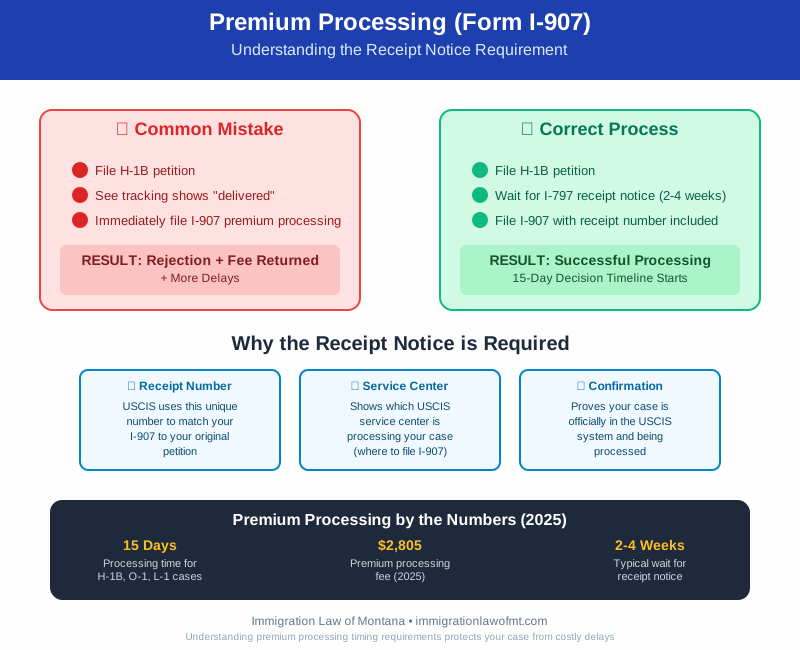
Your attorney cannot file for premium processing until USCIS sends you a receipt notice (Form I-797) for your original petition. This isn’t your attorney being overly cautious—it’s a hard requirement from USCIS that will result in your premium processing request being rejected if ignored.

Why USCIS Requires the Receipt Notice

Think of the receipt notice as your case’s “birth certificate” in the USCIS system. Here’s what that piece of paper provides:

Your Unique Case Number

Every immigration case gets assigned a specific receipt number (like MSC1234567890). USCIS uses this number to match your premium processing request to your original petition. Without it, they literally cannot connect the two applications.

Proof Your Case Exists in Their System

Just because your package was delivered doesn’t mean USCIS has processed it into their system yet. The receipt notice confirms they’ve accepted your case and assigned it to the right service center.

The Correct Filing Location

USCIS has multiple service centers, and your premium processing request must go to the exact same location handling your original case. The receipt notice tells us which service center is processing your petition.

What Happens If We Try to File Without It

We’ve seen well-meaning attorneys try to file premium processing without the receipt notice, and the results are always the same:

  • USCIS immediately rejects the premium processing request
  • Your premium processing fee gets returned
  • You lose valuable time because now you have to start the premium processing process over
  • Your case gets more complicated with multiple rejected filings in the record

USCIS is very clear about this: they will reject premium processing requests when they “are not able to match your Form I-907 with the receipt” for your underlying petition.


When You CAN Get Premium Processing

Option 1: File Everything Together (Best Case)

If you know from the beginning that you want premium processing, your attorney can file both your main petition (like H-1B) and the premium processing request at the same time. This avoids the waiting period entirely because USCIS processes them together.

Option 2: Upgrade After Filing (Your Current Situation)

When you decide to add premium processing after already filing your main petition, the process requires:

  1. Waiting for your receipt notice to arrive (usually 2-4 weeks)
  2. Confirming which service center is handling your case
  3. Filing premium processing with the correct receipt number and location
  4. Starting the premium processing clock (15 days for most employment cases)

Option 3: After a Transfer

Sometimes USCIS transfers cases between service centers. If this happens, you’ll get a transfer notice, and your attorney will need both the original receipt notice and the transfer notice to file premium processing at the new location.

How Long Will You Wait?

For the Receipt Notice

Most clients receive their receipt notice within 2-4 weeks of USCIS receiving their petition. During busy filing periods (like the H-1B cap season), this can take longer.

For Premium Processing Results

Once we can file your premium processing request:

  • H-1B, L-1, O-1 cases: 15 calendar days
  • Employment-based green card cases: 15-45 calendar days depending on category
  • Student work authorization: 30 calendar days

For specific details about these visa categories, see our comprehensive guides to H-1B visas, O-1 visas for individuals with extraordinary ability, and R-1 religious worker visas.

Special Considerations for Religious Organizations

Qualifying religious organizations receive significant benefits in the premium processing system. IRS-designated 501(c)(3) religious organizations typically pay reduced premium processing fees and may qualify for expedited processing even when premium processing isn’t available to commercial petitioners.

For R-1 religious worker cases, this can result in substantial savings while still achieving faster processing times. Religious organizations should always verify their eligibility for these reduced fees when requesting premium processing.

What to Do While You Wait

Track Your Case

Once you get your receipt notice, you can track your case status online at the USCIS website using your receipt number.

Prepare for Premium Processing

Your attorney can prepare the premium processing paperwork while waiting for the receipt notice, so they’re ready to file immediately once it arrives.

Understand the Costs

Premium processing fees in 2025 range from $1,685 to $2,805 depending on your case type, and these fees are in addition to your original filing fees. According to USCIS’s official immigration data reports, premium processing volumes continue to increase annually. The current fee structure was established through a Federal Register rule implementing inflation adjustments.

Set Realistic Expectations

Remember that the 15-day premium processing clock doesn’t start until USCIS receives your premium processing request—not when you decide you want it.

Why This Matters for Your Planning

Understanding this timing requirement helps you make better decisions:

For Future Cases

If you know you’ll need premium processing, ask your attorney to file both forms together from the beginning to avoid any waiting period.

For Business Planning

Factor in the 2-4 week wait for receipt notices when planning start dates or business decisions that depend on immigration approvals.

For Peace of Mind

Knowing this is a standard USCIS requirement—not a delay caused by your attorney—can help reduce anxiety during the waiting period.

Alternative Strategies When Time is Critical

Request Expedited Processing (No Fee)

In truly urgent situations, you might qualify for expedited processing without premium processing fees, though this is much more difficult to obtain.

Plan Concurrent Filing for Future Cases

For clients with ongoing immigration needs, recommend filing premium processing concurrently with initial petitions to avoid this timing issue.

Consider Alternative Visa Categories

Sometimes switching to a different visa category can provide faster overall processing. Our complete guide to US visa types explains all available options and their respective processing times.

Montana, North Dakota, and Wyoming Experience

As an immigration attorney practicing in the Rocky Mountain region, I regularly handle premium processing requests for clients across Montana, North Dakota, and Wyoming. The agricultural and energy sectors in these states often create time-sensitive employment situations where understanding premium processing timing is crucial.

Whether you’re a ranch operation in Wyoming needing seasonal H-2A workers, a technology company in Montana hiring H-1B specialists, or an energy company in North Dakota with urgent O-1 needs, proper timing of premium processing requests can mean the difference between meeting critical deadlines and costly delays.

When Premium Processing Strategy Matters Most

Understanding premium processing timing is just one piece of a larger immigration strategy. Some situations where professional guidance becomes essential:

Multiple Visa Options Available

Choosing between H-1B, O-1, or other categories based on processing timing needs requires understanding the nuances of each visa type and their premium processing availability.

Business Critical Deadlines

When project start dates, contract requirements, or seasonal work demands drive timing decisions, having an attorney who understands both immigration law and business realities becomes invaluable.

Complex Case Factors

Cases involving previous denials, transfers between service centers, or concurrent filings require careful timing coordination to avoid costly mistakes.

These scenarios often benefit from a comprehensive strategy consultation to ensure all timing and procedural requirements align with your business or personal goals.

Red Flags: When to Question Your Attorney

While waiting for receipt notices is normal, here are situations where you should ask questions:

  • It’s been over 6 weeks with no receipt notice
  • Your attorney won’t explain why they can’t file premium processing
  • They suggest filing premium processing without a receipt number
  • They can’t tell you which service center will handle your case

The Bottom Line

Your attorney isn’t trying to delay your case or avoid extra work—they’re following USCIS requirements that protect your case from rejection and additional delays. The receipt notice requirement exists because USCIS needs that specific information to process your premium processing request correctly.

While waiting can be frustrating, especially when you’re eager to get results, filing prematurely would only create more delays and complications. A qualified immigration attorney will always follow these procedural requirements to protect your interests, even when it means telling you something you don’t want to hear.

Getting the Right Help

Immigration law is full of procedural requirements like this one that can significantly impact your case timing and success. If you’re working with an attorney who can’t clearly explain these requirements or seems willing to cut corners, it might be time to get a second opinion.

Understanding these rules helps you make informed decisions about your immigration case and sets appropriate expectations for timing. When your attorney explains why something can’t be done immediately, they’re usually protecting you from costly mistakes that could delay your case even further.

Questions about premium processing requirements or other immigration timing issues? These procedural details can make or break your case timeline. Consider consulting with an experienced immigration attorney who can guide you through the process and help you avoid common pitfalls.

Filed Under: Blog

DUI Charges and Your H-2A Visa: What Agricultural Workers Need to Know

July 30, 2025 by Admin-ILM

H-2A agricultural worker pulled over by police officer - DUI immigration consequences
H-2A agricultural worker pulled over by police officer – DUI immigration consequences

Getting charged with DUI while on an employment visa can be scary and confusing. While we don’t handle criminal defense (you’ll need a criminal attorney for that), we can help you understand how these charges might affect your immigration status.

If you’re working in the United States on an H-2A visa or another employment visa, facing DUI charges raises important questions about your ability to stay in the country and return in the future. The answers depend on both current immigration law and proposed changes that could dramatically alter the landscape for all non-citizens.

Criminal charges create additional layers of complexity for H-2A workers, particularly those who are trying to extend their stay beyond one season or who are in the process of obtaining green cards through employer sponsorship. Workers facing DUI or other criminal charges while pursuing these strategies should consult with an immigration attorney immediately to understand how the charges may affect their immigration plans.

For more on non-traditional H-2A strategies including sequential positions and green card timing, see our guide on H-2A workers staying longer than one season.

Current Immigration Impact: The Good News First

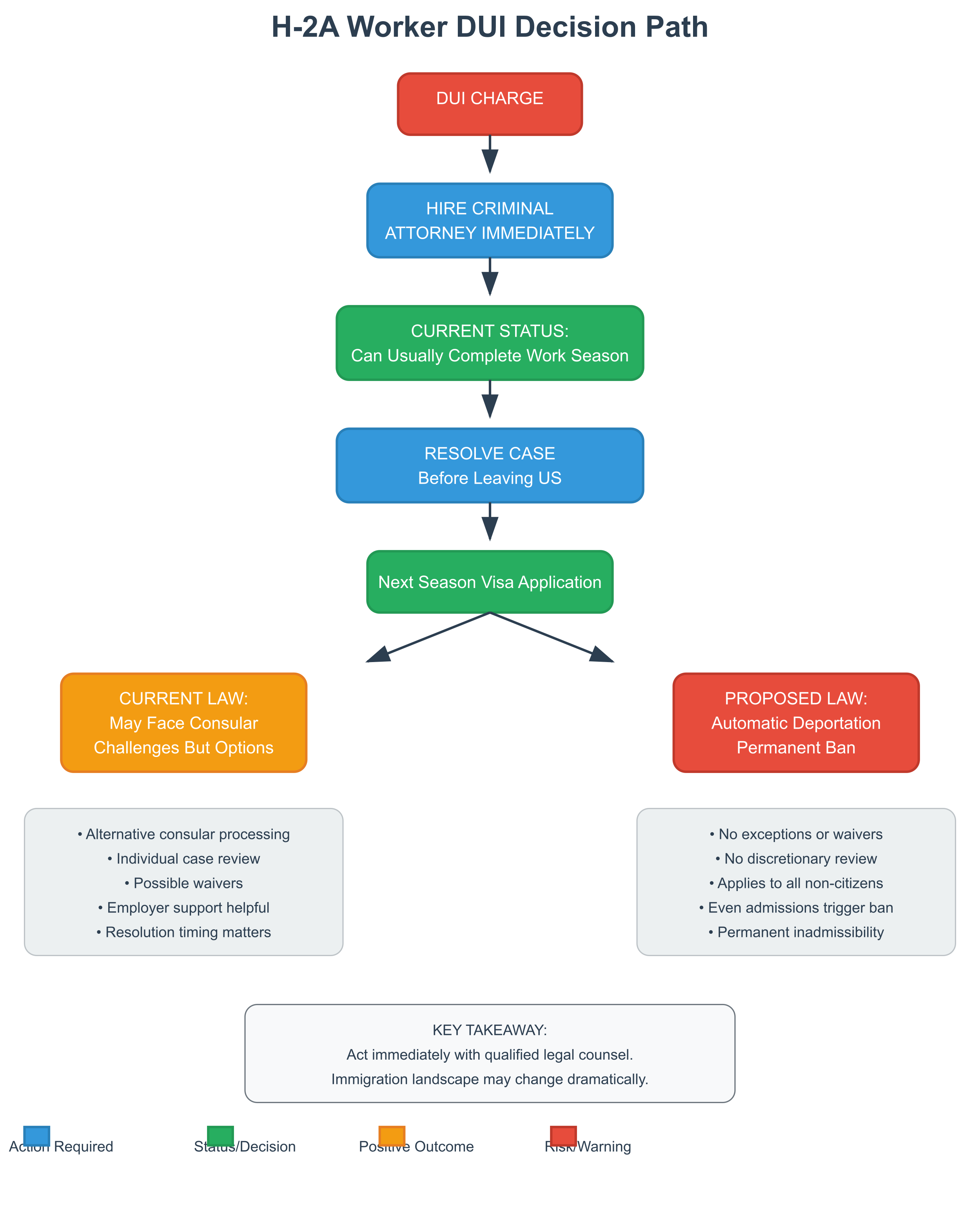
For most H-2A workers, a single DUI charge or conviction won’t automatically end your current legal status. Under existing federal immigration law, you can typically complete your authorized work period and return home as planned.

Here’s what current law says about DUI and employment visas:

Your Current Status Usually Remains Valid

  • A first-time DUI without serious aggravating factors typically doesn’t make you immediately deportable
  • You can generally continue working through your authorized period (usually until November for agricultural workers)
  • Your employer can usually keep you employed without immigration law violations

When DUI Becomes More Serious

Some situations do create bigger immigration problems:

  • Multiple DUI convictions may be considered “crimes involving moral turpitude”
  • DUI involving drugs (not just alcohol) can trigger controlled substance violations
  • Aggravating factors like injuries to others, very high blood alcohol, or children in the vehicle
  • DUI while driving on a suspended license

The Visa Revocation Risk You Need to Know About

Here’s something many workers don’t realize: even if your current status is safe, your visa stamp can be revoked while you’re still in the United States.

What is Prudential Revocation?

The U.S. State Department can cancel your visa based on a DUI arrest – even before you’re convicted. This is called “prudential revocation,” and it’s become increasingly common since 2015.

Important facts about visa revocation:

  • It can happen based on arrest alone, not just conviction
  • You might not even know it happened until you try to travel
  • The consulate may email you, but they don’t have to
  • It typically takes effect when you leave the United States

Real-World Impact

If your visa gets revoked:

  • You can finish your current work period in the United States
  • But you’ll need a new visa to return next season
  • The application process becomes much more complicated

Timing Matters: Why You Should Resolve Your Case Before Going Home

One of the most important things you can do is resolve your criminal case before leaving the United States. Here’s why:

Unresolved Cases Create Problems

  • Pending charges may look worse to consular officers than resolved cases
  • It’s nearly impossible to appear in court from South Africa
  • Uncertainty about your case outcome complicates future visa applications

H-2A Workers Have Limited Time

Since H-2A visas are annual, timing is crucial:

  • Most agricultural seasons end in November
  • You want your case resolved before you go home
  • Next year’s visa application may depend on having clear documentation

This is why you need a criminal defense attorney who understands these timing pressures. We can work with your criminal lawyer to understand the immigration implications, but we cannot represent you in criminal court.

H-2A agricultural worker pulled over by police officer - DUI immigration consequences
H-2A agricultural worker pulled over by police officer – DUI immigration consequences

Next Year’s Visa: The Challenges Ahead

Even with a resolved DUI case, getting your H-2A visa for next season may be more difficult.

Consular Decisions

Consulates may:

  • Deny your visa application based on the DUI conviction
  • Require additional documentation like court records
  • Request medical examinations
  • Create processing delays that affect seasonal timing

Alternative Options

If one consulate denies your application, you may have other options:

  • Applying at different consular locations within South Africa
  • Each consulate reviews cases independently
  • Success rates vary by location and individual circumstances

Agricultural employers often work with experienced immigration attorneys to help valuable workers navigate these challenges. If you’re an employer dealing with this situation, we can help evaluate your worker’s options.

Plea Agreements and Lesser Charges

Your criminal attorney may be able to negotiate a plea to a lesser charge like reckless driving instead of DUI. Under current law, this can reduce immigration consequences.

However – and this is important – even admitting to facts that show you drove under the influence could still create problems, especially under proposed new legislation.

We can consult with your criminal attorney about the immigration implications of different plea options, but the criminal defense strategy is their expertise.

The Game-Changer: Proposed Federal Legislation

Congress is considering legislation that would completely change how DUI affects immigration status. The Jeremy and Angel Seay and Sergeant Brandon Mendoza Protect Our Communities from DUIs Act of 2025 passed the House of Representatives in June 2025.

What This Bill Would Do

If this legislation becomes law, any DUI conviction or even admission would make you:

  • Automatically deportable from the United States
  • Permanently inadmissible for future visas
  • Ineligible for bond during removal proceedings

No Exceptions

Unlike current law, the proposed legislation would:

  • Apply to first-time offenders with no prior record
  • Cover all non-citizens, including legal workers
  • Eliminate all discretionary considerations
  • Make even admissions to DUI conduct grounds for removal

The End of Current Protections

This would eliminate:

  • The ability to complete your work season after a DUI
  • Options for alternative consular processing
  • Consideration of individual circumstances
  • All current immigration protections for DUI cases

While this legislation may not become law, it represents a continuing trend toward stricter penalties for non-citizens with criminal issues. Similar proposals are likely to keep appearing in Congress.

What You Should Do Right Now

Get Legal Help Immediately

  1. Hire a criminal defense attorney – This is not optional. We cannot help you with the criminal case.
  2. Consult with an immigration attorney – We can explain how different outcomes might affect your immigration status.
  3. Don’t try to handle this alone – The stakes are too high.

Focus on Resolution

  • Work with your criminal attorney to resolve the case before going home
  • Get all court documentation properly certified
  • Complete any required programs or probation
  • Keep detailed records of everything

Plan for Next Season

  • Understand that next year’s visa application may be more complicated
  • Work with your employer on documentation and strategy
  • Consider having legal help with the visa application process

For Employers: Supporting Your Workers

Agricultural employers who have invested in training H-2A workers often want to help them return next season. Here’s how:

  • Connect workers with qualified criminal defense attorneys
  • Understand the immigration implications through consultation with immigration counsel
  • Plan for potentially more complex visa application processes
  • Consider legal assistance for valuable returning workers

If you’re an employer facing this situation, we can help you understand your worker’s options and develop a strategy for next season.

Getting Immigration Help

While we cannot represent you in criminal court, we can:

  • Explain how different criminal outcomes might affect your immigration status
  • Consult with your criminal attorney about immigration implications
  • Help you understand visa application challenges
  • Assist with waiver applications if needed
  • Work with employers on strategies for returning workers

Remember

  • Criminal defense first – Resolve your case with qualified criminal counsel
  • Immigration planning second – Understand the long-term implications
  • Act quickly – Time is limited for H-2A workers

The Bottom Line

DUI charges don’t have to end your ability to work in the United States, but they do create serious challenges that require immediate attention and professional help. Current law provides some protections, but proposed legislation could eliminate them entirely.

Don’t wait to get help. The decisions you make now about your criminal case could affect your immigration options for years to come.

This information is for educational purposes only and does not constitute legal advice for any specific situation. Every case is different, and you should consult with qualified attorneys about your specific circumstances.


Need help understanding how criminal charges might affect your immigration status? Contact us for a consultation. We serve agricultural workers and employers throughout Montana, North Dakota, Wyoming, and the broader Rocky Mountain region.

Filed Under: Blog

Why Asylee Green Card Applications Take So Much Longer: INA 209 vs. 245 Adjustment Explained

July 8, 2025 by Admin-ILM

The Asylee Advantage

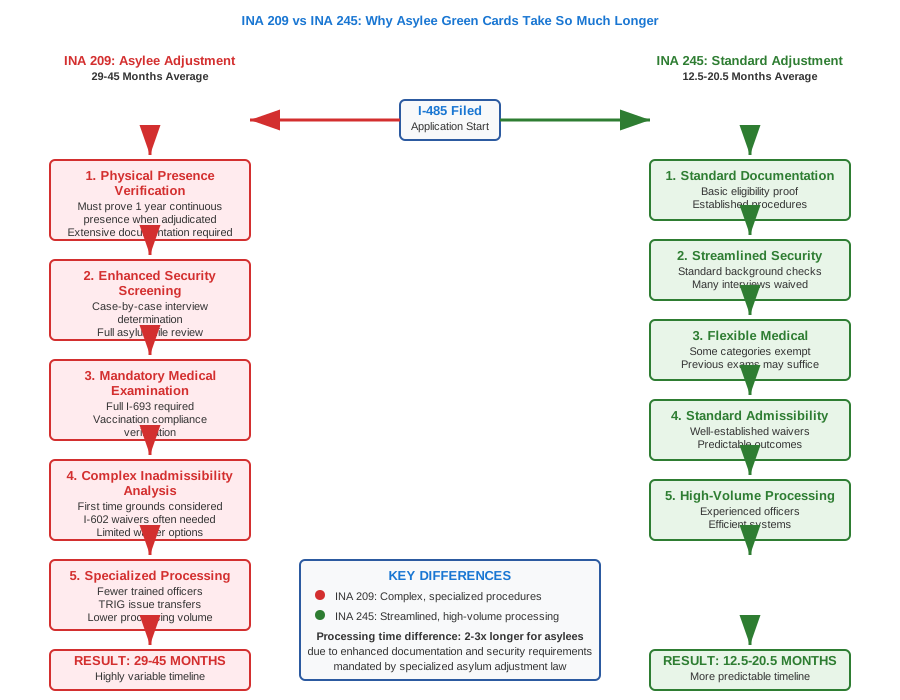
Bottom Line Up Front: Asylees adjusting status under INA 209 face processing times of 29-45 months compared to family-based adjustments under INA 245 taking 12.5-20.5 months. The difference stems from unique documentation requirements, mandatory interviews, enhanced security screening, and specialized processing procedures that don’t apply to most other green card applicants.

Understanding the Two Pathways

When applying for a green card while in the United States, most immigrants file under INA Section 245 – the general adjustment of status provision. However, asylees must use a completely different legal pathway: INA Section 209(b), which contains specific requirements and procedures that significantly extend processing times.

INA 245: The Standard Route

Most immigrants – including those married to U.S. citizens, employment-based applicants, and diversity visa winners – adjust status under INA 245. This established process benefits from:

For more information on standard green card processes in Montana, see our comprehensive guide

  • Streamlined procedures developed over decades
  • High application volume that creates processing efficiency
  • Optional interviews for many categories
  • Fewer documentation requirements for admissibility
  • No mandatory waiting periods after filing

INA 209: The Asylee-Specific Route

Asylees must use INA 209(b), which Congress designed specifically for those granted protection in the United States. This pathway includes additional safeguards and requirements that extend processing times significantly.

The Key Differences That Create Delays

1. Mandatory Physical Presence Documentation

INA 209 Requirement: Asylees must have been physically present in the United States for one year when USCIS adjudicates their Form I-485, not just when they file it. This creates unique documentation challenges.

Why It Delays Processing:

  • USCIS must verify continuous physical presence, not just residence
  • Officers must review extensive documentation proving day-by-day presence
  • Any gaps in documentation trigger Requests for Evidence (RFEs)
  • If USCIS cannot determine whether an applicant satisfies the one-year physical presence requirement, they may request additional evidence, and it might take longer to process

Documentation Challenges:

  • School transcripts and attendance records
  • Employment records showing daily work
  • Medical records with appointment dates
  • Utility bills and lease agreements
  • Travel documents for any departures
  • Affidavits from witnesses to physical presence

2. Enhanced Security and Background Checks

INA 209 Requirements: USCIS will determine, on a case-by-case basis, whether an interview by an immigration officer is necessary to determine the applicant’s admissibility, but interviews are significantly more common for asylees.

Why It Delays Processing:

  • Enhanced security screening due to asylum background
  • Review of entire asylum case file and decision
  • Verification that asylum status remains valid
  • Additional background checks through multiple agencies
  • Case-by-case interview determinations add processing steps

3. Complex Inadmissibility Analysis

INA 209 Specifics: Because an asylee is not subject to admissibility grounds at the time of the asylum grant, the adjudication of the adjustment application may be the first instance that inadmissibility grounds are considered.

Processing Complications:

  • Full medical examination required (unlike some INA 245 categories)
  • The asylee is required to establish compliance with the vaccination requirements
  • Comprehensive review of criminal and immigration history
  • Waiver applications often needed for technical violations

4. Limited Waiver Options

INA 209 Restrictions: An applicant who is not admissible may have the grounds of inadmissibility waived except for those grounds under sections 212(a)(2)(C) and 212(a)(3)(A), (B), (C), or (E).

Why This Causes Delays:

  • Careful legal analysis required for each inadmissibility ground
  • Waiver applications (Form I-602) add months to processing
  • Limited waiver availability creates complex eligibility determinations
  • Officers must balance humanitarian factors against statutory restrictions

5. Comprehensive Review of Underlying Asylum Decision

INA 209 Requirement: In determining eligibility for adjustment of status of an alien with asylum status, the officer should review the underlying application (either Form I-589 or Form I-730) that provided the alien with asylum status.

Why This Creates Massive Delays:

  • Complete legal re-examination: Officers must review the entire asylum case file and legal determination
  • Fraud detection analysis: Officers look for new evidence that the original asylum grant was improper
  • Ongoing refugee status verification: Determination of whether the person still meets the refugee definition
  • Country condition updates: Research into whether conditions have changed since asylum was granted
  • Identity reconciliation: Verification that the adjustment applicant is the same person granted asylum

Comparison to Other Categories:

  • I-130 Family Cases: Simple relationship verification (marriage/birth certificates)
  • I-140 Employment Cases: Job qualifications and labor certification review
  • I-589 Asylum Reviews: Complex legal determination about persecution, credibility, and protection needs

Processing Impact: This represents a fundamental difference in complexity. While family and employment cases involve document verification, asylee cases require re-examining a sophisticated legal determination about persecution, credibility, and international protection – essentially a “second look” at the asylum decision itself.

6. Specialized Officer Training Requirements

Resource Allocation Issues:

  • Fewer officers trained in both INA 209 procedures and asylum law complexities
  • Unless a case is sent specifically to a field office for resolution of Terrorist Related Inadmissibility Ground (TRIG) issues, an officer should return any asylee adjustment case with unresolved TRIG issues to the originating service center
  • Cases often transferred between offices for specialized review
  • Limited processing capacity compared to high-volume INA 245 applications
Comparison flowchart showing INA 209 asylee adjustment taking 29-45 months versus INA 245 standard adjustment taking 12-20 months, with detailed breakdown of processing factors
Visual comparison of INA 209 vs INA 245 processing requirements and timelines

Current Processing Time Reality

Recent Data Shows Significant Disparities

current USCIS processing time estimates

  • Asylee Adjustments (INA 209): 29 to 45 months
  • Family-based Adjustments (INA 245):5 to 20.5 months
  • Refugee Adjustments (INA 209): 14 months (significantly faster than asylees)

Why Refugee Adjustments Are Faster

Refugees benefit from pre-screening overseas and often have:

  • Complete documentation from refugee processing
  • Medical examinations already completed
  • Background checks conducted before U.S. entry
  • Established identity verification

Document Preservation: Critical for Asylee Cases

Essential Records to Maintain

Asylum Documentation:

  • Original asylum approval notice or court order
  • All correspondence with immigration courts or USCIS
  • Attorney representation records from asylum case
  • Country condition evidence used in asylum case

Physical Presence Evidence:

  • Employment Records: Pay stubs, W-2s, employment verification letters
  • Educational Records: Transcripts, enrollment verification, attendance records
  • Medical Records: Doctor visits, prescription records, hospital admissions
  • Financial Records: Bank statements, tax returns, credit card statements
  • Housing Records: Lease agreements, utility bills, mortgage statements

Travel Documentation:

  • Any advance parole documents used
  • Entry/exit stamps in passport
  • Documentation of any emergency travel
  • Refugee travel documents if applicable

Common Documentation Pitfalls

Insufficient Physical Presence Proof:

  • Gaps in employment or school records
  • Missing documentation for specific time periods
  • Failure to document brief trips outside the U.S.
  • Inadequate witness statements for undocumented periods

Medical Examination Issues:

  • Using non-designated civil surgeons
  • Incomplete vaccination records
  • Expired medical examinations
  • Missing required supplemental forms

When Waivers May Be Required

Common Inadmissibility Issues for Asylees

Immigration-Related Grounds:

  • Unauthorized employment before asylum grant
  • Unlawful presence accrual
  • Document fraud during initial entry
  • Failure to maintain status before asylum approval

Criminal Grounds:

  • Minor criminal violations
  • Arrests without convictions
  • Civil violations treated as criminal matters
  • Conduct occurring before asylum grant

Waiver Application Strategy

Form I-602 Applications:

  • Filed concurrently with I-485 or separately
  • An asylee adjustment applicant may have a ground of inadmissibility waived for humanitarian purposes, to assure family unity, or when it is otherwise in the public interest
  • No extreme hardship requirement (unlike other waivers)
  • Discretionary decisions requiring compelling evidence

The Role of Interviews in Delays

Why Asylee Interviews Are More Complex

Comprehensive Case Review:

  • Verification of asylum claim validity
  • Review of changed country conditions
  • Assessment of continued refugee status
  • Evaluation of family relationships for derivatives

Extended Interview Preparation:

  • Review of entire asylum file
  • Country condition research updates
  • Security clearance verification
  • Coordination between multiple USCIS offices

Planning Your Asylee Adjustment Strategy

Optimal Timing Considerations

When to File:

  • Your application may be processed more quickly if you wait until 1 year after you are granted asylum to file Form I-485
  • Ensure all required documentation is complete
  • Consider concurrent filing of derivative applications
  • Plan for potential RFEs and interview scheduling

Working with Experienced Counsel

Why Professional Guidance Matters:

  • Complex interplay between asylum and adjustment law
  • Waiver eligibility requires careful legal analysis
  • Document preparation strategies can prevent delays
  • Interview preparation for asylee-specific questions

Recent Policy Changes Affecting Processing

February 2023 USCIS Clarification

USCIS updated guidance to clarify that both asylees and refugees must have been physically present in the United States for one year when we adjudicate their Form I-485, rather than at the time they file their adjustment of status application.

Impact on Processing:

  • Cases filed early may face longer adjudication waits
  • Enhanced documentation requirements for physical presence
  • Increased RFE rates for insufficient presence evidence

Conclusion

Facing asylee adjustment delays? Get experienced guidance from a Montana immigration attorney who understands the complexities of INA 209 cases.

The dramatic difference in processing times between INA 209 and INA 245 adjustments reflects the complexity and specialized nature of asylee cases. While family-based and employment adjustments follow well-established procedures with predictable timelines, asylee adjustments require individualized review of protection claims, enhanced security screening, and complex legal determinations.

Working with an experienced Montana immigration attorney can help navigate these complex requirements.

Understanding these differences helps asylees and their families plan appropriately for the extended timeline while taking steps to minimize delays through careful documentation and strategic timing of their applications.

Once you receive your green card, understand the asylee advantage for naturalization that allows citizenship after just 4 years.

Key Takeaways:

  • Asylee adjustments take 2-3 times longer than standard family-based cases
  • Physical presence documentation is the most common source of delays
  • Professional legal assistance can help navigate complex waiver requirements
  • Early preparation and comprehensive documentation are essential for success


This article provides general information about immigration law and should not be considered legal advice for your specific situation. For personalized guidance on your asylee adjustment case, consult with a qualified immigration attorney who can evaluate your individual circumstances.

Filed Under: Blog

  • « Go to Previous Page
  • Page 1
  • Page 2
  • Page 3
  • Page 4
  • Page 5
  • Go to Next Page »

Footer

Our Location

We are located about 20 minutes NE of Billings in a rural community:

Immigration Law of Montana, P.C.
8400 Clark Rd
Shepherd, MT 59079
406-373-9828

Affiliations

Montana State Bar

AILA Member


Social

  • Facebook
  • LinkedIn
  • Tumblr
  • Twitter
  • YouTube
  • Immigration Lawyer Montana
  • Privacy Policy
  • Disclaimer
  • Terms of Service
  • Site Map
  • Contact Us

COPYRIGHT © 2026 Immigration Law of Montana · All Rights Reserved

  • English
  • Español