
When the U.S. government grants you a humanitarian immigration benefit—whether asylum, Special Immigrant Juvenile Status (SIJS), or another form of protection—that benefit is based on specific facts about your situation. What many people don’t realize is that your actions after approval can destroy the very benefit you worked so hard to obtain.
This article examines a critical principle that applies across multiple humanitarian immigration programs: your conduct after receiving immigration relief must remain consistent with the basis on which that relief was granted. We’ll focus on two common scenarios where beneficiaries unknowingly jeopardize their status—asylum recipients returning to their home countries and SIJS beneficiaries reuniting with their parents.
Understanding the Foundation: Why Basis Matters
Humanitarian immigration benefits aren’t granted casually. Each one requires you to prove specific circumstances:
- Asylum: You were persecuted or have a well-founded fear of persecution based on race, religion, nationality, political opinion, or membership in a particular social group
- SIJS: A state court determined that reunification with one or both parents is not viable due to abuse, neglect, abandonment, or similar circumstances, and returning to your home country is not in your best interest
These aren’t just procedural requirements—they’re the legal foundation of your entire case. When you receive approval, the government is saying: “Based on these specific circumstances, we’re granting you protection.”
The problem arises when your later actions contradict those circumstances.
A benefit obtained through a dishonest filing is especially fragile, which is one reason fraud mills put even honest T-visa and VAWA applicants at risk.
The Asylum Trap: Why Returning Home Can Cost You Everything
How Asylum Works
When USCIS grants you asylum, it’s based on your claim that you cannot safely return to your home country. The government accepts that you face a credible threat of persecution and provides you with protection, work authorization, and eventually a path to permanent residence. Many of these problems begin at filing: an incomplete declaration invites the credibility attacks described in why the first telling of your story counts.
The Danger of Going Back
Many asylees feel drawn to return home for compelling reasons:
- A parent or family member is seriously ill
- They need to handle property or business matters
- Political conditions seem to have improved
- They simply miss their home and family
But returning to your home country can trigger asylum termination proceedings.
The Legal Standard
Under 8 CFR § 208.24(a), an asylum officer may terminate a grant of asylum made by USCIS — after giving you written notice and an interview — if the officer finds either fraud in your application that made you ineligible when asylum was granted, or one of the conditions listed in INA § 208(c)(2). Those conditions include that you no longer qualify as a refugee owing to a fundamental change in circumstances, and that you have “voluntarily availed” yourself of your home country’s protection by returning there with permanent resident status or the reasonable possibility of obtaining it. (If an immigration judge granted your asylum, termination goes through the immigration court instead.)
A single visit home is not, by itself, one of the listed grounds. The danger is what the visit suggests. When you return to the country you fled, immigration authorities may conclude:
- Your fear of persecution was not genuine
- Conditions have changed sufficiently that you no longer need protection
- You obtained asylum through misrepresentation
Real-World Consequences
Immigration officers examine several factors when an asylee returns home:
- Whether the return was voluntary
- How long you stayed
- Whether you obtained or renewed a passport from your home country
- Whether you took steps to re-establish yourself there (buying property, starting a business, etc.)
- Your explanation for the return
Even a single trip can raise questions. When you later apply to adjust status to permanent residence or naturalize as a U.S. citizen, the government can use evidence that you returned home to question whether your asylum grant was valid — or whether you still qualify for it.
The Naturalization Risk
The risk doesn’t disappear once you get your green card. When you apply for U.S. citizenship—which requires listing all international travel—a USCIS officer can question whether your original asylum claim was fraudulent if they discover you returned to your home country. This can result in:
- Denial of naturalization
- Loss of your permanent resident status
- Removal proceedings
The SIJS Parallel: When Reunification Contradicts Your Case
What SIJS Is Based On
Special Immigrant Juvenile Status provides a path to lawful permanent residence for children who have been abused, neglected, or abandoned. The statutory requirements at INA § 101(a)(27)(J) include a state court finding that reunification with one or both parents is “not viable.”
This isn’t simply a statement that the parents live far away or in another country. It’s a legal determination that the parent-child relationship has been fundamentally damaged by abuse, neglect, or abandonment to the point where reunification cannot appropriately occur.
The Automatic Revocation Rule — and What Actually Triggers It
Federal regulations at 8 CFR § 204.11(j)(1) contain a harsh consequence: an approved SIJS petition is automatically revoked, as of the date it was approved, if either of two things happens before the decision on your green card application becomes final. The first is reunification with one or both parents by virtue of a juvenile court order, where a juvenile court had previously found reunification with that parent not viable because of abuse, neglect, abandonment, or a similar basis under state law. The second is a determination in administrative or judicial proceedings that it is in your best interest to be returned to your (or your parents’) country of nationality or last habitual residence. USCIS then issues a notice of the revocation.
The USCIS Policy Manual adds one important limit: there is no revocation when the juvenile court places you with the parent who was not the subject of the non-viable-reunification finding.
Contact With a Parent Is Not Automatic Revocation — but It Is Not Risk-Free
Some SIJS beneficiaries hear that any contact with a parent — a visit in the United States, a trip home, a meeting in a third country — automatically cancels their SIJS approval. That is not what the regulation says. Automatic revocation is triggered by a juvenile court order reuniting you with the parent the court ruled out, or by a best-interest determination sending you home — not by a phone call, a visit, or a meeting abroad.
That does not make contact safe. According to the Policy Manual, USCIS may also revoke an approved SIJS petition on notice for “good and sufficient cause such as fraud, or if USCIS determines the petition was approved in error,” and your green card still requires a favorable exercise of discretion. Conduct suggesting that the facts behind the juvenile court’s findings were not true — moving back in with the parent the court found had abused, neglected, or abandoned you, for example — invites exactly those questions. Talk to your attorney before any contact, and never hide it.
The Interview Problem
SIJS-based green cards fall in the employment-based fourth preference (EB-4) category, and that category has a waiting line for visa numbers. In the September 2026 Visa Bulletin, the EB-4 final action date was December 15, 2022 for applicants from every country — so many beneficiaries wait years between SIJS approval and a green card decision. (That date is a snapshot; the bulletin changes monthly.)
USCIS does not interview every SIJS-based green card applicant. According to the USCIS Policy Manual, USCIS will generally not require an interview if the record is sufficient to approve the application, and when it does interview, it avoids questioning you about the details of the abuse, neglect, or abandonment — those issues are handled by the juvenile court — and focuses on your eligibility for adjustment of status.
If you have had contact with a parent since approval, telling the truth is not an automatic denial: contact is not automatic revocation. Lying about it, however, can make you inadmissible under INA § 212(a)(6)(C)(i), which applies to anyone who seeks an immigration benefit “by fraud or willfully misrepresenting a material fact” — a far bigger problem than the contact itself. Tell the truth, and prepare with your attorney to explain it.
The Permanent Parental Bar
SIJS comes with another significant consequence that illustrates how seriously the law treats the reunification requirement: even after you become a U.S. citizen, you can never petition for either parent to receive immigration benefits.
This is true even if only one parent was abusive and the other did nothing wrong. Congress wrote this rule specifically to ensure that parents who harmed their children cannot benefit from their children’s SIJS status. It reinforces that SIJS is premised on a fundamentally broken parent-child relationship.
The Common Thread: Actions Must Match Your Basis
Why This Principle Exists
Asylum is a discretionary benefit, and an SIJS-based green card requires USCIS to find that you merit a favorable exercise of discretion. The government doesn’t have to grant them—it chooses to based on your specific circumstances. When your conduct contradicts those circumstances, it suggests:
- Your original claim may have been exaggerated or false
- Your circumstances have fundamentally changed
- You don’t actually need the protection the benefit provides
The Fraud Investigation Context
Immigration authorities are increasingly vigilant about fraud in humanitarian programs. A July 2025 USCIS report reviewed more than 300,000 SIJS petitions and reported significant integrity concerns in the program, including age and identity fraud.
When you act inconsistently with your approved benefit, you trigger heightened scrutiny. Officers are trained to look for indicators that the original petition was not meritorious or that circumstances have changed.
Practical Guidance: Protecting Your Status
For Asylum Recipients
Before you have a green card:
- Avoid traveling to your home country except in the most extraordinary circumstances
- If you must travel for a genuine emergency, consult an immigration attorney first
- Be prepared to provide detailed documentation and explanation
- Consider whether the risk of losing asylum outweighs the reason for travel
After getting a green card:
- Understand that travel to your home country can still raise questions during naturalization
- Maintain documentation showing why any return trip was necessary and how you stayed safe
- Be prepared to explain any travel when you apply for citizenship
Always:
- Use aRefugee Travel Document (Form I-131) if you need to travel internationally
- Never renew or obtain a passport from the country of persecution without legal guidance
- Keep detailed records of your circumstances and any changes
For SIJS Beneficiaries
Before your green card is approved:
- Talk to your attorney before any contact with a parent the juvenile court found you could not reunify with
- Do not move back in with that parent, and do not ask any court to change the reunification or best-interest findings, without legal advice
- Document any unwanted contact attempts by parents
- Understand that the wait for visa availability does not change these precautions
During your adjustment interview:
- Answer all questions truthfully
- Be prepared to explain the current status of your relationship with your parents
- Provide any documentation showing changed circumstances only if they genuinely exist
After getting a green card:
- Consult with an immigration attorney before considering any parental contact
- Understand the permanent consequences (inability to petition for parents)
The Underlying Principle for All Humanitarian Benefits
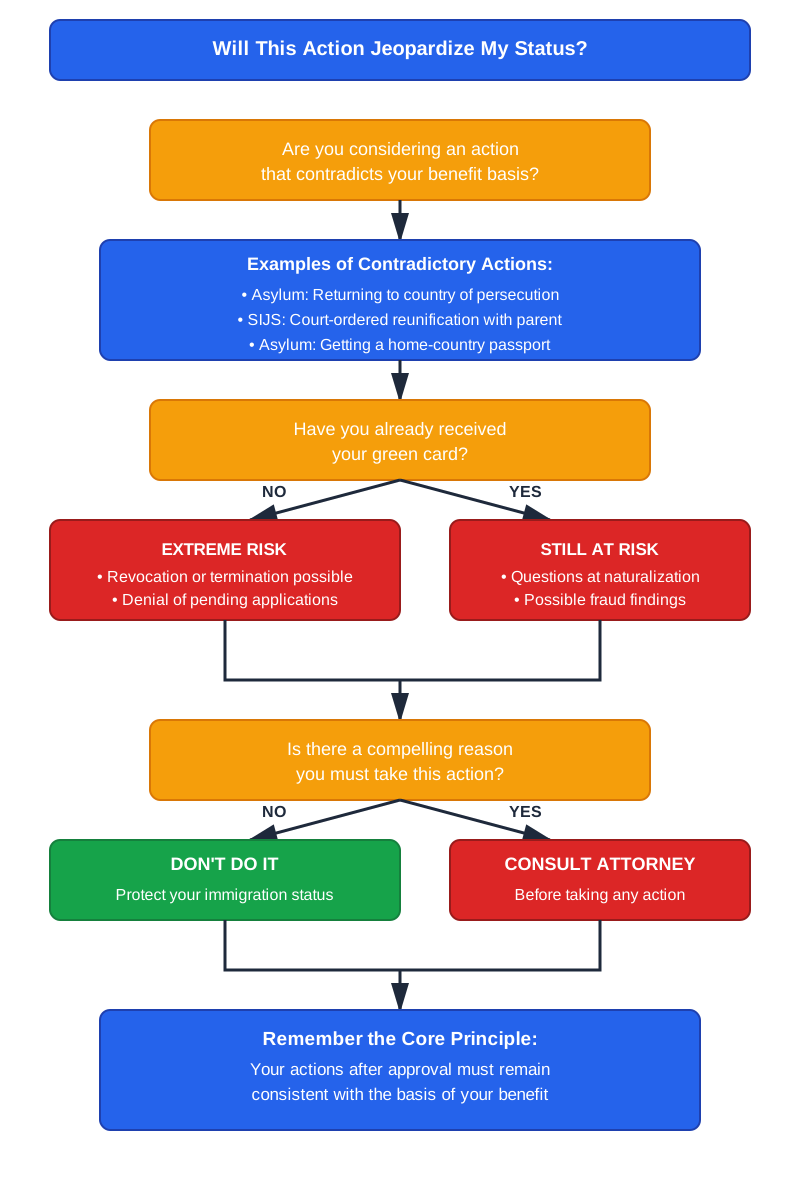
Your actions after approval must be consistent with the basis on which you were granted the benefit. If your conduct contradicts that basis, you risk losing the benefit entirely.
This applies whether you have asylum, SIJS, or other humanitarian relief. Each benefit has its own specific rules, but they all share this fundamental principle.
When Circumstances Genuinely Change
Sometimes circumstances do legitimately change after a benefit is granted:
- Political conditions improve in your home country
- Family relationships heal over time
- The situation that prompted your application resolves
If this happens, you should consult an immigration attorney about the implications. Depending on your specific benefit and timing, there may be safe ways to address changed circumstances. However, acting without legal guidance can be catastrophic.
The Cost of Inconsistent Conduct
The consequences of contradicting your immigration benefit’s basis can include:
- Revocation of approved petitions or status
- Denial of pending applications for adjustment or naturalization
- Fraud findings that permanently bar future immigration benefits
- Removal proceedings that could result in deportation
- Loss of work authorization and the ability to support yourself
- Years of wasted time and effort rebuilding your immigration case
Conclusion: Protecting What You’ve Earned
Receiving a humanitarian immigration benefit is often the culmination of a difficult journey. You’ve proven your case, provided evidence, and received approval. But that approval isn’t unconditional—it requires you to maintain consistency with the circumstances that justified the benefit in the first place.
Whether you have asylum, SIJS, or another form of humanitarian relief, remember:
- The government can and does scrutinize post-approval conduct
- Actions that contradict your original basis can destroy your benefit
- The emotional pull to return home or reunite with family must be weighed against legal consequences
- When in doubt, consult an immigration attorney before taking any action that might raise questions
Your humanitarian immigration benefit is valuable and hard-won. Protect it by ensuring your conduct remains consistent with the basis on which it was granted.
If you have questions about protecting your humanitarian immigration status, or if you’re concerned about whether past actions may have jeopardized your case, contact an experienced immigration attorney for guidance. The stakes are too high to risk your immigration future on assumptions.